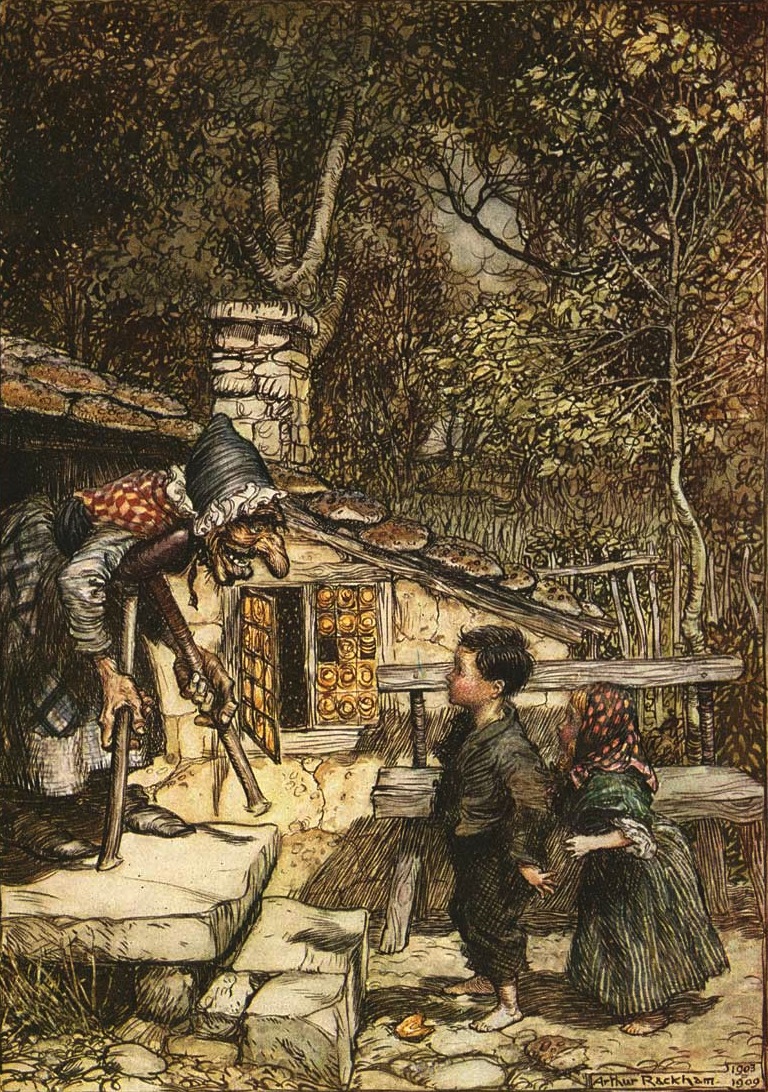
Two children walk into the woods.
Breadcrumbs behind them.
A candy house ahead of them.
And somewhere in the middle of all that…
A story got much darker than most people remember.
The Story Everyone Knows
If you’ve heard Hansel and Gretel, you probably remember the broad strokes.
A poor family can’t afford to feed everyone, so Hansel and Gretel are abandoned in the forest. The children try to find their way home using breadcrumbs, but birds eat the trail.
Lost and starving, they discover a magical house made of candy and sweets.
Inside lives an old woman who seems kind at first… until she reveals herself to be a witch who plans to fatten the children up and eat them.
Hansel is trapped. Gretel outsmarts the witch and pushes her into the oven. The children escape with treasure and return home.
It’s one of the most famous fairy tales ever told.
A cautionary story.
A spooky bedtime tale.
A classic Brothers Grimm story.
That’s the version we remember.
But that’s not the whole story…
The Deep Dive
Like many Grimm fairy tales, Hansel and Gretel didn’t begin as a polished children’s story.
It came from older European oral traditions — stories passed down during periods of famine, instability, and extreme poverty.
And once you know that…
The entire story changes.
Because at its core, this isn’t really a story about witches.
It’s a story about starvation.
In medieval and early modern Europe, famine wasn’t rare.
Bad harvests could destroy entire communities. Food shortages forced impossible choices. Historical records from parts of Europe even contain references to abandonment, infanticide, and rumors of cannibalism during severe crises.
That context matters.
The opening of Hansel and Gretel is horrifying because it’s grounded in something real:
Parents considering whether they can keep their children alive.
Even in the Grimm version, the father is hesitant. The mother — originally a stepmother in many tellings — pushes the idea harder. That detail wasn’t random.
Fairy tales often used stepmothers as narrative shields. It allowed stories to explore ugly family dynamics without directly accusing biological mothers.
Then there’s the witch.
Modern versions often portray her as a cartoon villain.
But older folklore treated witches differently. They represented isolation, fear of the unknown, and anxieties about women who lived outside normal society.
And the candy house?
That’s the cruelest detail in the entire story.
Think about it:
Children starving so badly that a house made of food overrides every survival instinct they have.
The house isn’t just magical.
It’s temptation weaponized against desperation.
There’s also an uncomfortable cyclical element people rarely talk about.
The witch tries to consume children to survive.
The family nearly abandons children to survive.
Everybody in the story is making decisions driven by scarcity.
That’s why the tale feels so tense.
No one is fully safe.
No one is fully clean.
It’s survival horror disguised as a fairy tale.
And then there’s Gretel.
In many old folk stories, girls are passive figures waiting to be rescued.
Not here. Not this time. Not Gretel.
Gretel saves herself.
She saves her brother.
She defeats the witch.
Gretel is the hero.
In an era where women in folklore were often passive, rescued, or punished, Gretel is the one who acts. She outsmarts the witch, saves her brother, and survives the nightmare through courage and quick thinking. Long before “final girls” became a horror trope, Hansel and Gretel quietly gave us one of folklore’s earliest female survivors.
That’s part of why the story endured.
Underneath the darkness is resilience.
Why It Matters
Hansel and Gretel survives because the fear underneath it never really disappeared.
Not the witch.
The insecurity.
The fear of being abandoned.
The fear of hunger.
The fear that adults might fail you when things get hard.
Those ideas still hit.
And that’s why fairy tales last longer than trends.
They evolve, but the emotional core stays recognizable.
There’s also something timeless about the image itself:
Children walking into the woods.
It represents stepping into uncertainty.
Growing up.
Leaving safety.
Realizing the world can be beautiful and dangerous at the same time.
That’s bigger than one story.
That’s practically mythology.
The Modern Connection
Hansel and Gretel’s DNA is everywhere.
You can see echoes of it in:
- Dark fantasy anime
- Survival horror games
- “Don’t trust appearances” storytelling
- Internet horror aesthetics where cute things become threatening
Even modern media loves the contrast:
Candy colors hiding something terrible underneath.
That’s Hansel and Gretel all over modern pop culture.
You can feel it in movies like Coraline, where temptation and comfort become traps.
The formula still works because the fear still works.
So What Is Hansel and Gretel Really About?
A witch in the woods?
Sure.
But also:
- Poverty
- Hunger
- Family strain
- Survival
- Growing up too fast
It’s one of the clearest examples of how fairy tales weren’t originally designed just to entertain children.
They were warnings.
And warnings tend to survive.
Question for Readers
What’s the scariest part of Hansel and Gretel to you?
The witch?
The forest?
The idea of being abandoned?
Or the fact that underneath all the magic…
The story feels uncomfortably real? 🍬🌲