For many fans outside Japan, Dragon Ball gaming began with Budokai. It was the game that let us relive the anime. The game that finally made Kamehamehas, tournament battles, and iconic rivalries feel exactly the way they looked on television. At least, that’s how we remember it.
But long before Budokai arrived on the PlayStation 2, Dragon Ball had already spent more than fifteen years in the gaming world. There were adventures, RPGs, card battles, and strange experiments that most Western fans never knew existed.
And together, they tell the story of developers trying to answer one deceptively simple question: How do you turn Dragon Ball into a video game?
When most people think of Dragon Ball games, they think of fighting games.
- Budokai.
- Budokai Tenkaichi.
- FighterZ.
- Sparking! ZERO.
The image that immediately comes to mind is Goku standing across from Vegeta, both charging up for a massive battle. That’s understandable.
Dragon Ball is one of the most influential fighting anime franchises ever created, and many of its most famous moments revolve around martial arts tournaments, rivalries, and larger-than-life battles. But that’s not how Dragon Ball began.
The original Dragon Ball wasn’t primarily about saving the world. It was about adventure. It was a road trip, treasure hunt and a martial arts comedy.
A story about a strange monkey-tailed kid meeting bizarre characters and exploring a world full of mysteries. The earliest Dragon Ball games reflected that reality.
Before developers were trying to recreate Super Saiyan transformations, they were trying to recreate the feeling of going on an adventure with young Goku. And that led to some fascinating results.
Most people think Dragon Ball games started as fighting games. In reality, they started as adventure games because Dragon Ball itself began as an adventure story.
Mechanics — Nobody Knew What a Dragon Ball Game Was Yet
The first Dragon Ball games emerged during the late 1980s, when the manga was still developing and the anime was introducing audiences to Goku’s earliest adventures.
That meant developers didn’t have decades of established gaming conventions to follow. There was no blueprint. No proven formula. No “Dragon Ball game” genre. Instead, developers experimented.
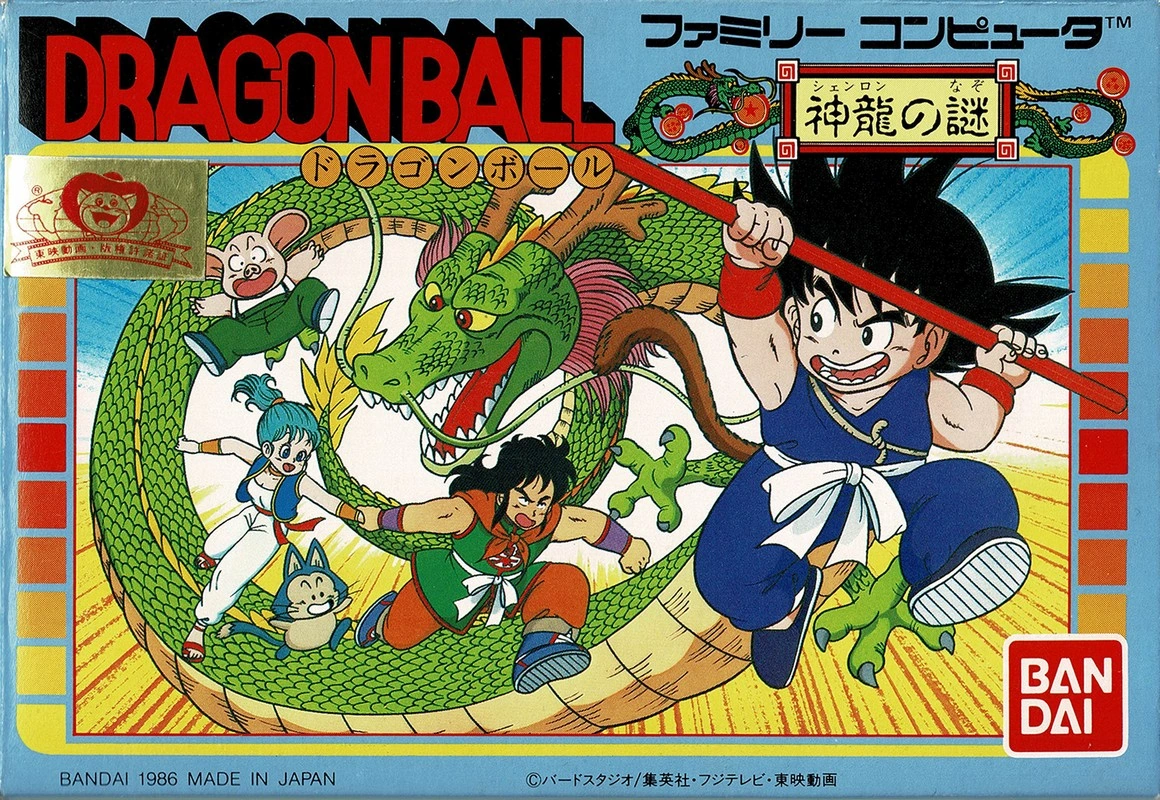
The very first Dragon Ball game, released in 1986, looked more like an arcade action title than anything modern fans would recognize. Soon afterward, games like Dragon Ball: Shenlong no Nazo attempted to capture the spirit of Goku’s adventures through exploration and action gameplay.
Other titles took even stranger approaches. Several Dragon Ball games used card systems to represent combat, movement, and story progression. Rather than relying on reflexes alone, players had to think strategically about how they advanced through the world.
Looking back, these games feel unusual. But they reveal something important. Developers weren’t trying to recreate Dragon Ball Z. They were trying to recreate Dragon Ball.
Story & Characters — Young Goku’s World
The early games focused heavily on the original cast.
- Young Goku.
- Bulma.
- Yamcha.
- Oolong.
- Master Roshi.
- Launch.
- The Red Ribbon Army.
- King Piccolo.
These were the stories that Japanese fans were experiencing in real time. As a result, many of the games felt closer to interactive manga adaptations than traditional action titles.
Players weren’t simply fighting. They were traveling. Exploring. Meeting new characters. Collecting Dragon Balls. Experiencing the journey that made Dragon Ball special in the first place.
That emphasis on storytelling separated Dragon Ball from many licensed games of its era. Even in their primitive forms, these games understood that the heart of Dragon Ball wasn’t just combat. It was the adventure.
World / Visuals / Atmosphere — Capturing Toriyama’s Imagination
One of Akira Toriyama’s greatest strengths was worldbuilding. Dragon Ball’s world feels enormous despite being wonderfully ridiculous.
There are talking animals. Flying clouds. Martial arts masters living on tiny islands. Capsules that fit entire houses into your pocket. Dinosaurs roaming through the wilderness. And somehow all of it works.
The earliest games had limited hardware to work with, but they still attempted to capture that sense of wonder. Players traveled across maps. Visited recognizable locations. Encountered familiar enemies. And explored a world that felt far larger than the technology should have allowed.
Many of these games may seem primitive today, but they carried Toriyama’s imagination into an entirely new medium. For many Japanese fans, they became another way to experience the Dragon Ball universe between manga chapters and anime episodes.
Sound & Music — The Spirit Before the Spectacle
Modern Dragon Ball games often rely on spectacle. Huge transformations. Explosive attacks. Cinematic presentations. The early games couldn’t do any of that.
Instead, they relied on simple melodies, recognizable sound effects, and imaginative presentation. The music helped create a sense of adventure. The sound effects gave weight to combat. And the limitations of the era forced developers to focus on atmosphere rather than visual fireworks.
Ironically, that made many of these games feel remarkably close to the original Dragon Ball itself. Because before Dragon Ball became synonymous with planet-shattering battles, it was a story filled with curiosity, humor, and exploration. The games reflected that spirit.
The Long Road to Budokai
Looking back, the most fascinating thing about these early releases isn’t any single game. It’s the evolution. Every title represented another attempt to understand what Dragon Ball should feel like in interactive form.
Some emphasized exploration. Some emphasized story. Some emphasized strategy. Some experimented with combat systems that would later evolve into more familiar fighting mechanics.
Each release added another piece to the puzzle. Developers were slowly discovering what fans wanted from a Dragon Ball game. And eventually, Dragon Ball itself began to change.
The adventure gave way to larger battles. The martial arts tournaments became more intense. The stakes became bigger. The series entered a new era. And gaming would eventually follow.
WHY IT MATTERS
Gaming history tends to remember the games that perfect ideas. It often forgets the games that first attempt them.
Budokai is remembered because it successfully translated Dragon Ball into a modern fighting game experience. But Budokai didn’t appear out of nowhere. It stood on the shoulders of fifteen years of experimentation.
Those earlier games helped establish how Dragon Ball stories could be adapted. How characters could progress. How battles could work. How players could experience Toriyama’s world firsthand.
Without those early experiments, there is no path to Budokai. And without Budokai, the entire future of Dragon Ball gaming looks very different. The forgotten games matter because they reveal the process. They show developers learning alongside the franchise itself.
MODERN CONNECTION
Today, Dragon Ball gaming feels bigger than ever. Sparking! ZERO is breaking sales records. Dragon Ball FighterZ became one of the most respected anime fighting games ever made.
Entire generations have grown up associating Dragon Ball with competitive battles and flashy combat. But the roots of Dragon Ball gaming tell a different story. They remind us that Dragon Ball wasn’t originally about power levels.
It was about adventure. The search for the Dragon Balls. Meeting strange friends. Exploring an unpredictable world.
In many ways, the earliest Dragon Ball games understood something modern fans sometimes forget. Before Dragon Ball became a battle anime, it was one of the greatest adventure stories ever told.
QUESTION
Before Budokai, had you ever heard of any of these early Dragon Ball games And if not, which forgotten Dragon Ball title would you most want to experience today?
Next week, Dragon Ball becomes Dragon Ball Z.