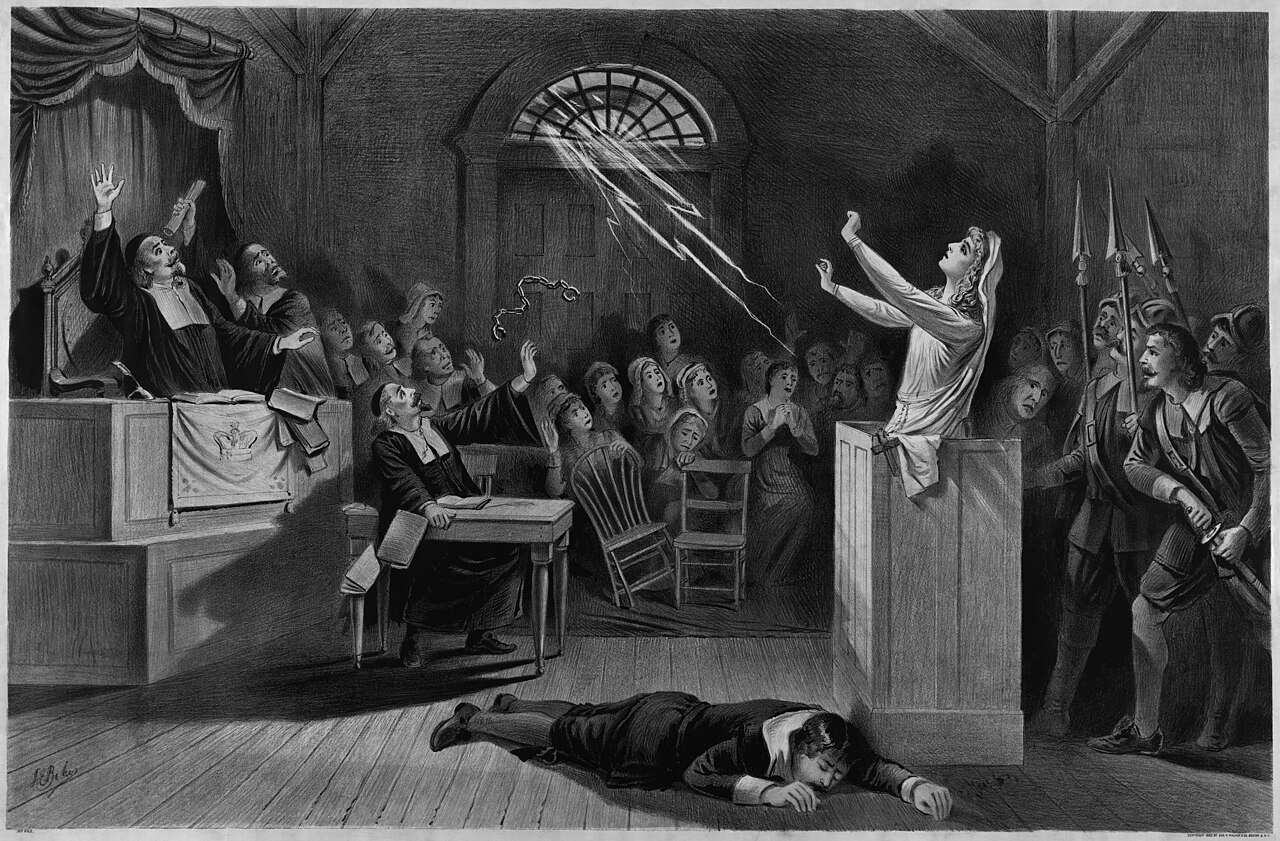
Everyone knows the Salem Witch Trials. Or at least… they think they do. You immediately think of witches, black magic, pointed hats. and people getting burned at the stake.
It’s one of those stories that’s become larger than history itself.
- A Halloween decoration.
- A horror movie setting.
- A shorthand for mass hysteria.
And on June 10, 1692, the first person was executed during the Salem Witch Trials. Her name was Bridget Bishop. She wasn’t the last. But here’s the strange part: The Salem Witch Trials were never really about witches. Not in the way most people imagine.
Because when you peel back the legends, the broomsticks, and the spooky imagery, what you find isn’t a supernatural story. It’s a story about ordinary people becoming convinced that fear was evidence. And once that happened, nobody was truly safe.
Here’s the version most of us learn. In 1692, in Salem Village, Massachusetts, a group of young girls began displaying strange behavior.
- Convulsions.
- Screaming.
- Fits.
Doctors couldn’t explain it. Eventually, the explanation offered was witchcraft. The girls accused local residents of tormenting them through supernatural means. The accusations spread rapidly. Trials followed.
By the time it was over:
- More than 200 people had been accused
- 19 people were hanged
- One man was pressed to death
- Several others died in prison
Today, the Salem Witch Trials are remembered as one of the most infamous examples of mass hysteria in American history. A cautionary tale about fear and false accusations. That’s the version most of us know. And for the most part? It’s true.
But history rarely stays that neat. Because Salem didn’t erupt out of nowhere. The accusations weren’t random. And the people involved weren’t cartoon villains. That’s what makes the story unsettling. The people of Salem believed they were doing the right thing.
WHAT ACTUALLY HAPPENED?
To understand Salem, you have to understand where it happened. This wasn’t a thriving city. It was a small Puritan community living on the edge of what they considered the wilderness. Life was difficult. Diseases were common. Crop failures happened. Conflict with Native tribes had displaced refugees into the region. Many residents already believed they were living in a spiritual battlefield between God and Satan.
When several girls began exhibiting strange symptoms, people didn’t ask: “What medical condition is causing this?” They asked: “Who is responsible?” And in Salem, there was already an answer waiting.
Witches.
THE HUMAN DRAMA
The accusations quickly became personal. Some targets were outsiders. Some had reputations that made them easy suspects. Others were involved in property disputes, family feuds, or long-standing disagreements.
Bridget Bishop, the first person hanged, stood out from her neighbors. She dressed differently. She had been accused before. She didn’t fit neatly into Salem’s expectations. Whether guilty or innocent didn’t matter. She was vulnerable, and Salem was looking for answers.
As fear spread, accusations spread too. Soon respected church members were being accused. Then community leaders. Then people who originally supported the trials. The circle kept widening. That’s the terrifying part. The system eventually became so aggressive that it began consuming its own supporters.
THE SPECTRAL EVIDENCE PROBLEM
Here’s where things truly went off the rails. The courts began accepting something called spectral evidence. In other words: Someone could claim they saw your spirit attack them. Not you. Your spirit.
- A dream.
- A vision.
- A supernatural encounter.
And that testimony could be used against you.
Think about that for a moment. How do you prove you didn’t appear in someone’s dream? How do you defend yourself against an accusation that cannot be tested? You can’t. Once spectral evidence became acceptable, the trials were operating on belief rather than proof. And that’s when things became dangerous.
THE WILD DETAIL
Here’s the Salem lore drop most people never hear: Nobody was burned at the stake. That’s one of the biggest myths surrounding the trials. The convicted victims were hanged.
One exception stands out. A farmer named Giles Corey refused to enter a plea. Under English law, the court couldn’t proceed without one. So, authorities attempted to force a response. They placed heavy stones on his chest. More and more weight.
According to tradition, when asked for his plea, Corey simply replied: “More weight.” He died under the pressure. It’s one of the coldest lines in American history. And it actually happened.
HOW IT ENDED
Eventually even Salem started questioning itself. There were too many accusations. There were too many contradictions. Too many respected people being dragged into the chaos.
The governor of Massachusetts eventually prohibited spectral evidence and dissolved the special court. Almost immediately, convictions collapsed. The panic ended nearly as quickly as it had escalated.
Years later, many participants publicly expressed regret. But by then the damage had already been done.
WHY THIS MATTERED
The Salem Witch Trials endure because they reveal something uncomfortable about human nature. Most people imagine they would have resisted. Most people imagine they would have seen through the panic. History suggests otherwise.
Salem wasn’t powered by ignorance alone. It was powered by certainty. People became convinced they already knew the answer. And once that happened, evidence became secondary.
The trials became one of the earliest American examples of what happens when fear, authority, and social pressure combine. That’s why we still study them. Not because of witches. Because of people.
MODERN CONNECTION
This is why Salem still feels relevant. Not because we’re worried about witches flying overhead. Because we’ve seen what happens when rumors spread faster than facts. When accusations become evidence. When communities divide into believers and skeptics. When fear becomes contagious.
The technology changes. The psychology doesn’t. The Salem Witch Trials were basically a 1692 version of a modern moral panic. Different platform. Same human operating system. That’s what makes them fascinating. And unsettling.
The Salem Witch Trials are often remembered as a story about witches. They weren’t. They were a story about fear.
- Fear of the unknown.
- Fear of outsiders.
- Fear of being wrong.
- Fear of being accused next.
That’s why Salem still matters. Because witches may belong to folklore. But paranoia never went away.
CTRL+BINGE QUESTION
What do you think is more dangerous: A lie that nobody believes… Or a lie that everybody is certain is true?