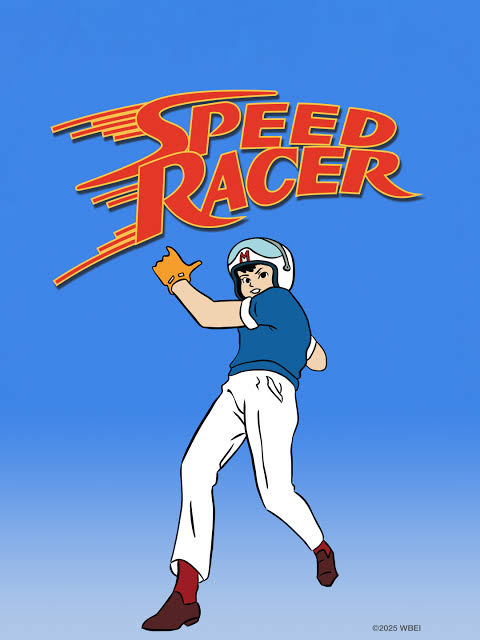
A white helmet. A red scarf. A car filled with gadgets. And one of the most important anime ever made.
At first glance, Speed Racer looks like a relic. The animation is simple. The dialogue is dramatic. The races are completely absurd.
Cars jump canyons, dodge saw blades and somehow survive situations that would make modern insurance companies faint. It feels like a cartoon from another era.
Because it is.
But here’s the fascinating thing: Long before Dragon Ball Z powered up. Long before Pikachu shocked anyone. Long before Sailor Moon transformed.
There was Speed Racer. And for many Americans, it wasn’t just their first anime. It was the first anime they ever heard of. They just didn’t know it yet.
What starts as a story about racing quickly becomes something bigger—a story about family, responsibility, ambition, and one young man trying to earn his place in a world that already knows his name.
At first glance, this looks like a cartoon about fast cars.
But the real story is about legacy.
For anyone who has never seen Speed Racer, here’s the simple version.
Speed Racer is a young racing prodigy determined to become the best driver in the world.
Driving the legendary Mach 5—a custom-built supercar designed by his father, Pops Racer—Speed enters increasingly dangerous races while facing rival drivers, criminal organizations, corrupt sponsors, and elaborate conspiracies.
Along the way, he’s supported by:
- Pops Racer
- Mom Racer
- Trixie
- Spritle
- Chim-Chim
- and the mysterious Racer X
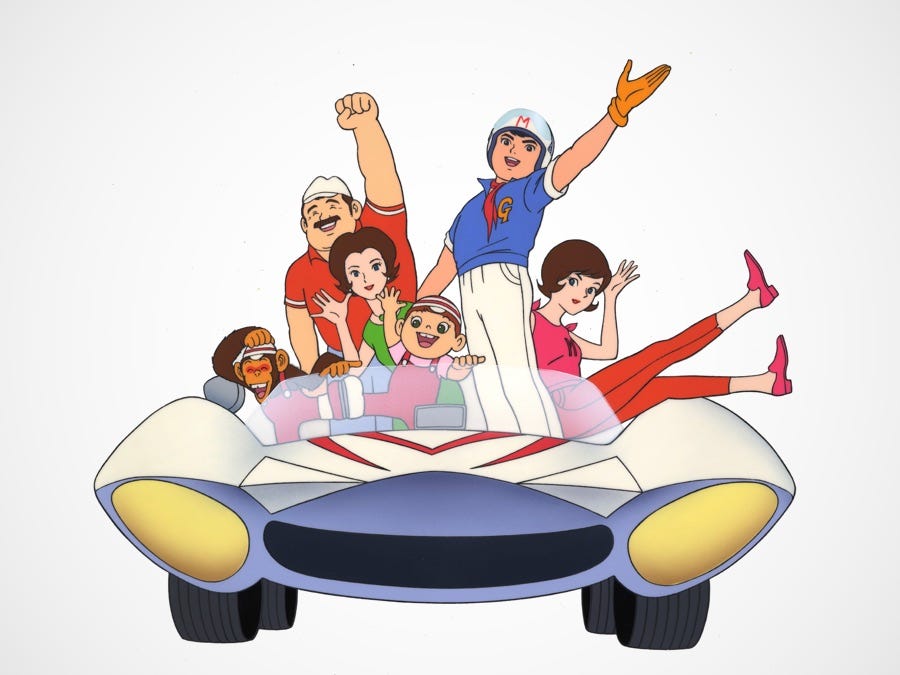
The setting is a heightened version of reality where racing isn’t just a sport. It’s an adventure. Every race feels like an action movie. Every track hides some new danger. Every competitor has a gimmick.
The hook is simple:
Imagine if James Bond, NASCAR, and a Saturday morning cartoon all got locked in a garage together. Then add one of the most influential anime exports in history.
Most people think Speed Racer is just an old racing cartoon with fast cars, ridiculous gadgets, over-the-top villains and shouting… lots of shouting.
Truthfully, they’re not wrong.
The Mach 5 is one of the coolest vehicles ever created. The races are wildly imaginative. The villains range from eccentric to downright bizarre. And the show embraces a level of sincerity that’s impossible not to smile at.
For many people, that’s the entire memory. A cool car. A catchy theme song. And a lot of speeding.
Others remember it as a curiosity. An old cartoon their parents watched. Something that existed before anime became mainstream. Something quaint. Something outdated. And viewed strictly through a modern lens, it’s easy to understand why.
Animation has evolved. Storytelling has evolved. Audience expectations have evolved. But focusing only on those differences misses what made Speed Racer special in the first place. Because the reason people still remember Speed Racer decades later isn’t the gadgets.
It’s what those gadgets represented.
But that’s the shallow read. The Mach 5 isn’t really the star of the story. Speed is. And his journey reveals why this series has endured for generations.
Main Character: Speed Racer
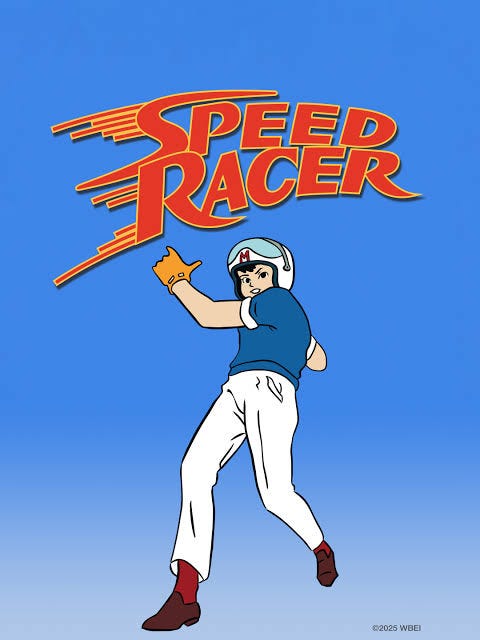
Speed is remarkably timeless. He’s talented but not arrogant. Confident but not invincible. Driven but not selfish. His greatest strength isn’t his driving ability. It’s his integrity.
Speed consistently chooses what is right over what is easy. That sounds simple. But it’s the foundation of the entire series. Every major challenge asks some version of the same question: What kind of person will Speed be when success becomes complicated? That’s what makes him compelling.
Supporting Cast
The Racer family is the emotional backbone of the series. Pops Racer isn’t just a mechanic. He’s a father trying to prepare his son for a difficult world. Their relationship gives the show surprising emotional depth.
Trixie provides support while refusing to be sidelined. She’s far more capable than many female characters of the era.
Meanwhile, Spritle and Chim-Chim inject pure chaos into every situation. They shouldn’t work. Somehow, they absolutely do.
Racer X
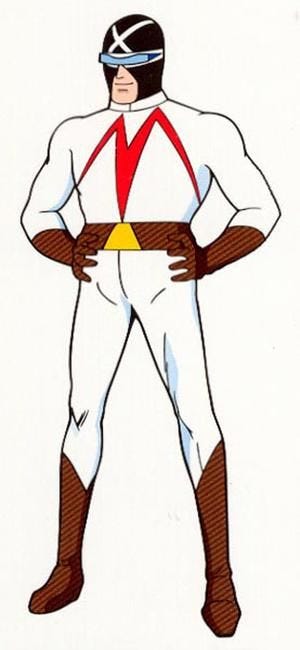
Then there’s Racer X. One of anime’s great mysteries. Cool. Competent. Dangerous. And hiding more secrets than anyone else in the cast. Even today, Racer X remains one of the show’s most memorable characters. Part rival. Part mentor. Part ghost. Every scene involving him carries weight.
WORLDBUILDING
Speed Racer’s world isn’t realistic. That’s part of its charm. This is a universe where racing sits at the center of everything. International conspiracies. Corporate corruption. Criminal enterprises. Secret organizations.
They all somehow intersect with motorsports. The show is better because of it. The world operates on adventure logic. Every location feels larger than life. Every race feels important. Every challenge feels dangerous.
There are deserts, mountains, jungles, international circuits and hidden compounds. It’s less interested in realism than excitement. And that creates a sense of endless possibility. The cultural impact is fascinating too.
The original Japanese series, known as Mach GoGoGo, introduced Western audiences to a storytelling style they had rarely seen before. Serialized adventures with emotional character arcs and dramatic visual storytelling. Many viewers didn’t realize they were watching something fundamentally different. But they felt it. The world felt bigger. Stranger. More imaginative. That’s part of why it lasted.
ACTION / POWER SYSTEM
The power system is easy.
The Mach 5.
That’s it.
And what a machine it is. The car contains:
- Jump jacks
- Buzz saws
- Underwater capabilities
- Special tires
- Defensive systems
Basically, every button on the steering wheel does something ridiculous. But here’s the genius: The gadgets don’t solve every problem. Speed still has to drive. He still has to think. He still has to take risks. The races become storytelling devices.
Each obstacle tests:
- courage
- creativity
- perseverance
The action isn’t about spectacle alone. It’s about character. Can Speed remain true to himself when winning becomes difficult? That’s the real challenge. The races simply provide the stage.
EMOTIONAL CORE
This story is really about inheritance. Not the inheritance of money. The inheritance of expectations. Speed Racer is constantly living in the shadow of what came before him.
His family built the Mach 5. His father built the foundation. His brother’s story looms over everything. The question becomes: What do you do when everyone already knows your name? How do you become your own person? That’s what makes Speed relatable.
Most people don’t inherit race cars. But many inherit expectations. Family expectations. Community expectations. Professional expectations. Speed’s journey is learning how to honor those expectations without being trapped by them. That’s a surprisingly mature theme for a racing cartoon.
The show also celebrates doing things the right way. Not because it’s easy. Because it’s difficult. Again and again, Speed chooses integrity over shortcuts. That message still resonates today. Perhaps more than ever.
STYLE / PRESENTATION
By modern standards, Speed Racer is undeniably dated. And that’s okay. The visual style remains iconic.
- The helmet.
- The scarf.
- The Mach 5.
- Racer X.
Every design is instantly recognizable. The animation relies heavily on techniques common to the era. Limited movement. Dramatic close-ups. Stylized action. But those choices helped create its unique identity. The soundtrack deserves recognition too.
And then there’s the dubbing.
Fast.
Breathless.
Occasionally hilarious.
The rapid-fire dialogue became part of the show’s charm. What could have been a weakness evolved into something unforgettable. Very few shows are instantly recognizable from a single line of dialogue delivery. Speed Racer is.
LET’S BE FAIR
Let’s be honest. Modern viewers may struggle with parts of Speed Racer. The pacing can feel repetitive. Some episodes follow similar structures. The animation shows its age. Certain supporting characters may feel one-dimensional by modern standards. And yes, Spritle can test your patience depending on your tolerance for kid sidekicks.
The storytelling also lacks the complexity modern audiences often expect. This isn’t a layered prestige drama. It’s an adventure serial. That simplicity won’t work for everyone. But context matters.
Judging Speed Racer solely against modern anime misses the point. Its importance lies not in what it borrowed from future shows. It’s in what future shows borrowed from it.
WHO IS THIS FOR?
This is for people who love:
✔ Anime history
✔ Classic animation
✔ Racing stories
✔ Family-centered narratives
✔ Adventure serials
✔ Underdog protagonists
✔ Gateway anime
✔ Pop culture history
This may NOT be for you if:
✖ Older animation is a dealbreaker
✖ You need modern pacing
✖ You prefer darker stories
✖ Nostalgia does nothing for you
WHY IT MATTERS
Speed Racer matters because it arrived before the infrastructure existed. Before anime conventions. Before streaming. Before fandoms. Before “anime fan” was even a common identity in America.
It crossed oceans and introduced audiences to Japanese animation decades before the medium exploded internationally. Its influence reaches beyond anime. It helped normalize imported animation. It demonstrated that audiences would connect with stories from different cultures. And perhaps most importantly: It proved there was an audience waiting.
Every gateway anime that followed walked through a door Speed Racer helped open.
- Dragon Ball Z.
- Pokémon.
- Sailor Moon.
- Gundam Wing.
They expanded the audience. Speed Racer helped create it. That’s a legacy worth remembering.
CTRL+BINGE FINAL TAKE
Speed Racer isn’t great because it’s flawless. It’s great because it got there first. Not first anime. Not even close. But for many Western viewers? It was the first anime that mattered. The first glimpse into a different style of storytelling. The first race in a much longer journey.
Long before anime became mainstream, a kid in a white helmet climbed into the Mach 5 and stepped on the gas. The rest of anime history eventually followed.
QUESTION
Every generation has its gateway anime. Be it Speed Racer, Sailor Moon, DBZ, Gundam Wing, or Pokémon.
What was the first anime that made you realize cartoons could be something different?
FAQ
Is Speed Racer beginner friendly?
Absolutely. It’s simple, accessible, and historically important, making it a fascinating entry point into anime history.
How old is Speed Racer?
The original Japanese series debuted in 1967, making it one of the earliest anime successes in the West.
Is Speed Racer still worth watching?
If you enjoy animation history, classic adventure stories, and seeing where many anime traditions began, absolutely.
What makes Speed Racer important?
It was one of the first major anime series to find success with American audiences, helping pave the way for future anime imports.
Is the Mach 5 still one of the coolest anime vehicles ever?
Yes.
End of discussion.