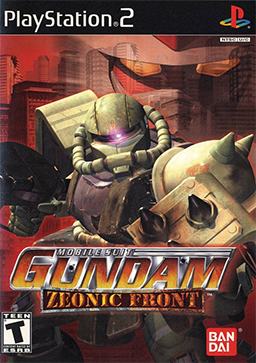
Most Gundam games want you to be the hero.
The ace.
The chosen pilot.
The one with the flashy prototype mobile suit and dramatic anime music swelling in the background.
Mobile Suit Gundam: Zeonic Front says:
That’s cute.
Then hands you a standard-issue Zeon suit and reminds you war is less about heroics… and more about surviving the mission.
If people remember Zeonic Front at all, it usually gets described the same way:
“That Gundam tactical game where you play as Zeon.”
And honestly?
That’s not wrong.
Released on the PlayStation 2, Zeonic Front immediately stood out because it did something most Gundam games didn’t:
It put you in the cockpit of the “bad guys.”
Not Char Aznable.
Not some anime super ace.
Just a military unit fighting for the Principality of Zeon during the One Year War.
For casual Gundam fans, that alone was the hook.
For people who never played it, it probably sounds like:
“Oh, so a villain campaign?”
Not quite.
Others remember it as clunky.
Slow controls. Deliberate movement. Less arcade action than other Gundam titles.
No wild beam spam.
No anime protagonist nonsense.
And depending on your tolerance for older PS2-era design?
That reputation is either a warning…
Or a recommendation.
Because Zeonic Front isn’t trying to make you feel powerful.
It’s trying to make you feel like a soldier.
And that changes everything.
Mechanics — This Is Gundam as Tactical Warfare
If you’re expecting fast-paced mecha action, recalibrate immediately.
Zeonic Front is a tactical squad-based combat game disguised as a Gundam title.
Yes, you pilot mobile suits.
But this isn’t:
“dash in, anime scream, beam saber everyone.”
This is planning.
You command a Zeon special forces unit known as the Midnight Fenrir Corps, assigning pilots and machines before missions, coordinating movements, and managing battlefield positioning.
Combat is slower. Heavier.
Mobile suits feel like armored war machines, not anime superheroes.
You:
- issue orders
- coordinate attacks
- set ambushes
- manage limited resources
- exploit terrain
And because Federation forces often have superior firepower?
You learn quickly that frontal assaults are bad for your continued existence.
This is Gundam as military tactics.
Not Gundam as toy commercial power fantasy.
And tonally?
That rules.
Story & Characters — The Enemy Gets a Human Face
This is where Zeonic Front gets fascinating.
Gundam has always played with moral ambiguity.
Even in the original series, Zeon wasn’t presented as cartoon evil.
Dangerous? Absolutely.
Authoritarian? Oh yes.
But also full of ordinary soldiers, patriots, and people caught inside a war machine.
Zeonic Front leans directly into that.
You play as Lieutenant Commander Garret Schmitzer and the Midnight Fenrir team.
Not celebrities.
Not chosen ones.
Professionals.
The story doesn’t ask you to love Zeon ideology.
It asks you to understand the people fighting for it.
That’s a huge distinction.
Your squad becomes the emotional hook:
- hardened veterans
- specialists
- soldiers with loyalty, fears, and battlefield personalities
And because the game strips away anime melodrama, their humanity lands differently.
This feels less like Gundam Wing.
More like Band of Brothers with mobile suits.
That’s a compliment.
World / Visuals / Atmosphere — Mud, Steel, and War
This is one of the grittiest Gundam games ever made.
No sleek space opera glamor.
No Newtype mysticism.
No teenage angst in a space colony.
Instead?
War zones.
Dust.
Urban combat.
Ground operations.
The One Year War from ground level feels completely different than it does from the perspective of Amuro Ray and White Base.
Federation mobile suits feel threatening.
GMs aren’t disposable background units here.
They’re problems.
And when the Gundam itself appears?
Oh buddy.
That’s not a rival mech.
That’s basically a horror movie monster.
Because from Zeon’s perspective?
The Gundam is terrifying.
That’s one of the smartest perspective flips in the game.
Sound & Music — Restraint Over Spectacle
This isn’t a soundtrack built around emotional anime heroism.
It’s militaristic.
Tense.
Functional.
The sound design matters even more.
Heavy footsteps.
Weapons fire.
Mechanical movement.
Mobile suits sound like machines with weight.
And that’s critical.
Because this game’s immersion depends entirely on selling the fantasy that you are piloting military hardware—not flashy super robots.
The audio does a ton of heavy lifting there.
Why Playing as Zeon Works So Well
Let’s be honest.
Part of the appeal is simple:
Playing the bad guys is fun.
But Zeonic Front works because it doesn’t frame it like Saturday morning villain cosplay.
It shows how war narratives change depending on perspective.
To the Federation?
You’re the aggressor.
To your squad?
You are comrades trying to survive.
That nuance makes the experience stick.
Because Gundam has always been less interested in:
“Who’s evil?”
And more interested in:
“What does war turn people into?”
Zeonic Front gets that.
This game matters because it trusted Gundam fans to want something different.
Not faster.
Not louder.
Different.
In the early 2000s, a lot of licensed games chased accessibility and spectacle.
Zeonic Front said:
“What if we made players think instead?”
It also quietly nailed something many franchise games still struggle with:
Perspective.
Too many tie-in games want you to replay the famous hero story.
This one says:
“What about everyone else?”
That makes the One Year War feel bigger.
Messier.
More human.
And that’s pure Gundam.
MODERN CONNECTION
You can absolutely see this game’s DNA in modern tactical experiences.
Games like:
- XCOM
- Company of Heroes
- squad-based military sims
…all live in the same philosophical neighborhood.
Narratively?
This also fits perfectly into today’s appetite for villain-perspective storytelling.
Andor.
The Last of Us Part II.
Stories that complicate who “the good guys” are.
Even anime keeps returning to this idea.
Because audiences increasingly understand something Gundam knew decades ago:
The other side usually thinks they’re right too.
Zeonic Front was doing that in 2001.
And from a Ctrl+Binge lens?
This is basically:
Gundam meets tactical war drama meets “what if the monster is the hero depending on where you stand?”
Which is catnip for us.
QUESTION
Let’s settle it:
If a franchise gives you the option…
Do you want to play the hero?
Or are villain / opposing force campaigns always more interesting?