THE CAMPFIRE STORY
Before there were Super Saiyans, there was a child standing beneath a full moon. He was small. Good-natured. Completely unaware of the danger buried inside him.
Then he looked up. His heart began to race. His body expanded. His clothes tore away. And the innocent little boy named Goku disappeared beneath the shadow of a gigantic ape.
The Great Ape was one of Dragon Ball’s first true monsters. It was enormous, uncontrollable, and powerful enough to flatten everything around it. More importantly, it was Goku.
Not a villain possessing him. Not a curse placed upon him. Not some outside force twisting him into something unnatural. The monster had always been there.
Dragon Ball eventually moved away from that idea. The tails disappeared. The moon stopped mattering. Golden-haired transformations replaced the hulking ape that once terrorized the heroes.
For years, it seemed as if Goku had simply outgrown that part of himself. Then Dragon Ball GT brought it back. Not as a joke. Not as nostalgia. As the missing piece necessary to create Super Saiyan 4.
GT looked back at the boy with the monkey tail and asked a surprisingly ancient question: What happens when a human-looking hero is forced to confront the beast inside him?
Because long before Dragon Ball, cultures around the world were already telling stories about creatures that looked almost human.
Hair-covered giants. Wild men in forests. Mountain beasts. Ape-like shadows watching from beyond the edge of civilization.
Different places gave them different names. But the fear beneath them remained remarkably familiar.
Something is out there. It resembles us. It may even be related to us. But it has never been tamed.
Dragon Ball GT took that ancient uneasiness and placed it inside its greatest hero.
THE FAMILIAR VERSION
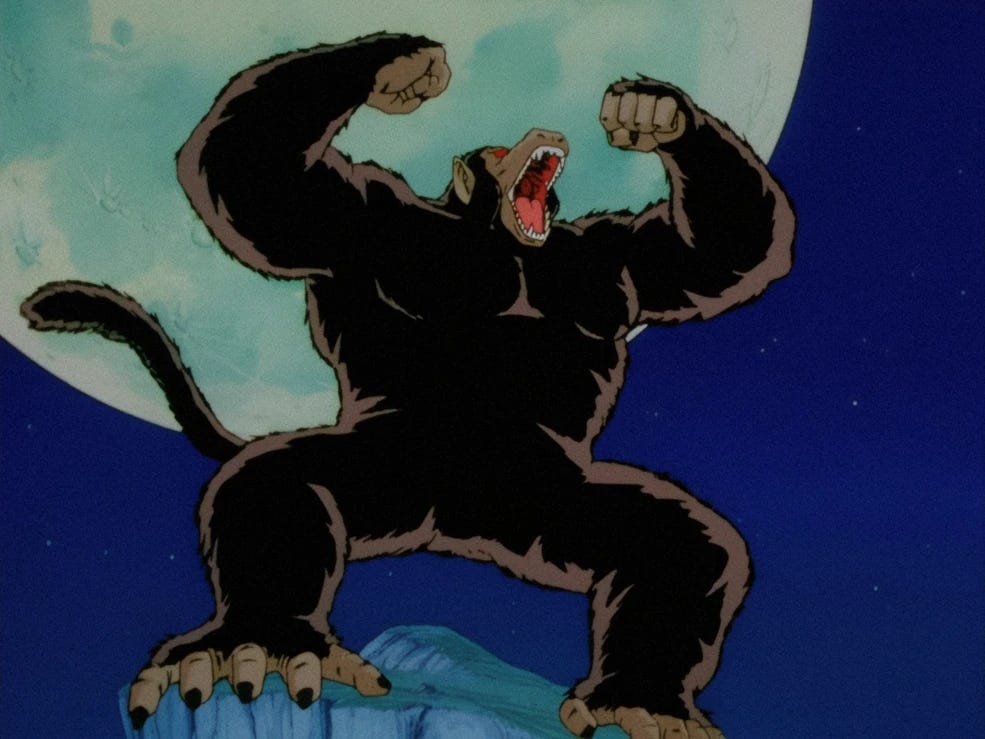
Most Dragon Ball fans understand the Great Ape transformation through a simple set of rules.
A Saiyan has a tail. The Saiyan looks at a full moon—or another source of the right kind of lunar energy. The transformation begins. The Saiyan grows into an enormous ape with incredible destructive power.
Early in the series, Goku loses all control when this happens. He does not know who his friends are. He does not understand what he is destroying. He simply becomes the beast.
Later, Vegeta reveals that an experienced Saiyan can retain his intelligence and even speak while transformed. That changes the Great Ape from a mysterious curse into something cultural.
The Saiyans knew what they were. They understood the transformation. They used it as a weapon.
The Great Ape was not an accident in Saiyan history. It was part of how they conquered worlds. Then the franchise moved on.
Goku lost his tail. Gohan lost his. Vegeta stopped relying on the transformation. The Super Saiyan became the defining image of the race. Golden hair replaced brown fur. Focused rage replaced blind destruction.
By the end of Dragon Ball Z, the Great Ape felt like something from an earlier version of the story. Dragon Ball GT remembered it. And more importantly, GT understood that Goku’s final transformation should not merely climb higher.
It should dig deeper.
The Golden Great Ape was not Dragon Ball GT inventing a new monster. It was Dragon Ball remembering the first one.
THE CREATURE JUST BEYOND THE FIRELIGHT
It would be too easy to say that every old story about a hairy wild creature was secretly describing Bigfoot. Folklore does not work that neatly.
Stories change as they move. Symbols overlap. Creatures that appear similar may carry completely different meanings in the cultures that created them. Still, the image of the wild, hair-covered humanoid is remarkably persistent.
Medieval European art and literature featured the wild man of the woods: a large, hairy figure believed to live beyond civilized society. The figure appeared in stories, carvings, and heraldry as something caught between humanity and nature.
Elsewhere, stories developed around mountain-dwelling or forest-dwelling beings that seemed human without fully belonging to humanity.
- The Yeti.
- The Sasquatch.
- The Yowie.
- The Almas.
- The Orang Pendek.
Some are described as giants. Others are smaller. Some are presented as flesh-and-blood animals. Others feel more like spirits, guardians, warnings, or memories of an older world.
They are not all the same creature. But they frequently occupy the same symbolic territory.
They live beyond the village. Beyond the road. Beyond the boundary where human rules still apply.
They are what civilization believes may be waiting when the firelight ends. That is why the wild ape or wild man has remained such a powerful figure.
A dragon is fantastical. A ghost belongs to the dead. But an ape-like creature feels disturbingly possible.
It has hands. It has eyes. It stands upright. It seems capable of thought.
When it looks back at us, we cannot help wondering what it recognizes.
WHY APES FEEL DIFFERENT
Human beings can look at a tiger and immediately understand that we are seeing another kind of animal.
The tiger is beautiful. Dangerous. Powerful. But unmistakably separate from us.
Primates complicate that feeling. Their expressions appear familiar. Their fingers curl around objects. They form social groups. They play, fight, protect their young, and react emotionally to the world around them.
We do not merely observe them. We recognize pieces of ourselves. That recognition can be comforting. It can also be deeply unsettling. The ape-like monster is frightening because it threatens the boundary between person and animal.
It asks whether civilization truly changed us—or merely covered something older. That is the fear Dragon Ball reaches whenever a Saiyan becomes a Great Ape. The transformation does not turn Goku into a completely unrelated monster.
It exaggerates traits that were already present. His strength becomes catastrophic. His energy becomes uncontrollable. His playful monkey imagery becomes something enormous and terrifying.
The child who spent his days wandering through mountains becomes a beast capable of destroying them. That is what makes the Great Ape so effective.
Goku is not being replaced. He is being revealed.
THE MONKEY INSIDE THE SAIYAN
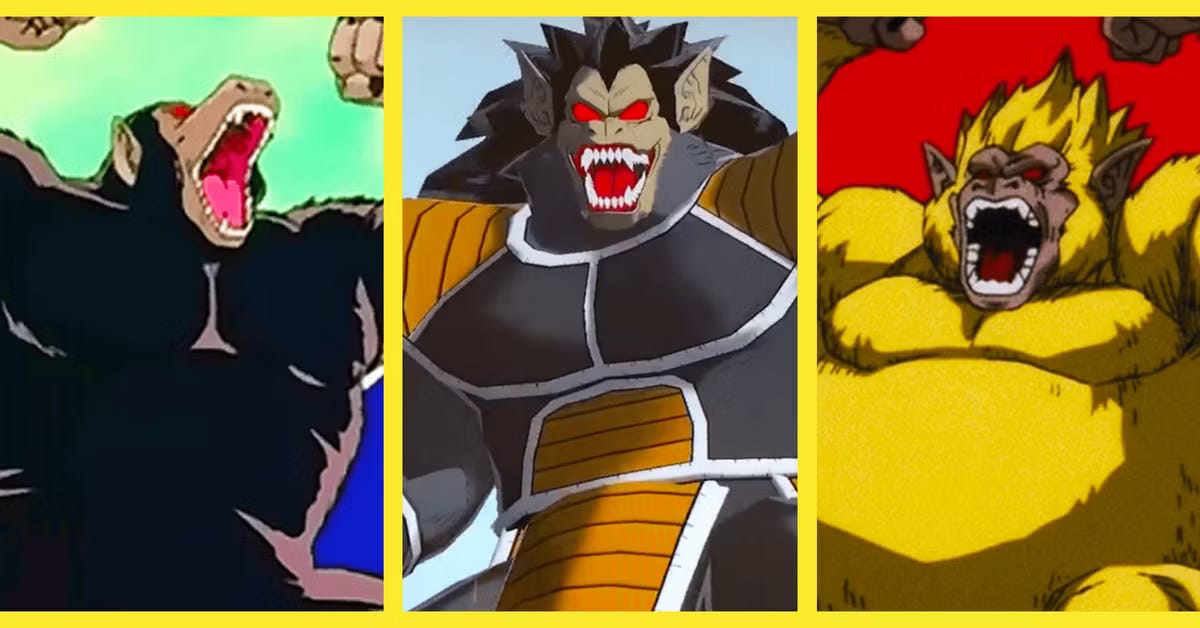
There has always been something wonderfully strange about the fact that Dragon Ball’s warrior race is associated with monkeys.
The Saiyans are not modeled after lions. They are not wolves. They are not elegant dragons or soaring birds of prey. They are spacefaring conquerors with tails who can transform into giant apes.
On paper, it sounds ridiculous. Within Dragon Ball, it feels inevitable. Monkeys have always been tied to Goku’s identity.
His original inspiration, Sun Wukong, is the Monkey King. Young Goku had a tail. He used a magical staff. He rode a cloud. He was curious, mischievous, impulsive, and almost impossible to contain.
The Saiyan revelation in Dragon Ball Z did not erase the monkey imagery. It gave it a new explanation. Goku was not merely a strange little boy. He belonged to a race that carried its animal nature physically.
The tail was not decorative. It was a trigger. The full moon did not simply make Saiyans stronger. It released the thing hiding beneath their human shape.
For most Saiyans, that beast was useful. They could send young warriors to distant worlds, wait for the moon, and allow the transformation to do the work of an entire army. The Great Ape was warfare reduced to instinct.
But Goku was different. Earth changed him. Grandpa Gohan raised him with kindness. Master Roshi gave his strength discipline. Krillin, Bulma, Chi-Chi, Piccolo, Gohan, and the rest of his family gave him something worth protecting.
Goku did not become heroic because he stopped being a Saiyan. He became heroic because the wildness inside him was given a better direction.
Dragon Ball GT makes that idea visible.
GT BRINGS BACK THE MONSTER
By the time GT begins, Goku has transformed so many times that another level of Super Saiyan could easily have felt routine.
- Make the hair longer.
- Make the aura brighter.
- Increase the power.
- Continue climbing.
Instead, GT turns backward. Goku’s adult body has been taken from him. He is physically a child again. His tail returns. The story sends him into space, echoing the wandering adventures of early Dragon Ball.
Then Baby takes control of Vegeta and turns Earth into the center of a conflict involving the Saiyans’ oldest crimes. Everything in the Baby Saga is about buried history returning.
The Tuffles return through Baby. Vegeta’s body becomes the weapon. The Saiyans’ past refuses to remain dead. So it makes perfect sense that Goku cannot defeat that past by discovering something completely unrelated to it.
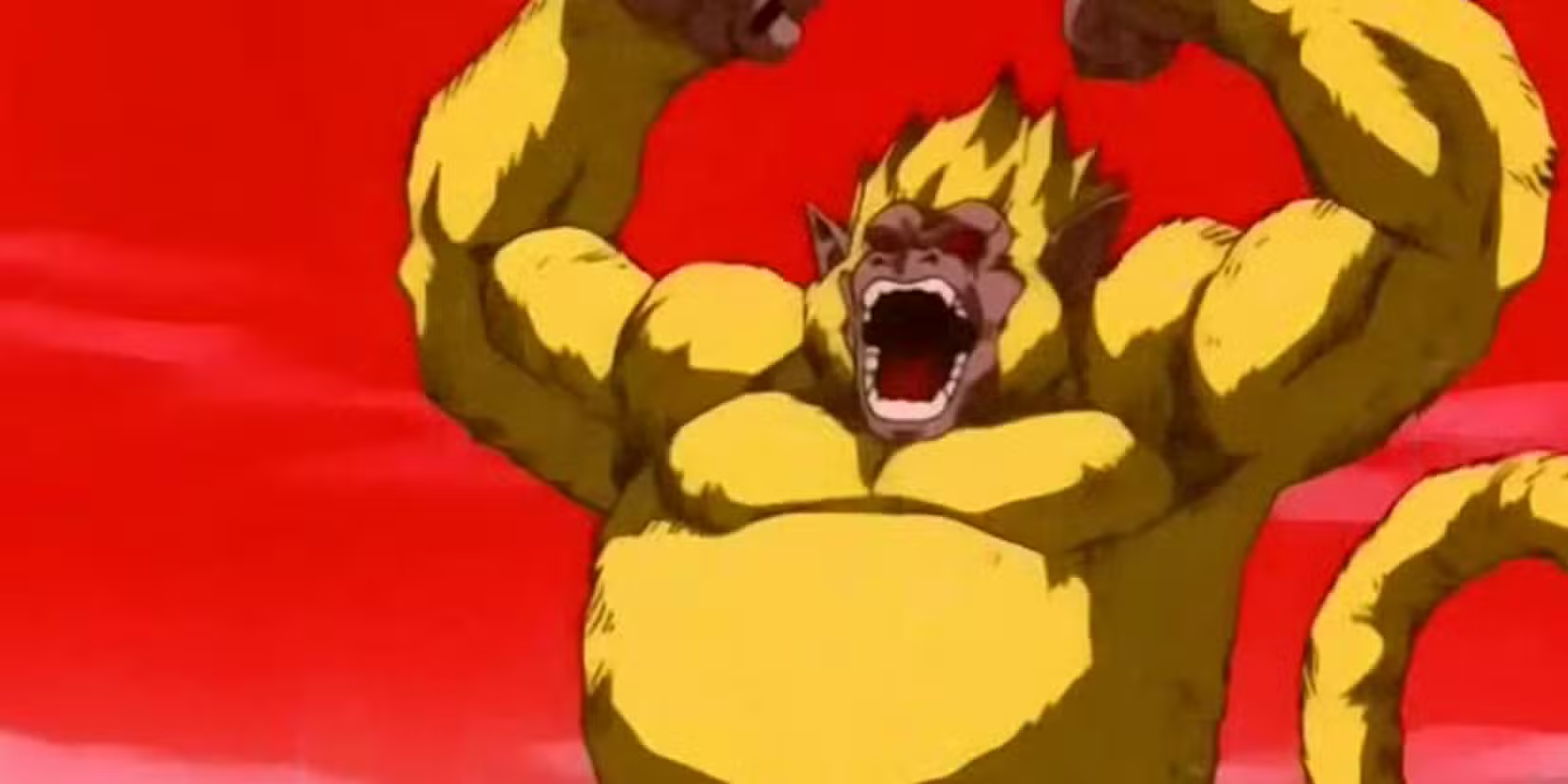
He has to become the Great Ape again. When Goku receives enough Blutz Waves, his body changes. He becomes a Golden Great Ape.
The result combines two defining pieces of Saiyan mythology:
- The primal Great Ape.
- The legendary Super Saiyan.
But power does not equal mastery. Golden Great Ape Goku is terrifying. He rampages. He destroys his surroundings. He cannot immediately recognize the people trying to reach him.
The strongest hero in the universe has returned to the same condition he experienced as a child beneath the full moon.
All that growth. All that training. All those transformations. And the beast is still there.
PAN AND THE MONSTER
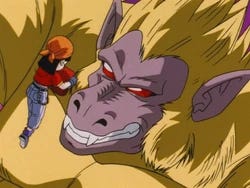
Goku does not regain control because someone defeats the ape. He does not transform because a warrior delivers a greater attack. He comes back because Pan reaches him.
She shows him what he is destroying. She reminds him who he is. That distinction matters.
The Golden Great Ape is not overcome through violence. It is overcome through recognition. Inside the monster, Goku sees his granddaughter. He sees his family. He sees the Earth.
He remembers the relationships that separate him from the conquering Saiyans who came before him. Pan does not destroy Goku’s primal nature. She gives it a reason to stop.
That emotional control allows the transformation to evolve into Super Saiyan 4. In GT, Goku reaches the form only after passing through the Golden Great Ape and regaining himself through his connection to Pan.
This makes Super Saiyan 4 different from nearly every transformation before it.
Goku does not simply generate more energy. He reconciles two versions of himself. The warrior and the animal. The master and the child. The Saiyan raised for conquest and the Earthling raised to love.
Super Saiyan 4 is not what remains after the beast disappears. It is what appears when the beast finally listens.
WHY SUPER SAIYAN 4 STILL HAS FUR
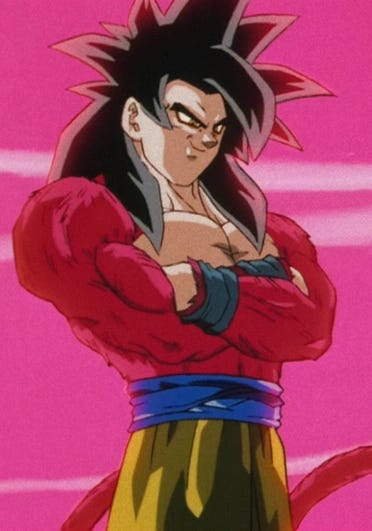
Super Saiyan 4 remains one of the most recognizable designs in the entire franchise because it does not look like a natural continuation of Super Saiyan 3.
The hair becomes dark again. Red fur covers much of the body. The tail remains or shows up again. The eyes become sharper. The face looks older and more confident, even though Goku’s ordinary body is still that of a child.
It is simultaneously more human and more animal. That apparent contradiction is the entire point. The transformation does not cleanse Goku of the Great Ape. It carries the ape forward.
The fur is not leftover decoration. It is the visual proof that Goku’s primal nature has not been rejected.
Super Saiyan 4 says that enlightenment does not always mean leaving the body behind. Sometimes it means understanding the body completely.
Goku does not become divine. He becomes whole. That is also why Super Saiyan 4 feels unusually physical.
The transformation has weight. Muscle. Claws. Fur. A tail.
It does not make Goku appear like a glowing spirit drifting beyond mortal concerns. It makes him look connected to blood, instinct, ancestry, and the wild. Super Saiyan 4 is powerful because it looks ancient.
THE BEAST AND THE KING
Modern ape stories often return to a similar tension.
King Kong is terrifying because of his size and strength, but his stories repeatedly ask whether the creature is truly the monster—or whether the civilized people pursuing him are worse.
Planet of the Apes destabilizes humanity by placing intelligent apes in the position we assumed belonged to us.
Bigfoot stories turn the wilderness into a place where something intelligent may be observing us without needing our cities, machines, or permission.
Again and again, the ape becomes a mirror.
Dragon Ball uses that mirror differently. The Great Ape is not another species judging humanity. It is Goku’s ancestry judging Goku. Every time the beast appears, it asks what kind of Saiyan he truly is.
A conqueror? A destroyer? A weapon responding to the moon? Or something capable of choosing a different path?
GT’s answer is not that Goku must abandon his Saiyan blood. It is that his Saiyan blood must become part of the person Earth helped him become.
The ape does not disappear. It kneels to no master. It simply recognizes Pan. And through her, it recognizes home.
VEGETA AND THE PRIDE OF THE APE
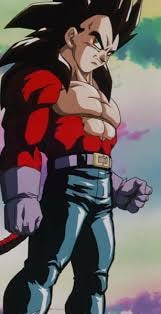
The Great Ape carries a different meaning for Vegeta. Goku spends much of his life disconnected from Saiyan culture. Vegeta defines himself through it.
He knows the transformation. He understands its military purpose. He once controlled it through training and royal blood. Yet GT ultimately makes Vegeta retrace the same primal road before he can reach Super Saiyan 4.
With Bulma’s technology recreating the necessary Blutz Waves, Vegeta transforms into a Golden Great Ape and then gains control of the form.
There is something fitting about Bulma being part of that process. Vegeta’s transformation is not achieved through Saiyan tradition alone. It requires the woman he loves. The technology of Earth. The life he built after the destruction of his people.
Like Goku, Vegeta reaches his most primal Saiyan form through the relationships that made him more than a Saiyan. That may be the quiet heart of Super Saiyan 4. Neither man achieves wholeness by returning to the past exactly as it was.
They carry the past into the lives they chose.
THE WILD MAN INSIDE THE CITY
Old stories often placed the wild man outside civilization. He belonged in the mountains. The forest. The unexplored country beyond the walls. He represented everything society believed it had left behind.
- Instinct.
- Violence.
- Freedom.
- Chaos.
Sometimes the wild man was a warning. Sometimes he was an ideal. He could represent the terror of becoming uncivilized—or the fantasy of escaping rules that had become suffocating.
Dragon Ball GT moves that ancient figure inside the hero. Goku does not need to enter a forbidden forest to meet the wild man. He carries it in his blood. That makes the Great Ape less like Bigfoot and more like an inherited memory.
It is the Saiyan body remembering what it was designed to do. Look at the moon. Grow. Destroy. Conquer.
Super Saiyan 4 interrupts that command. Look at the moon. Grow. Remember. Choose. The sequence begins the same way.
The ending changes.
WHY WE KEEP TELLING THIS STORY
The beast within is one of humanity’s most enduring ideas because no civilization has ever fully convinced itself that civilization is permanent.
We build cities. We create laws. We teach manners. We place distance between ourselves and the wilderness.
Still, anger can overwhelm reason. Fear can erase compassion. Power can make people cruel. The animal never feels completely gone.
Stories allow us to confront that fear safely. Werewolves lose themselves beneath the moon. Wild men live beyond the border. Ape creatures haunt the forest. Saiyans transform beneath artificial moons and tear cities apart.
But Dragon Ball GT offers an unusually hopeful version of the idea. It does not say the animal must die. It says control is possible.
Not control through shame. Not control through denial. Control through identity. Goku remembers Pan. He remembers Earth. He remembers himself.
Then the power that once destroyed everything becomes the foundation for something greater.
THE CTRL+BINGE CONNECTION
Super Saiyan 4 is often discussed as a design.
The red fur. The black hair. The eyes. The tail.
Fans argue about whether it looks better than later transformations, whether it deserves a place in the larger canon, and whether GT handled it properly.
Those conversations are understandable. The design is incredible.
But Super Saiyan 4 works because it tells a story before Goku throws a single punch. It looks backward. Back to the monkey boy who lived alone in the mountains. Back to the full moon. Back to Grandpa Gohan’s death. Back to the Saiyans. Back to the Great Ape Vegeta used against Goku. Back to a power Goku never truly mastered because his friends usually solved the problem by removing his tail.
GT finally refuses to cut the tail off. It makes Goku deal with it. That is the brilliance of the transformation. Super Saiyan 4 is not another step away from Goku’s beginnings. It is a return to them.
The boy, the warrior, the Saiyan, and the ape all become one person. GT did not make Goku powerful by helping him escape the monster. It made him powerful by allowing him to understand it.
Long before gods and angels entered Goku’s world, there was a monkey boy beneath the moon.
Long before divine transformations, there was the Great Ape.
Long before the universe understood what a Saiyan could become, Goku’s greatest danger was already living inside him.
Dragon Ball GT remembered that. It remembered that Goku’s story began with a tail. It remembered that Saiyan power was once wild, frightening, and impossible to control.
And when the time came to create GT’s ultimate transformation, it did not throw that history away. It brought the beast back. Not to destroy Goku. To complete him.
The Great Ape was never merely an old transformation that Dragon Ball outgrew. It was Goku’s oldest unfinished story. Super Saiyan 4 finally gave it an ending.
THE QUESTION THAT LINGERS
Was Super Saiyan 4 really Goku’s newest transformation…
or was it his oldest one finally brought under control?