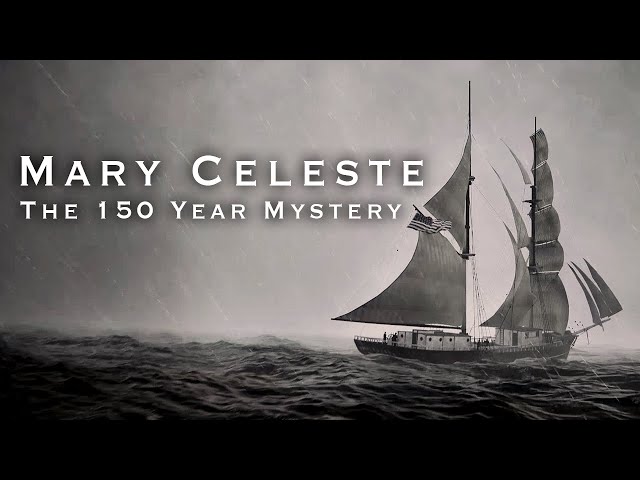
“Ten people left a ship that refused to sink. The real mystery is what made an experienced captain believe the open Atlantic was safer.”
Yesterday, our ghost ships sailed out of folklore.
They carried drowned sailors, ignored warnings, and appeared through the fog when the living least wanted to see them.
Today, we board one that actually existed.
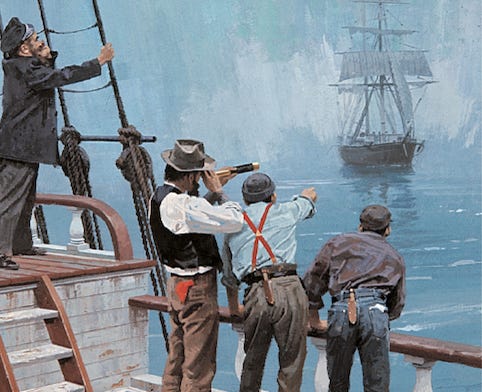
On December 4, 1872, sailors aboard the Dei Gratia spotted another vessel moving erratically through the Atlantic near the Azores. Its sails were partially set, but no one appeared on deck. Hails received no answer.
A boarding party climbed aboard.
The cargo remained.
The crew’s belongings remained.
Food and water remained.
Captain Benjamin Briggs was gone. So were his wife, his two-year-old daughter, and all seven members of his crew.
Ten people had sailed from New York. The ship was recovered.
They were not.
The Version Everyone Knows
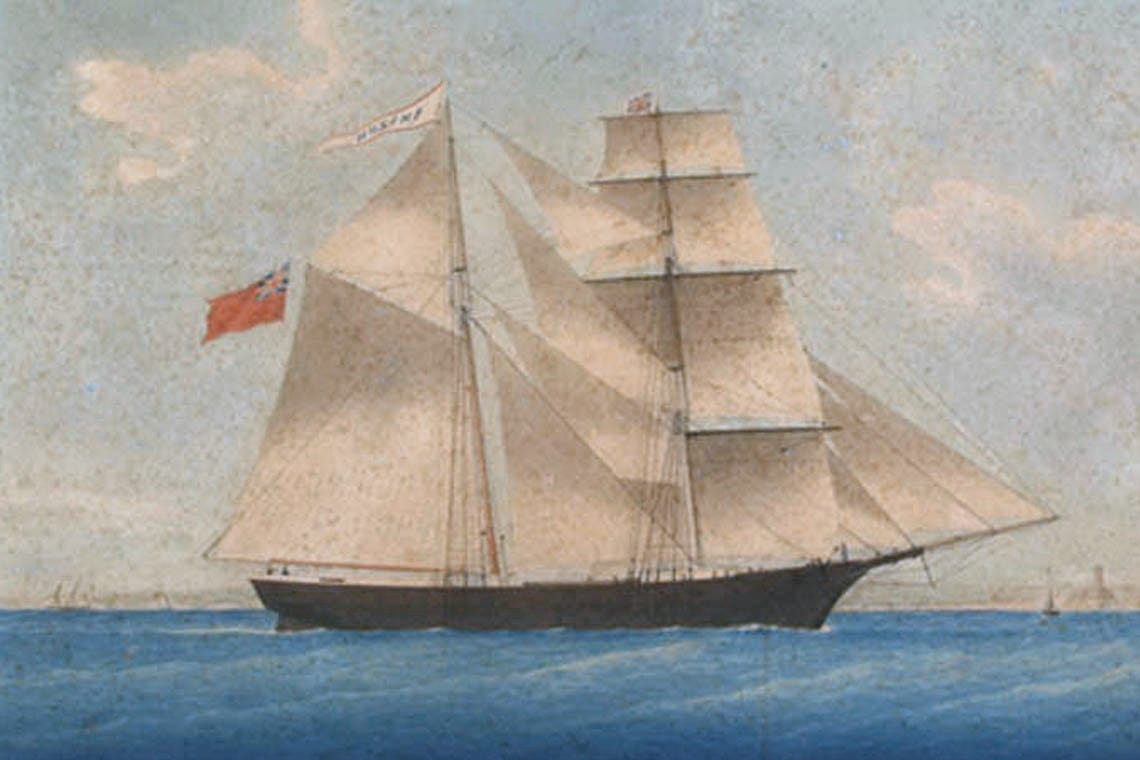
The familiar story presents the Mary Celeste as a perfect maritime time capsule.
A seaworthy ship was discovered sailing by itself. Food supposedly sat waiting on the table. Personal belongings remained neatly in place. The cargo was untouched. There were no signs of violence, panic, or struggle.
Everyone had simply vanished.
That empty space invited nearly every explanation imaginable.
- Pirates.
- Mutiny.
- Murder.
- An alcohol explosion.
- A waterspout.
- A giant sea creature.
- Alien abduction.
The Bermuda Triangle occasionally gets dragged into it, despite the Mary Celeste being abandoned in an entirely different part of the Atlantic.
That is the legend: a perfectly normal ship whose people disappeared as though something had reached down and removed them.
Except the ship was not perfectly normal.
And its people probably did not vanish from it.
They left.
They Took the Boat
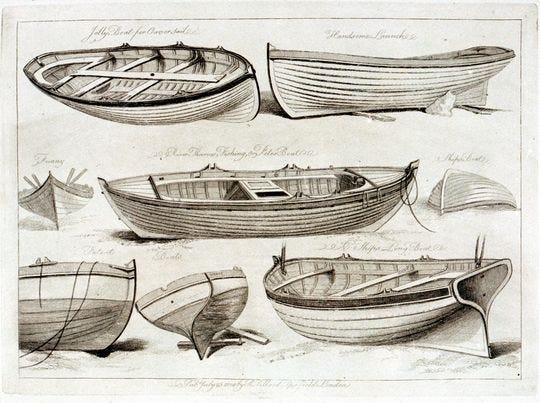
The Mary Celeste carried one small boat.
It was missing.
So were Captain Briggs’s navigational instruments and most of the ship’s papers.
Those are not the things a supernatural force removes for dramatic effect. They are the things sailors take when abandoning a vessel.
The crew’s possessions remained because they were not packing for a new life. They were responding to an emergency.
The real question is not what made ten people disappear from the deck.
It is what convinced an experienced captain to place his wife, his little girl, and seven sailors into one open boat in the middle of the Atlantic.
Ten People Bound for Genoa
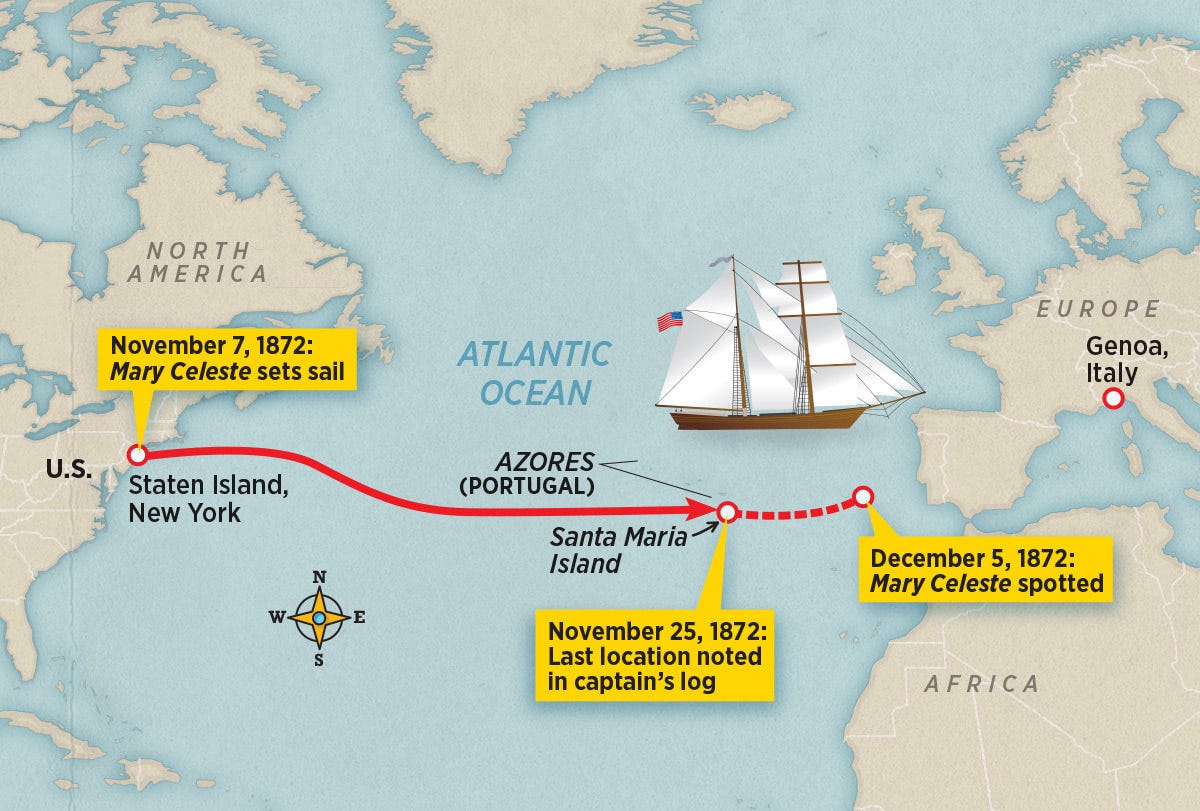
The Mary Celeste departed New York on November 7, 1872, bound for Genoa, Italy.
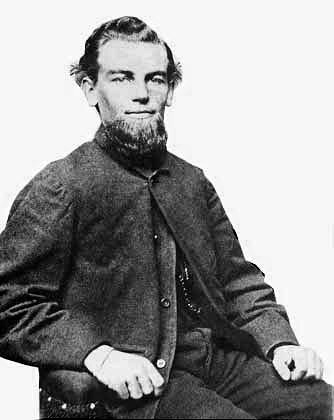
Captain Benjamin Spooner Briggs was a respected and experienced mariner. This was not a reckless man gambling with an unfamiliar ship. He knew the sea, understood the risks, and had enough confidence in the voyage to bring his family.
His wife, Sarah, traveled with him. So did their two-year-old daughter, Sophia.
Seven crewmen completed the ship’s company.
Below deck sat 1,701 barrels of industrial alcohol.
For more than two weeks, the voyage continued through difficult weather. The final entry preserved on the ship’s log slate was made on the morning of November 25, placing the vessel near Santa Maria Island in the Azores.
After that, the record stopped.
Nine or ten days later, depending on how the dates were recorded aboard the two ships, the Dei Gratia found the Mary Celeste hundreds of miles away.
Still sailing.
Still carrying her cargo.
Completely empty.
What the Boarding Party Actually Found
The ship was not a pristine dining room floating peacefully through a calm sea.
Its sails and rigging showed damage. Some cargo hatch covers had been removed and were lying on deck. Water had entered the hold. One of the ship’s pumps was partly dismantled, and a sounding rod, a tool used to measure water inside the vessel, was nearby.
The ship’s compass equipment had also been damaged.
None of this proved the Mary Celeste was sinking. In fact, the sailors from the Dei Gratia managed to bring her safely to Gibraltar.
But Captain Briggs did not know that would happen.
He knew his ship had endured rough weather. He knew water was entering the hold. He may not have trusted one of the instruments meant to tell him how much water was there.
He also had no weather forecast, radio, satellite positioning, or rescue service waiting for a distress call.
The difference between “damaged but seaworthy” and “about to sink” is much easier to calculate from the safety of dry land.
The missing boat, papers, and navigational equipment all point in the same direction:
Briggs ordered an evacuation.
Why he gave that order remains the mystery.
The Investigation That Wanted a Murder
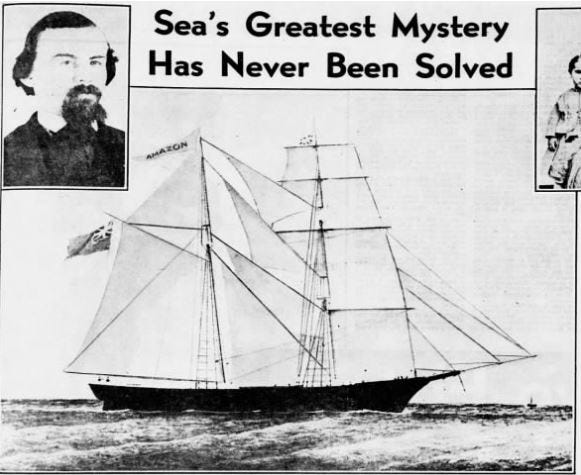
When the salvaged Mary Celeste reached Gibraltar, the legal process should have been relatively straightforward.
The crew of the Dei Gratia had recovered an abandoned vessel and wanted a salvage award.
Instead, Gibraltar’s attorney general, Frederick Solly-Flood, became convinced that a crime had occurred.
He suspected mutiny, murder, piracy, insurance fraud, or some combination of all four. Marks on the ship became possible weapon damage. Stains became possible blood. The surviving crew of the Dei Gratia became possible conspirators.
The investigation had found its villain before it found its evidence.
Then the evidence began refusing to cooperate.
The supposed blood was not blood. Marks initially treated as suspicious could be explained by the natural action of the sea. Nothing aboard established that Briggs, his family, or the crew had been attacked.
After months of investigation, no murder was proven. No pirate plot emerged. No conspiracy explained why ten people would leave a valuable ship and its cargo behind.
Solly-Flood’s suspicions did not solve the case.
They did, however, help transform it into a sensation.
Once the possibility of murder entered the newspapers, an accident no longer seemed exciting enough.
Why Would Briggs Leave?
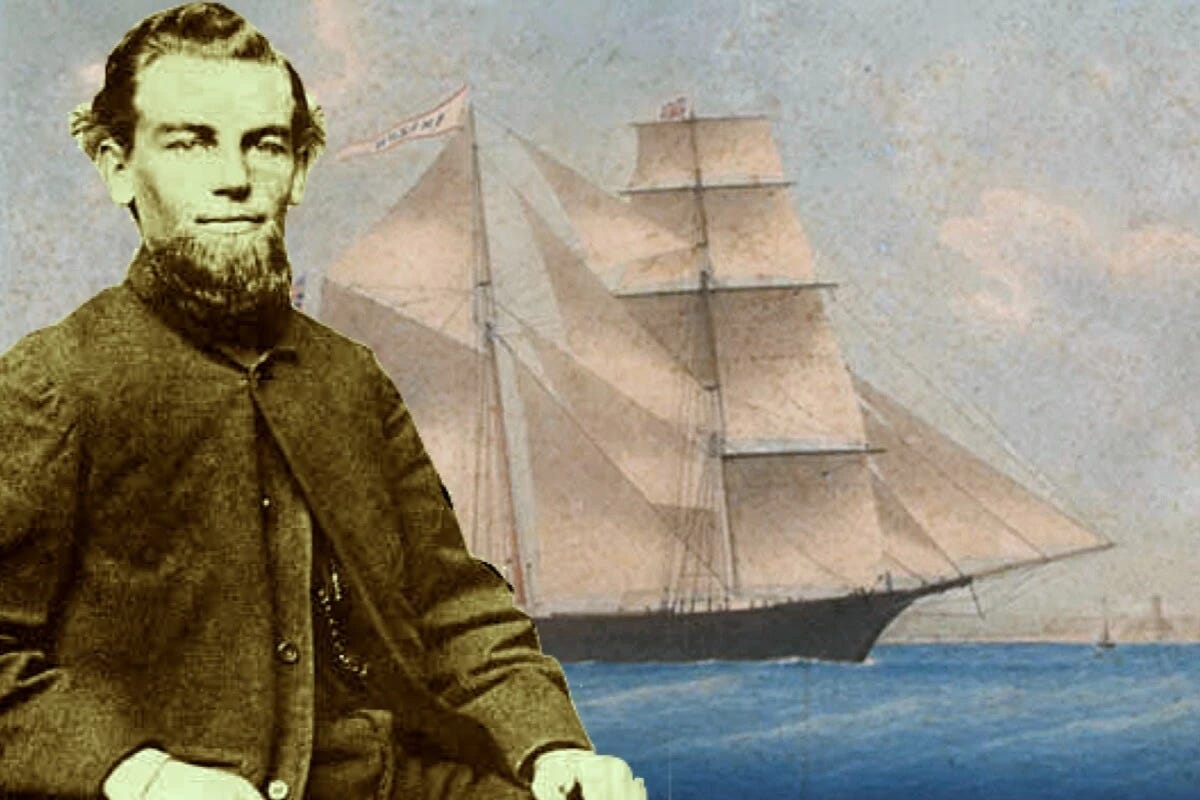
Several theories remain possible, but the evidence best supports some kind of perceived emergency.
One popular explanation centers on the alcohol below deck.
When the cargo was eventually unloaded, nine of the 1,701 barrels were empty. Those nine barrels were made from more porous red oak rather than the white oak used for most of the cargo. Alcohol may have leaked and produced fumes inside the hold.
Perhaps Briggs feared an explosion.
That would explain a sudden evacuation without requiring an actual fire. But no one reported scorching, an explosion, or even a strong smell when the ship was boarded. The alcohol theory remains possible, not proven.
Another reconstruction begins with the pump.
The Mary Celeste had recently undergone extensive work and had previously carried coal. Dust and construction debris may have interfered with the pumps. If Briggs could not operate one pump or accurately measure the water entering the hold, he may have believed the ship was flooding faster than it really was.
One modern investigation also suggested that an inaccurate chronometer may have left Briggs uncertain of his position after days of rough weather. When Santa Maria finally appeared, he may have believed it was his last opportunity to reach land before the vessel sank.
Put those pieces together:
- A battered ship.
- Water in the hold.
- A pump that could not be trusted.
- A captain uncertain about the vessel’s condition.
- Land apparently within reach.
- His wife and child aboard.
Under those circumstances, launching the boat may have looked like the cautious decision.
It is possible that Briggs intended to keep the boat tethered to the Mary Celeste. That would allow everyone to return if the danger passed while keeping them ready to escape if the ship went down.
Then the line may have broken.
The Mary Celeste, lighter and still under partial sail, moved away.
The small boat was left behind.
That sequence fits much of the surviving evidence, but it remains a reconstruction.
No witness survived to confirm it. No lifeboat was recovered. No bodies were found.
We can explain why they probably left.
We cannot prove what happened next.
The Man Who Made the Mystery Stranger
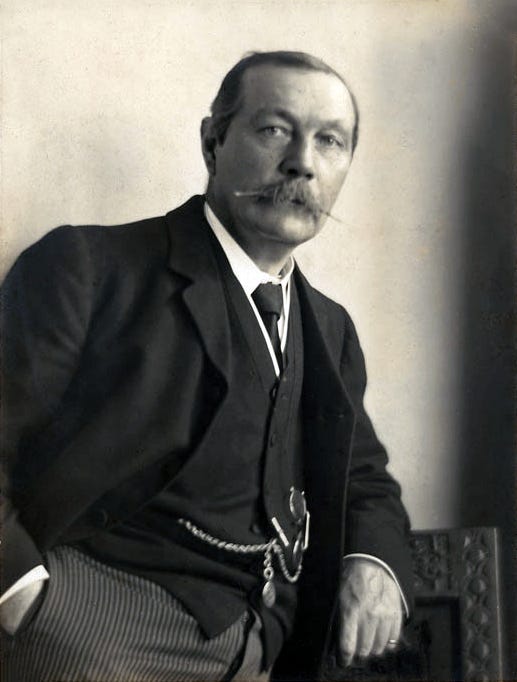
The Mary Celeste might eventually have become an obscure maritime case if a young writer had not discovered it.
In 1884, Arthur Conan Doyle (before Sherlock Holmes made him famous) published J. Habakuk Jephson’s Statement.
It was fiction, written as a survivor’s account and loosely inspired by the abandoned ship.
Doyle changed the voyage. He changed the people. He invented an explanation. He even renamed the ship the Marie Celeste.
The story was convincing enough that readers began confusing Doyle’s inventions with the real case. The incorrect name still appears today.
Other retellings added their own decorations: meals waiting on the table, drinks still warm, everything perfectly arranged, and a crew removed in the middle of ordinary life.
The historical Mary Celeste became buried beneath a better ghost story.
This was nineteenth-century true-crime culture.
The algorithm was print.
The Ship That Would Not Die
Here is the detail that somehow makes everything stranger:
The Mary Celeste survived.
After being recovered, she completed her voyage and returned to commercial service. She sailed under several owners for roughly twelve more years.
Then, in 1885, her final captain deliberately ran her onto a reef near Haiti as part of an attempted insurance scheme.
The most famous suspected insurance fraud in the ship’s history was unsupported.
Her actual attempted insurance fraud came years later.
The scheme failed, and the Mary Celeste was finally destroyed.
The people from her most famous voyage were still missing.
Why the Mary Celeste Still Matters
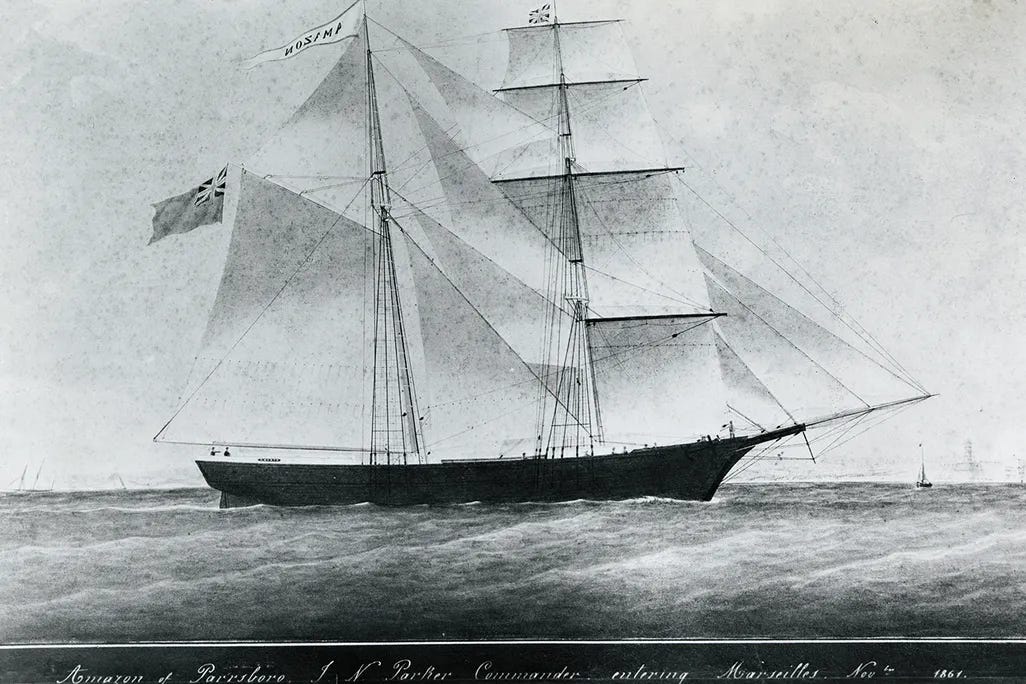
The Mary Celeste became the model for the modern unsolved mystery.
- There was enough evidence to build a theory, but not enough to finish it.
- There were official records, but no eyewitnesses.
- There was an investigation, but no conclusion.
There were grieving families, suspicious authorities, eager newspapers, and storytellers who understood that an unexplained disappearance could hold an audience forever.
Every generation then supplied the threat it understood best.
Victorian readers imagined mutiny and piracy.
Later audiences added sea monsters, secret conspiracies, the Bermuda Triangle, and alien abduction.
Today, we would turn the voyage into a ten-part podcast, examine every barrel in slow motion, and accuse at least six innocent people before reaching the final episode.
The tools change.
The hunger for an ending does not.
That is where Thursday meets Wednesday.
Ghost ships haunt us because the ocean refuses to return everyone it takes.
The Mary Celeste is worse because it returned the largest piece of the story.
It gave us the ship. It gave us the clues. It gave us the decision. It kept the ending.
The Final Button
The Mary Celeste did not return from the dead.
She did something more haunting.
She survived the decision that probably killed everyone who had trusted her to carry them across the Atlantic.
The ship came home.
Her people never did.
The Ctrl+Binge Question
You are Captain Briggs.
There is water in the hold. One pump cannot be trusted. Rough weather is behind you. Land may be nearby. Your family is aboard.
Do you remain with the ship? Or do you take your chances in the boat?