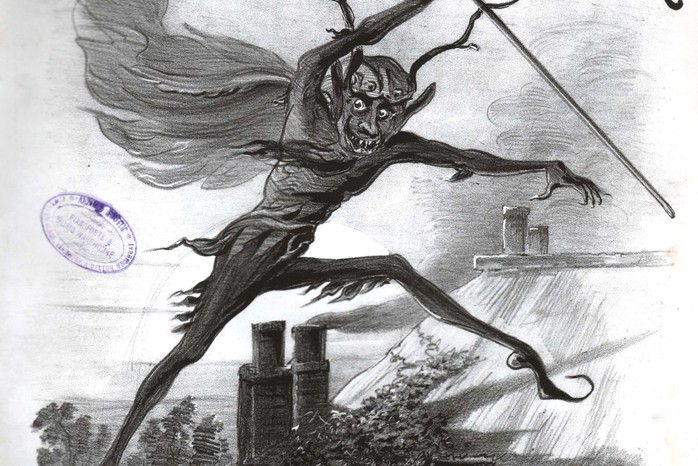
London in the Victorian era was growing.
Gas lamps pushed against the darkness. New streets stretched farther into the countryside. Crowds moved through neighborhoods where strangers could disappear almost instantly.
Then something began jumping over the walls.
Witnesses described a tall, devilish figure lurking along the roads outside London. He wore a dark cloak. His eyes glowed red. His fingers ended in metallic claws.
Some claimed he breathed blue-and-white fire. Others said he could clear fences, rooftops, and entire buildings in a single impossible leap.
He attacked. He laughed. Then, before anyone could catch him, he sprang into the darkness.
London called him Spring-heeled Jack.
He may have been a criminal. A wealthy prankster. Several copycats. A newspaper creation. Or perhaps—as terrified Victorians whispered—something that was not human at all.
But whether Jack could truly leap across rooftops eventually stopped mattering. Because the legend could.
THE FAMILIAR VERSION
This is the version most people know: Spring-heeled Jack was a demonic figure who terrorized Victorian London beginning in 1837.
He supposedly possessed extraordinary jumping ability, glowing red eyes, clawed hands, a dark cloak, tight-fitting clothing, and the ability to breathe fire.
He attacked young women, frightened travelers, mocked anyone who attempted to capture him, and escaped by leaping over obstacles no ordinary person could clear.
Eventually, sightings spread beyond London.
Jack was reported in towns, villages, military installations, and cities across Britain. By the end of the nineteenth century, he had become one of the country’s great boogeymen.
Parents reportedly used his name to frighten misbehaving children. Travelers feared meeting him along dark roads. Newspapers attached his name to strange disturbances even when the reports shared few details with the original encounters.
Spring-heeled Jack became Victorian Britain’s answer for almost anything that moved through the darkness too quickly to identify. But that neat version combines decades of contradictory reports, theatrical fiction, rumor, retrospective storytelling, and possible copycat attacks.
The real history is far messier. And far more interesting.
Spring-heeled Jack wasn’t one monster with one story. He was a character Victorian Britain kept rewriting.
THE NIGHT LONDON MET JACK
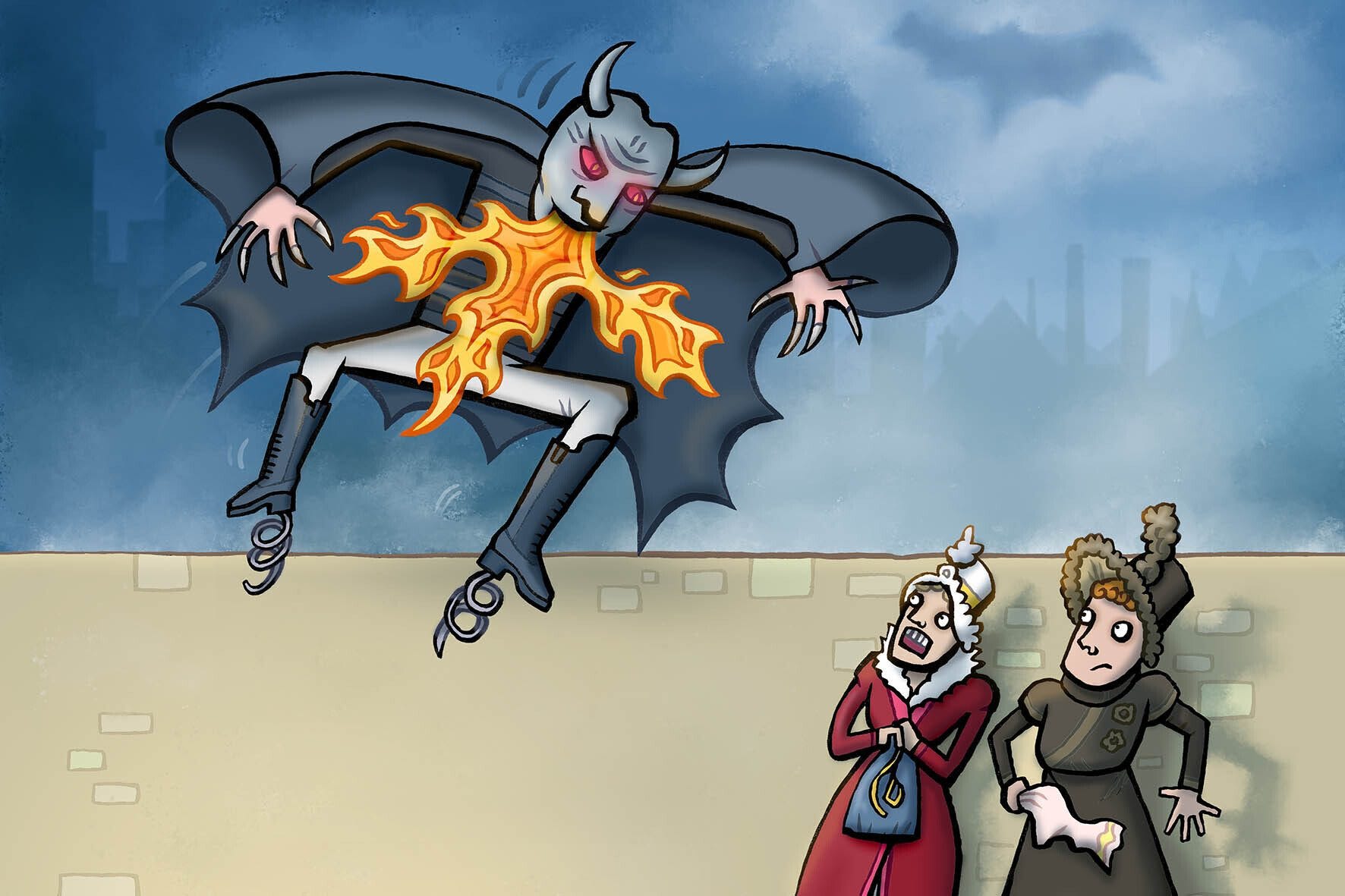
Many modern retellings begin with an alleged 1837 attack on a servant named Mary Stevens.
According to that version, Stevens was walking through the area around Clapham Common when a strange figure leaped from an alley, grabbed her, tore at her clothing with cold claw-like hands, and escaped when her screams attracted attention.
It is a suitably frightening beginning.
The trouble is that the story is difficult to trace through contemporary reporting and appears more clearly in later retellings of the legend.
The strongest documented trail begins on January 9, 1838.
That was when The Times reported that London’s Lord Mayor, Sir John Cowan, had publicly discussed a letter from an anonymous “resident of Peckham.”
The letter claimed that several young aristocrats had accepted a wager to frighten people while disguised as a ghost, bear, or devil.
According to the warning, these men had been terrifying women around the villages surrounding London. Some victims had supposedly been injured by claws, while others had suffered fits brought on by fright.
The Lord Mayor was skeptical of the more supernatural details. He reportedly doubted that any ghost was performing the feats of a devil on Earth. However, he believed someone could be staging what he called a “pantomime display,” and the accusations were serious enough to attract official attention.
That moment brought the rumors out of suburban darkness and into public life.
Suddenly, London had a named terror.
Once the newspapers gave the fear a recognizable form, almost any strange nighttime encounter could become another appearance of Spring-heeled Jack.
JANE ALSOP OPENS THE DOOR
The most famous alleged attack occurred on February 19, 1838.
Eighteen-year-old Jane Alsop heard someone knocking at her family’s home in Old Ford. The man outside claimed to be a police officer. He announced that Spring-heeled Jack had been caught nearby and asked Jane to bring him a light.
It was a clever trap.
Jane approached with a candle, believing she was helping the authorities capture the creature everyone had been discussing. Instead, the supposed officer revealed himself as the very monster he claimed had been caught.
According to Jane’s account, the stranger threw aside his cloak and exposed a hideous appearance. His eyes resembled red balls of fire. He wore something like a helmet and a tight white garment beneath the cloak.
Then he breathed blue-and-white flame.
The attacker grabbed Jane and tore at her clothing and skin with claw-like hands. She screamed, fought back, and attempted to escape while members of her family rushed outside to help her.
The attacker released her and disappeared into the night.
Less than two weeks later, another young woman named Lucy Scales reported an encounter with a cloaked figure in Limehouse.
Lucy and her sister were returning home when a tall man stepped from the darkness. The figure allegedly emitted blue flame toward Lucy’s face, leaving her temporarily blinded or stunned. Her sister helped carry her home.
These were not merely campfire tales.
The accusations involved assaults against real young women. They generated newspaper coverage, police attention, court proceedings, and genuine fear.
But the supernatural details complicated everything.
How do you arrest a man who witnesses believe can breathe fire and leap over buildings?
THE MAN WHO COULDN’T BREATHE FIRE
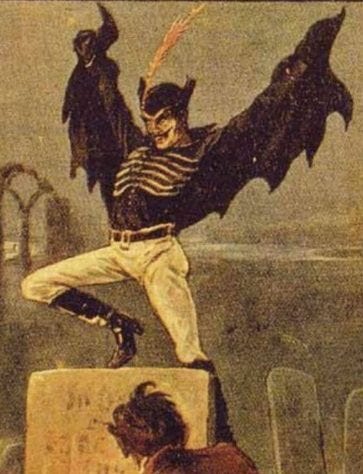
A man named Thomas Millbank reportedly boasted in a tavern that he was Spring-heeled Jack. That was not the wisest thing to announce while London was actively searching for him.
Millbank was arrested and investigated following the attack on Jane Alsop. His clothing apparently resembled portions of her description, and authorities had reasons to suspect he might have been involved.
There was one major problem. Jane insisted that her attacker had breathed fire. Millbank could not. Without an explanation for the flames, the case against him fell apart.
That strange discrepancy illustrates the difficulty at the center of the legend. There may have been a real attacker beneath the cloak.
A performer could conceivably have produced a burst of flame using chemicals or some concealed theatrical trick. London’s stages were already familiar with dramatic effects, disguises, and manufactured monsters.
But by the time authorities tried to identify the human being responsible, the criminal and the supernatural character had become inseparable.
Police were not merely searching for an attacker. The public expected them to capture a fire-breathing devil.
VICTORIAN PARKOUR
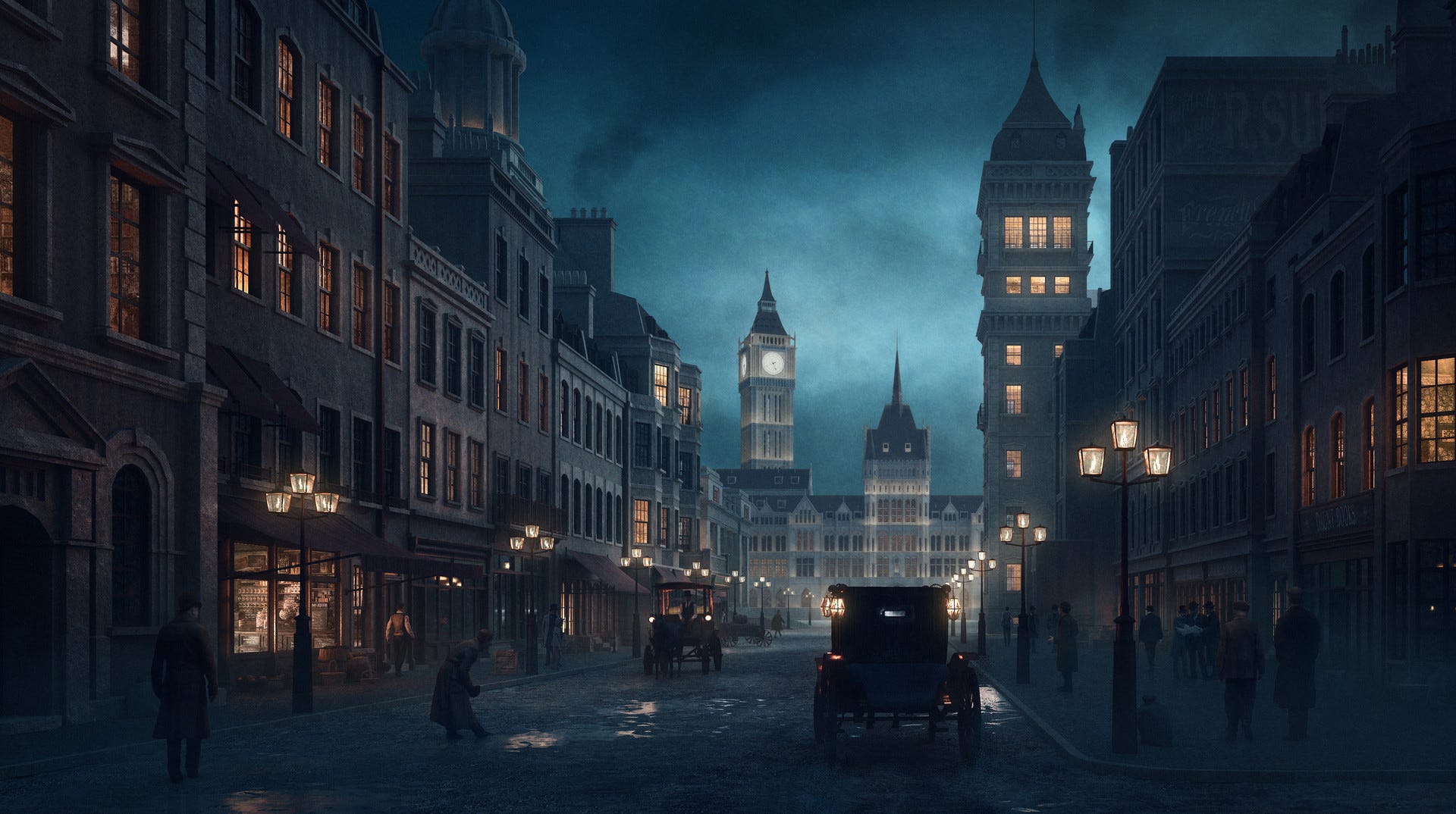
This is where Spring-heeled Jack separates himself from nearly every other monster of the period.
Jack did not merely run away. He moved through London differently from everyone chasing him.
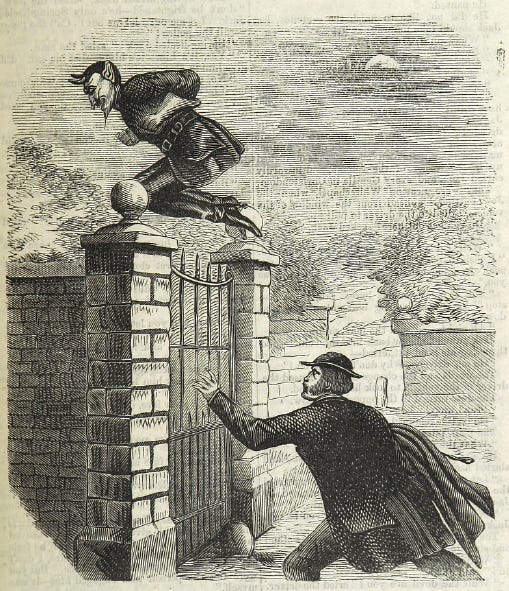
Walls did not contain him. Fences did not slow him. Rooftops became roads.
Witnesses claimed he could leap over gates, disappear across gardens, and clear obstacles no ordinary person could overcome.
That movement made him perfect for a rapidly changing city.
London was becoming larger, denser, and more anonymous. Neighborhoods were expanding beyond the old boundaries of the city. People traveled through unfamiliar streets filled with strangers, shadows, construction, and countless places where someone could hide.
Spring-heeled Jack transformed that architecture into part of the horror. He could appear beside a road, attack, clear a wall, and vanish into a maze of buildings.
In modern language, he sounds like a supernatural parkour runner.
But his jumping also gave him something monsters rarely possessed: Style.
Jack was not a lumbering creature shambling through the fog.
He was fast. Theatrical. Vertical.
He wore a recognizable costume and appeared to enjoy the chase. His ringing laughter made each escape feel less like panicked flight and more like a performance.
He did not simply haunt London. He performed for it.
WAS HE USING SPRING-LOADED BOOTS?
Victorians and later investigators naturally wondered whether Jack’s abilities came from some mechanical device.
Could someone have built spring-loaded footwear? Could an acrobat have used hidden equipment to launch himself over walls?
The explanation sounds reasonable until we consider what the machinery would actually have to accomplish.
A spring powerful enough to propel a person several feet into the air must also allow that person to land without destroying an ankle, knee, hip, or spine.
Launching upward is only half of the problem. Gravity handles the return trip.
There is no convincing evidence that anyone possessed practical boots capable of safely producing the enormous jumps attributed to Spring-heeled Jack.
That does not mean every leap was invented.
A skilled acrobat could have cleared walls or fences that appeared much larger in darkness. Frightened witnesses may have misjudged distances. Later storytellers could then increase the height every time the story was repeated.
A man jumps over a fence. The next person says it was a wall. The newspaper calls it a building. By the time the story reaches the other side of England, Jack is practically flying.
The likelier technology behind his impossible movement was a combination of athletic ability, darkness, terrified witnesses, exaggeration, and the greatest special-effects department of the nineteenth century: The newspaper.
THE MAD MARQUESS
Suspicion eventually fell upon Henry de La Poer Beresford, the Marquess of Waterford.
Waterford was infamous for drunken vandalism, violent practical jokes, reckless wagers, and behavior that earned him the nickname “the Mad Marquess.”
He fit the image described in the original letter: A wealthy young aristocrat frightening ordinary people for entertainment.
The theory is certainly tempting.
Waterford possessed the money to create an elaborate costume, the social position to avoid immediate consequences, and the reputation to make the entire performance believable.
But the identification came later. No solid evidence proves that Waterford was Spring-heeled Jack. He may have inspired part of the theory. He may have participated in similar pranks. Or his reputation may simply have made him the perfect man to blame.
The accusation nevertheless tells us something important about Victorian society. Jack was not always imagined as a poor criminal emerging from a dangerous neighborhood. Sometimes he represented the opposite: A wealthy young man using privilege, disguise, and mobility to terrorize people who could not stop him.
The monster may have been supernatural. The fear of unaccountable power was not.
THE MONSTER MULTIPLIES
Reports continued appearing long after the original London panic.
Jack—or figures identified as Jack—were blamed for incidents across Britain.
In 1847, a man named Captain Finch was convicted of assaulting women in Devon while reportedly wearing a disguise that included animal skin, horns, and a mask.
During the 1870s, renewed sightings were reported in places such as Sheffield and the military garrison at Aldershot.
At Aldershot, a strange figure allegedly approached a sentry, ignored his challenge, struck him, and escaped with enormous bounds. Shots were supposedly fired without stopping the intruder, although later versions disagree about whether the weapon contained live ammunition or whether anyone actually hit the figure.
Other sightings surfaced in Lincoln and Liverpool. Some accounts continued into the beginning of the twentieth century.
But this probably does not mean one immortal parkour demon spent nearly seventy years touring England. Spring-heeled Jack had become a recognizable identity anyone could borrow.
A prankster could dress like him. A criminal could use his reputation. A frightened witness could interpret something strange through the legend. A newspaper could attach his famous name to an otherwise unrelated incident.
The creature was no longer one possible man. He had become a costume Britain could place over any unexplained nighttime terror.
That is how an urban legend grows.
One story does not simply get repeated. It becomes a framework for understanding every strange event that follows.
THE PRINTING PRESS BUILDS A MONSTER
Spring-heeled Jack arrived at exactly the right moment.
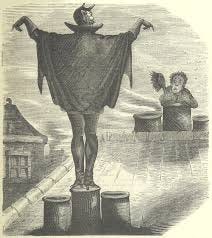
Britain’s growing newspaper industry allowed reports, rumors, and sensational claims to travel farther and faster than they could through conversation alone.
A frightening story from one neighborhood could reach readers across London. A London panic could become a provincial legend. A local prank could be interpreted through a name readers already recognized.
The newspapers did not necessarily invent Jack from nothing. But they gave him speed.
Each new report added another ability, costume detail, victim, or escape. Contradictions did not weaken the legend. They made it more adaptable.
Was Jack a ghost? A devil? A bear? A masked gentleman? A criminal in armor? The answer depended on which version someone encountered.
Spring-heeled Jack was never stable enough to be disproven because there was no single version to disprove.
Catch one prankster and another sighting could appear somewhere else. Explain one supposed jump and the next report would make him leap higher.
Jack escaped every explanation for the same reason he escaped every pursuer. The story refused to remain in one place.
FROM MONSTER TO SUPERHERO
Then Spring-heeled Jack made his strangest jump of all. He entered fiction.
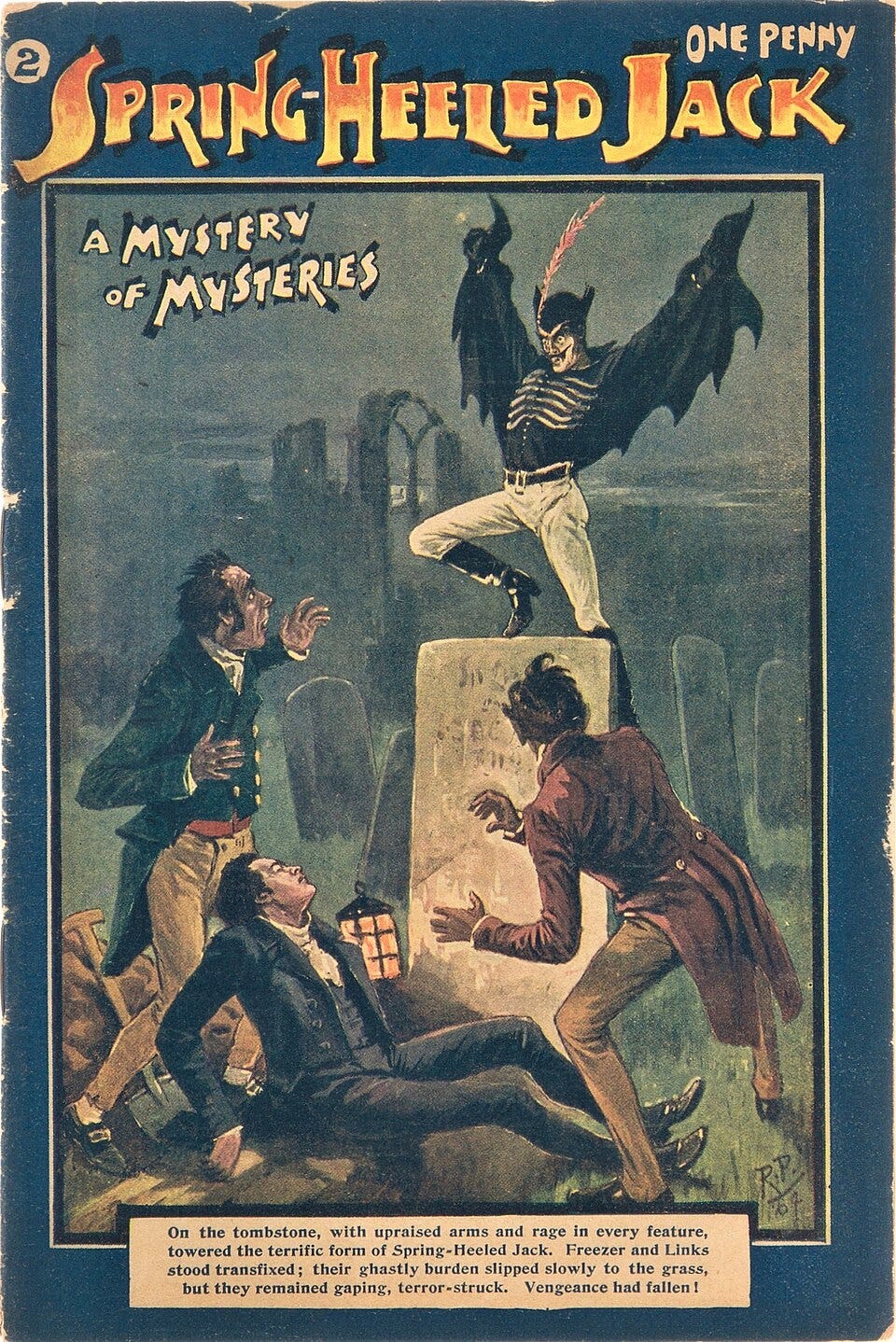
Stage productions, cheap serial stories, and penny dreadfuls transformed him from a reported attacker into an entertainment character.
At first, Jack remained terrifying. He was a villain. A demon. A creature stalking helpless people through the night.
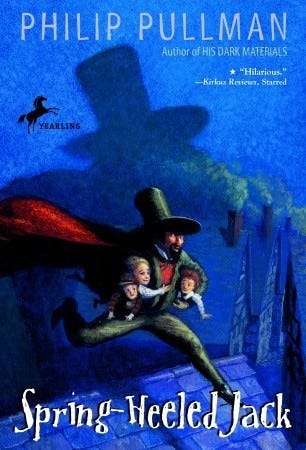
Over time, however, some writers reinvented him. Jack became a wronged aristocrat. A mysterious adventurer. A masked champion who protected vulnerable people and punished those who abused their power.
The frightening cloak remained. The secret identity remained. The extraordinary physical ability remained. The nighttime appearances remained.
But the villain became a hero. That sounds remarkably familiar.
Spring-heeled Jack began resembling the costumed vigilantes who would later dominate pulp magazines and comic books.
He was not “the first superhero” in any clean or uncontested sense. But he became part of the cultural road leading there.
Before Batman stalked rooftops in a cape, Victorian readers already had a mysterious nocturnal figure using fear, disguise, athletic movement, and a secret identity against his enemies.
The demon of London had become its protector.
WHY WE KEEP TELLING THIS STORY
Spring-heeled Jack could only have been born in a city caught between old superstition and modern mass media.
London wanted to consider itself advanced. Organized. Civilized. Too sensible to believe in demons.
Yet its streets still became dark at night. Its neighborhoods were expanding. Its population was growing.
Strangers could appear and disappear without anyone knowing their names. Newspapers could spread rumors faster than authorities could investigate them.
Jack belonged to both worlds. He looked like an ancient devil but behaved like a modern urban criminal. He wore claws and breathed fire, yet his legend spread through newspapers, commercial entertainment, and serialized fiction.
That may be why he remains fascinating.
He is not quite a ghost. Not quite a cryptid. Not quite a human criminal. Not quite a superhero.
Spring-heeled Jack exists in the moment when folklore learned how to navigate a modern city.
THE CTRL+BINGE CONNECTION
Spring-heeled Jack feels startlingly contemporary because movement defines him.
He treats walls as suggestions. He uses darkness, speed, elevation, and intimidation. He has a recognizable silhouette and what amounts to a superpower. He begins as an alleged monster, becomes a media sensation, and is eventually rewritten as an antihero.
That evolution sounds less like ancient folklore and more like the origin story of a modern franchise character. He contains pieces of the masked vigilante, the supervillain, the parkour hero, and the urban cryptid.
He would be equally at home in a gothic horror movie, an open-world video game, a Batman comic, or an anime about a supernatural assassin leaping across Victorian rooftops.
Victorian London did not merely create another ghost. It accidentally created a character capable of adaptation.
Every generation could give Jack a different motive, identity, costume, or morality. The one thing that never changed was the leap.
FINAL PUSH
Maybe Spring-heeled Jack was a violent prankster. Maybe he was several men borrowing the same disguise. Maybe frightened witnesses transformed ordinary jumps into impossible ones.
Or maybe Victorian London looked into the fog and saw something leap where no human being should have been able to go.
Whatever the truth, Jack escaped. Not over a wall. Into folklore.
THE QUESTION THAT LINGERS
What made Spring-heeled Jack supernatural:
The impossible things witnesses claimed he could do… or the fact that one frightened rumor learned to leap across an entire country?