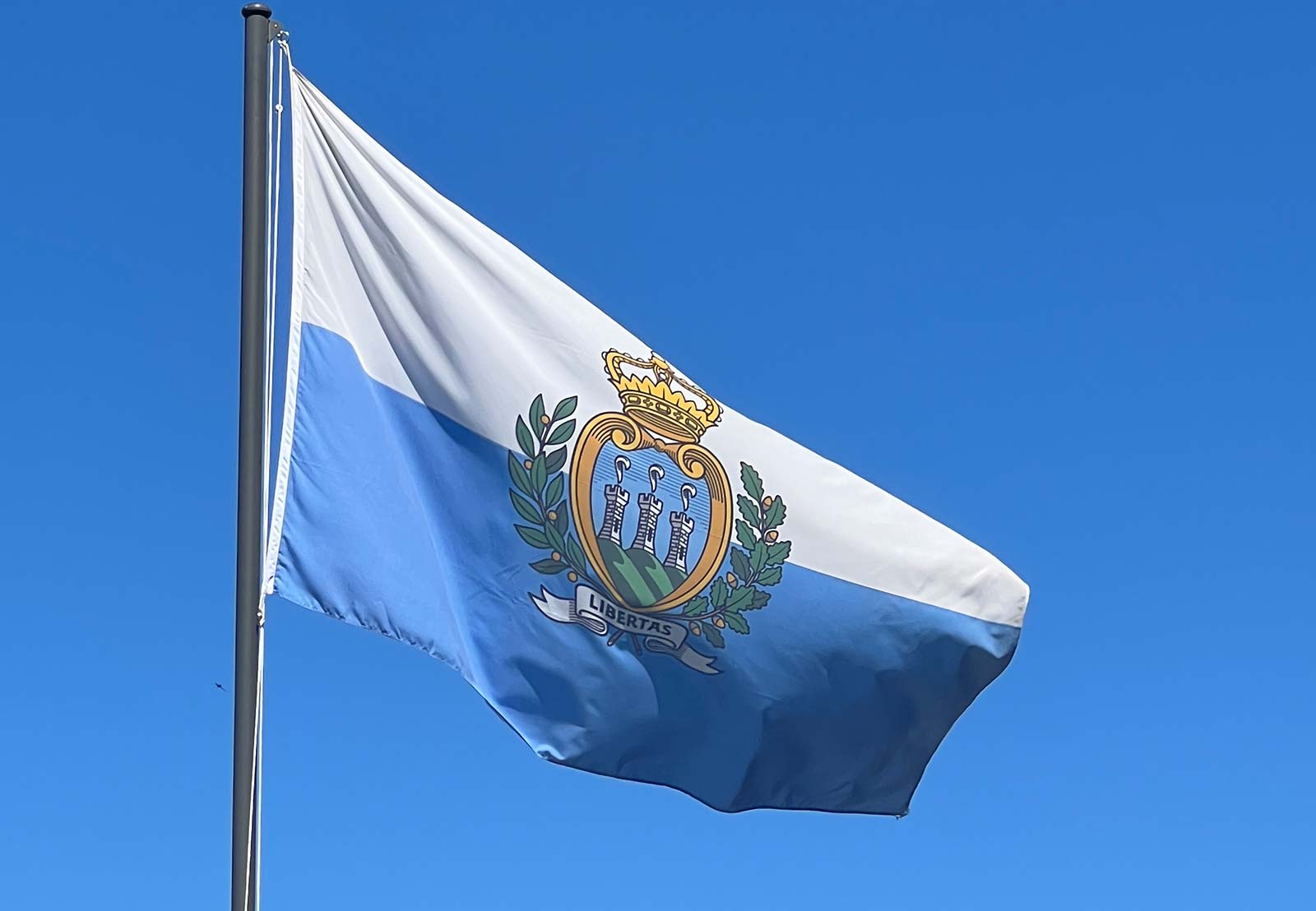
There is a little country inside Italy (technically, there are two. Not a province. Not a city with an unusual amount of local pride. An actual independent country…with its own government, laws, flag, military, Olympic team, national football squad, postage stamps, and two heads of state.
It covers approximately 61 square kilometres, or about 24 square miles. Roughly 34,000 people live there. You could drive across it without realizing you had just crossed an international border.
Yet San Marino claims a national story stretching back to September 3rd, 301.
That would mean its origins predate the collapse of the Western Roman Empire, the rise of Charlemagne, the Norman conquest of England, the Crusades, the Renaissance, and the existence of modern Italy by more than fifteen centuries.
Empires rose around it. Popes occupied it. Napoleon offered to make it larger. Italy unified on every side of it. And somehow, this tiny republic remained exactly where it was.
A Country Inside a Country
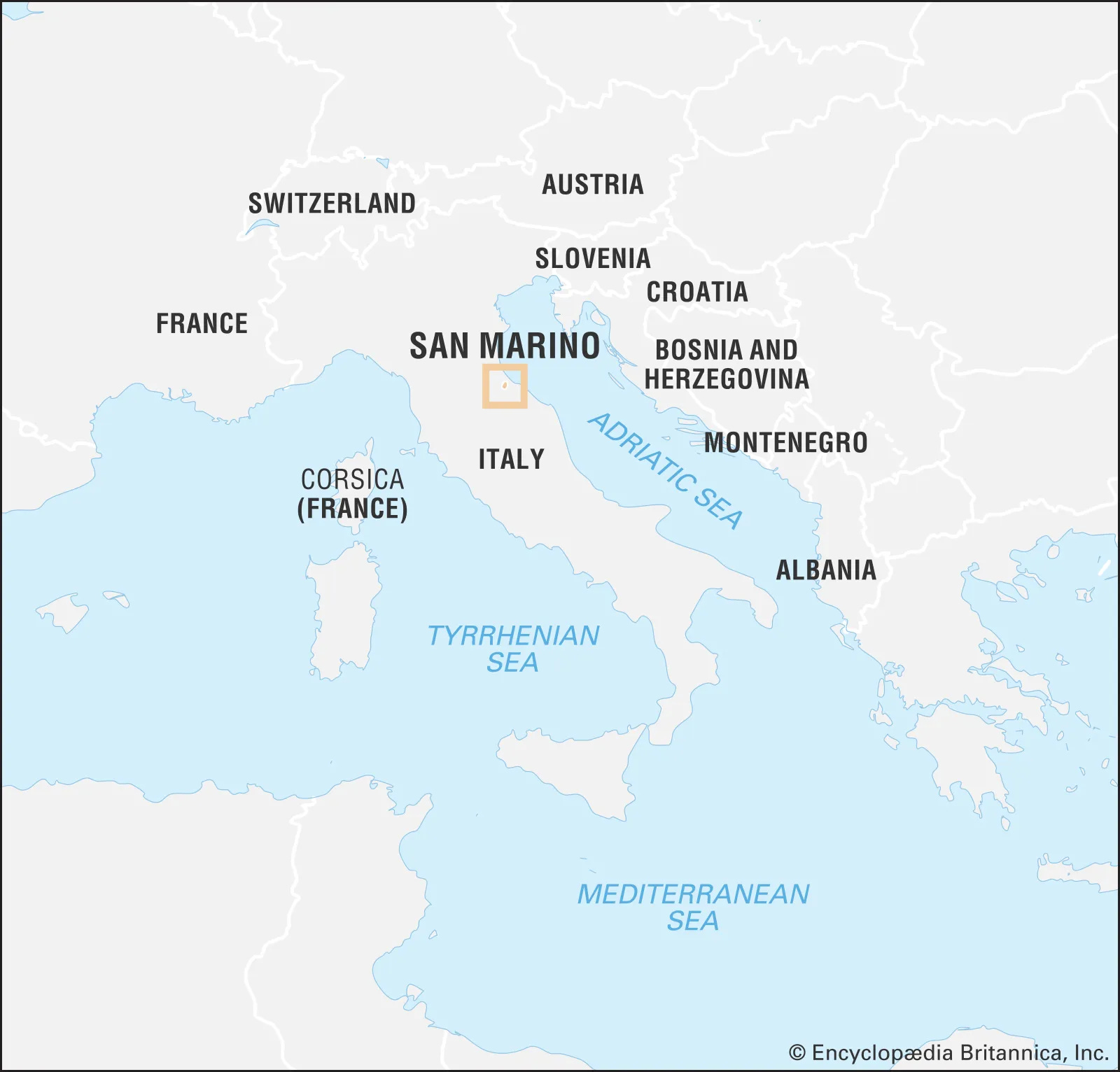
San Marino is one of only three countries in the world completely surrounded by another country.
The other two are Vatican City, also enclosed by Italy, and Lesotho, surrounded by South Africa.
Unlike Vatican City, San Marino is not merely a religious headquarters given sovereign status. It is a collection of nine municipalities spread across hilly territory near Italy’s Adriatic coast.
Its capital, also named San Marino, climbs the slopes of Mount Titano beneath three medieval towers that look like someone built a fantasy kingdom and forgot to remove it when the movie ended.
The country’s official name is the Most Serene Republic of San Marino.
Its residents speak Italian. They use the Euro. They share deep historical, cultural, and economic connections with Italy.
But they are not Italian citizens living in an unusually independent town. They are Sammarinese.
Their country is a sovereign member of the United Nations. It establishes diplomatic relations, signs treaties, sends athletes to international competitions, and elects its own parliament.
The obvious question is not what San Marino is. The obvious question is how it is still here.
The History-Class Version
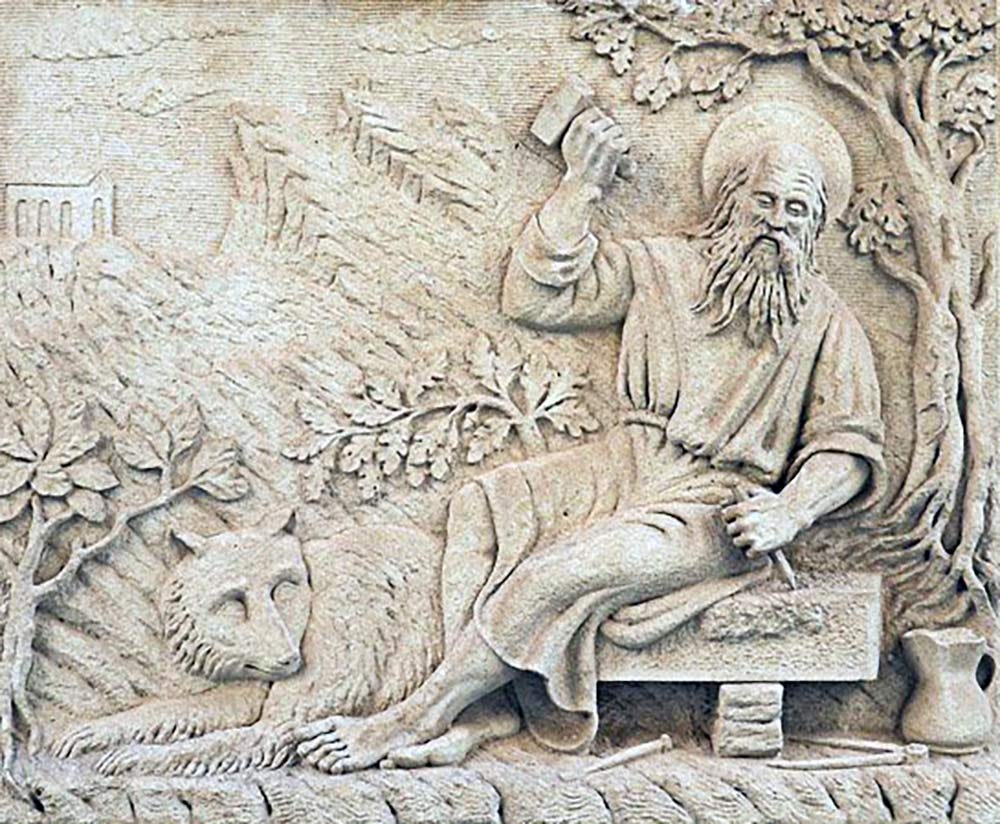
According to San Marino’s traditional founding story, everything began with a Christian stonemason named Marinus.
Marinus came from the island of Rab, off the coast of what is now Croatia. Tradition says he crossed the Adriatic and worked near Rimini before escaping religious persecution under the Roman emperor Diocletian.
He eventually climbed Mount Titano and established a small Christian community.
San Marino celebrates September 3, 301 as the founding date of that community and, by extension, the beginning of the republic.
Marinus was later recognized as a saint. The community took his name, preserved his memory, and supposedly inherited his commitment to living free from outside control.
It is a wonderful national origin story.
One humble stonecutter climbs a mountain to escape an empire. The empire eventually disappears. The stonecutter’s community remains.
There is just one complication.
September 3, 301 is a traditional date, not one confirmed by contemporary Roman records.
Even San Marino’s own historical materials treat the story of Marinus as legend.
That does not mean Marinus never existed or that no early Christian community developed on Mount Titano. It means the clean founding date belongs to national memory rather than firmly documented history.
The earliest surviving document describing an organized community on Mount Titano dates to 885, nearly six centuries after San Marino’s traditional birthday.
The republic we can recognize through surviving laws and institutions emerged later still, during the medieval world of Italian communes and city-states.
So, is San Marino really a country founded in 301? Traditionally, yes.
Documentarily, things get more complicated.
But even if we begin its continuous political story in the Middle Ages, San Marino’s survival remains astonishing.
From Stonecutter to City-State
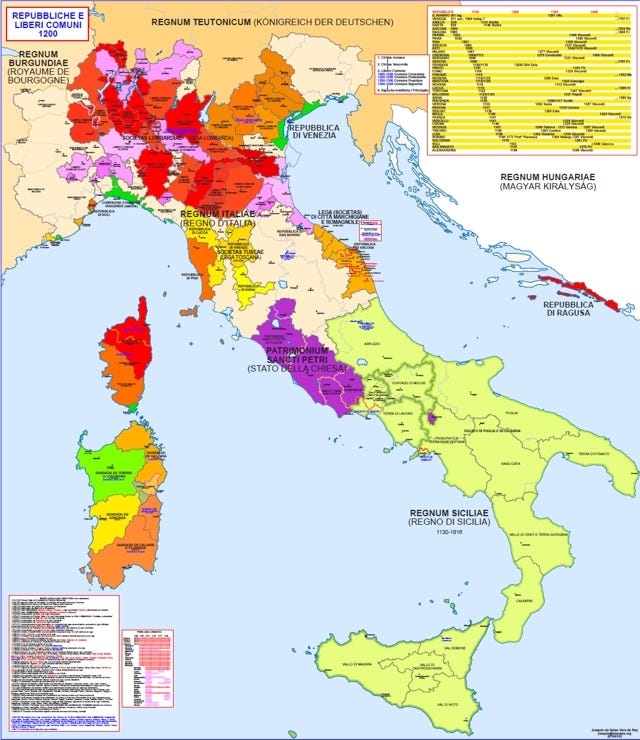
Medieval Italy was not one unified country.
The peninsula was divided among kingdoms, republics, duchies, communes, noble families, territories controlled by the pope, and lands claimed by outside powers.
Cities such as Venice, Florence, Genoa, and Milan developed governments, armies, alliances, rivalries, and commercial networks of their own. San Marino grew inside that fractured political world.
Its people initially governed themselves through the Arengo, an assembly composed of the heads of local families. As the community expanded, it developed new offices and written laws.
In 1243, San Marino appointed the first two officials who evolved into its Captains Regent.
Two leaders. Sharing power. Serving together. For only six months.
We will come back to that beautifully distrustful political arrangement.
San Marino’s early statutes appeared during the thirteenth century. They were revised repeatedly, culminating in the Statutes of 1600, which remain part of the foundation of the country’s constitutional system.
Its present borders were largely established in 1463, when San Marino gained several surrounding communities after supporting a successful alliance against the Malatesta rulers of Rimini.
Then it did something many states throughout history have found nearly impossible. It stopped expanding.
San Marino found borders it could defend and decided they were enough.
How Do You Keep a Tiny Country Alive?
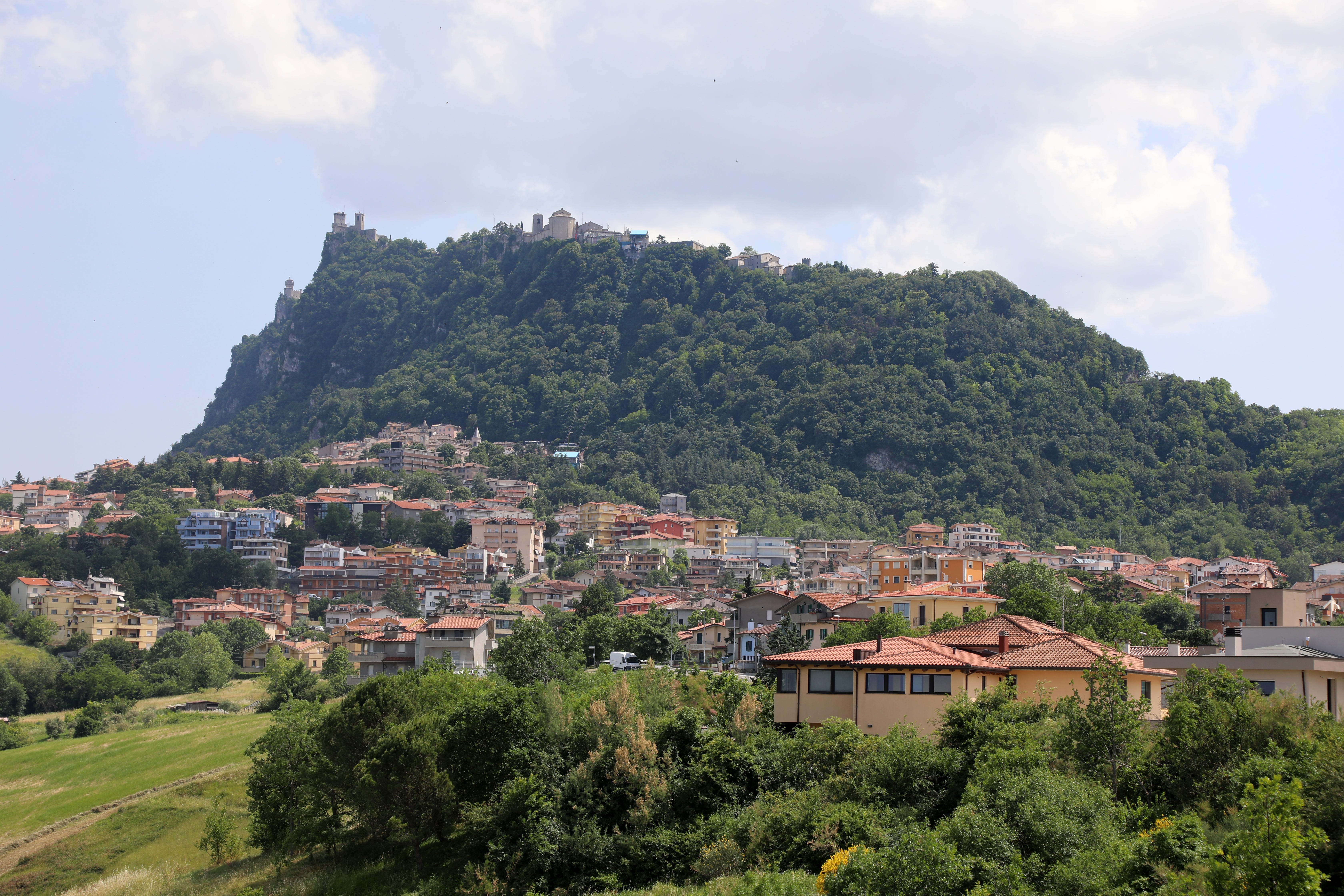
Mount Titano helped.
A fortified community sitting on steep, elevated ground was harder to conquer than a settlement spread across an open plain. San Marino’s towers, walls, and terrain provided protection.
But geography alone does not preserve a country for centuries.
San Marino also learned how to be small without appearing weak and independent without appearing dangerous.
It maneuvered among larger neighbors, negotiated with rulers, maintained relationships with the Papacy, and avoided giving powerful states too many reasons to destroy it.
That did not mean everyone left it alone.
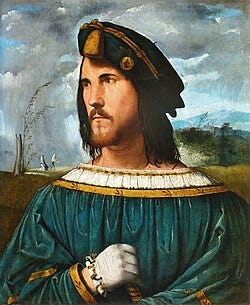
- Cesare Borgia occupied San Marino in 1503 during his attempt to carve out a powerful state in central Italy. His control lasted only a matter of months before his political fortunes collapsed following the death of his father, Pope Alexander VI.
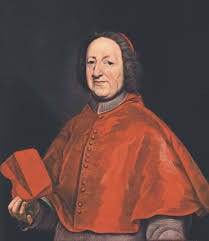
- In 1739, Cardinal Giulio Alberoni occupied the republic on behalf of the Papal States. San Marino appealed to Pope Clement XII, who restored its independence the following year.
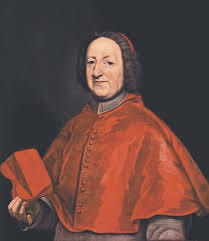
The republic survived both occupations.
Not because it possessed an army capable of defeating Europe’s great powers, but because it understood that military resistance was only one form of survival.
San Marino’s most effective weapons were geography, diplomacy, patience, political usefulness, and the ability to remain too respectable to erase.
Then Napoleon arrived.
Napoleon Offers San Marino a Bigger Country
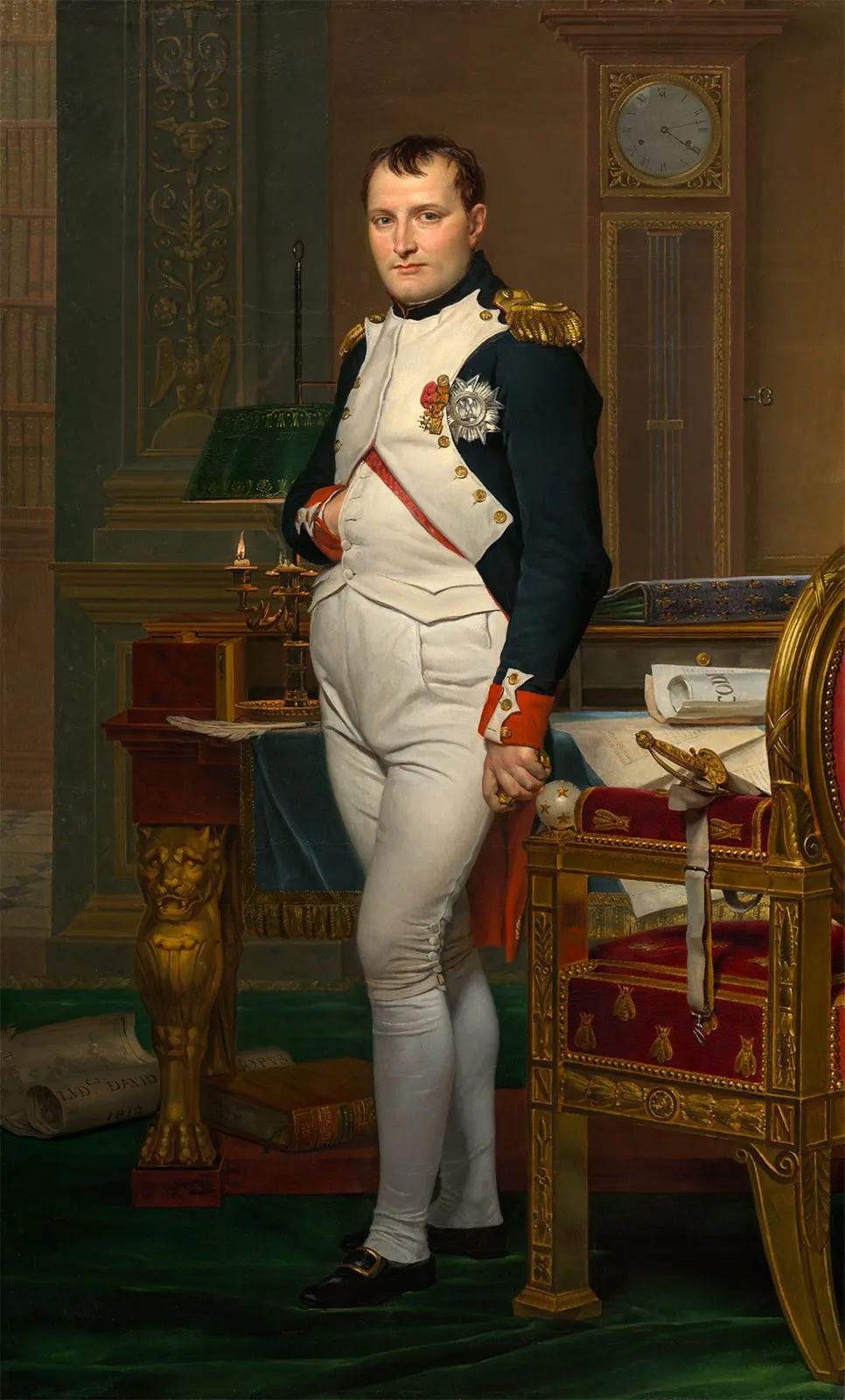
In 1797, Napoleon Bonaparte was remaking the political map of Italy. States disappeared. Governments fell. Borders moved according to French power and Napoleon’s plans. San Marino had every reason to be terrified.
Instead, Napoleon respected the republic. He offered it friendship, gifts, and reportedly enough additional territory to extend San Marino toward the Adriatic Sea.
For a country with no coastline, limited land, and little room for expansion, the offer must have been tempting. San Marino declined.
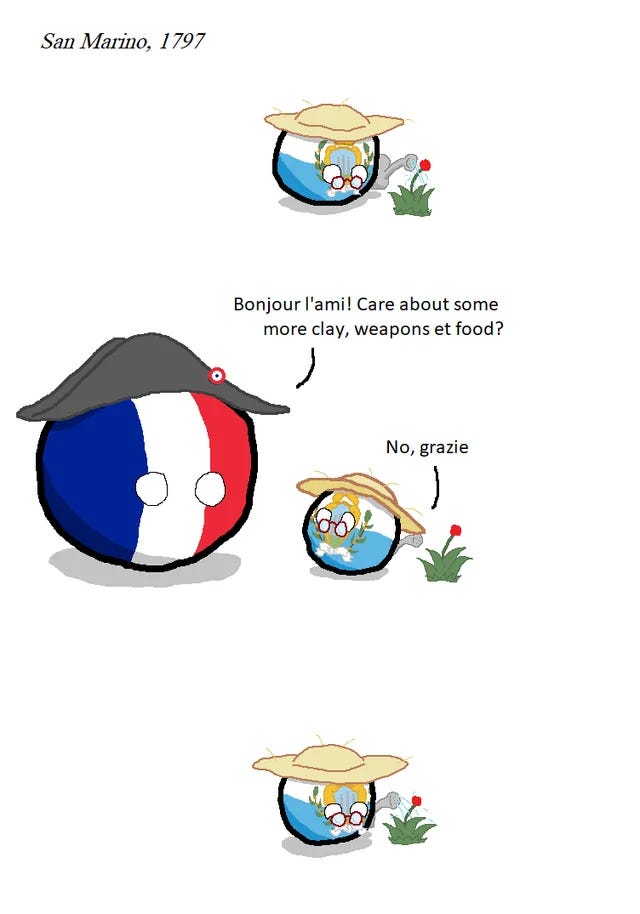
Its leaders said they were satisfied with the borders they already possessed. That may have been one of the smartest decisions in the country’s history.
Accepting Napoleon’s offer would have meant taking territory from someone else. It could have created enemies, border disputes, and future demands that San Marino return land acquired through French conquest.
Napoleon would not remain in power forever. San Marino understood that.
Instead of tying its future to the ambition of Europe’s most powerful man, the republic chose to remain small.
Napoleon conquered much of Europe. San Marino survived Napoleon.
The Favor Garibaldi Remembered
The next great threat came from the creation of modern Italy.
During the nineteenth century, revolutionaries and political leaders fought to unite the peninsula’s kingdoms, duchies, republics, and papal territories into a single Italian state.
A tiny independent republic sitting in the middle of that project could easily have become collateral damage.
Then San Marino made another decision that paid historical dividends.
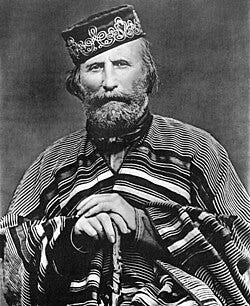
In 1849, Giuseppe Garibaldi and approximately 2,000 followers were fleeing Austrian and papal forces after the collapse of the revolutionary Roman Republic.
San Marino gave them refuge.
Its leaders then negotiated carefully enough to prevent pursuing forces from turning the situation into a battle inside Sammarinese territory. Garibaldi and his surviving followers were given time to disperse and escape.
San Marino had protected one of the men who would become a hero of Italian unification.
Garibaldi remembered.
When Italy became a unified kingdom in 1861, San Marino was not absorbed. The two countries signed a convention the following year establishing formal relations and recognizing San Marino’s place alongside its much larger neighbor.
That same era produced one of the strangest diplomatic friendships in the republic’s history.
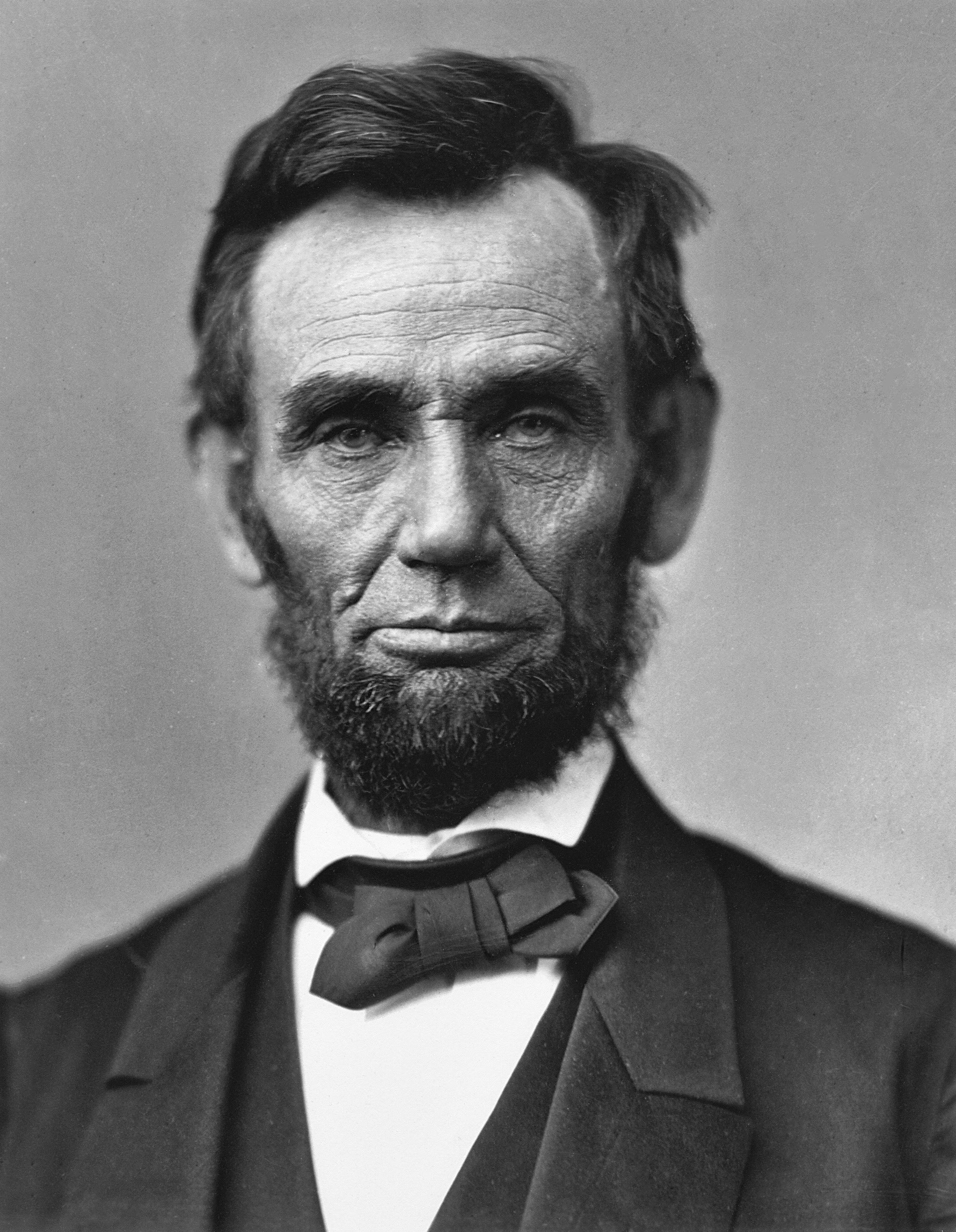
San Marino granted honorary citizenship to Abraham Lincoln.
Lincoln responded by praising the little republic, writing: “Although your dominion is small, your State is nevertheless one of the most honored in all history.”
The president of a young republic fighting to preserve itself recognized something familiar in an ancient republic that had spent centuries doing exactly that.
Surrounded by Fascism
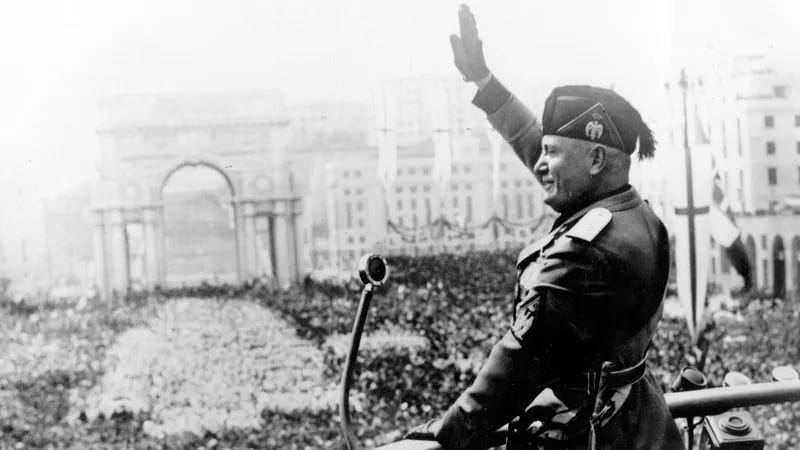
San Marino’s survival story is not one uninterrupted tale of perfect democracy.
A Sammarinese Fascist Party controlled the country’s political life from the 1920s into the 1940s, heavily influenced by Benito Mussolini’s Italy.
San Marino officially remained neutral during World War II, but geography made true separation from the conflict almost impossible.
The country became a refuge for enormous numbers of displaced Italians. San Marino maintains that approximately 100,000 people sought shelter there during the war—even though the republic’s own population was only around 15,000.
In June 1944, Allied aircraft bombed San Marino amid reports that German forces were using its territory. Dozens of civilians were killed.
Later that year, German troops entered the republic, and Allied and German forces fought across Sammarinese territory during the Italian campaign.
San Marino survived the war. Again.
Neutrality had not made it untouchable. Independence had not protected it from the violence surrounding it.
But when the armies moved on, the republic remained.
Two Heads Are Better Than One…For Six Months
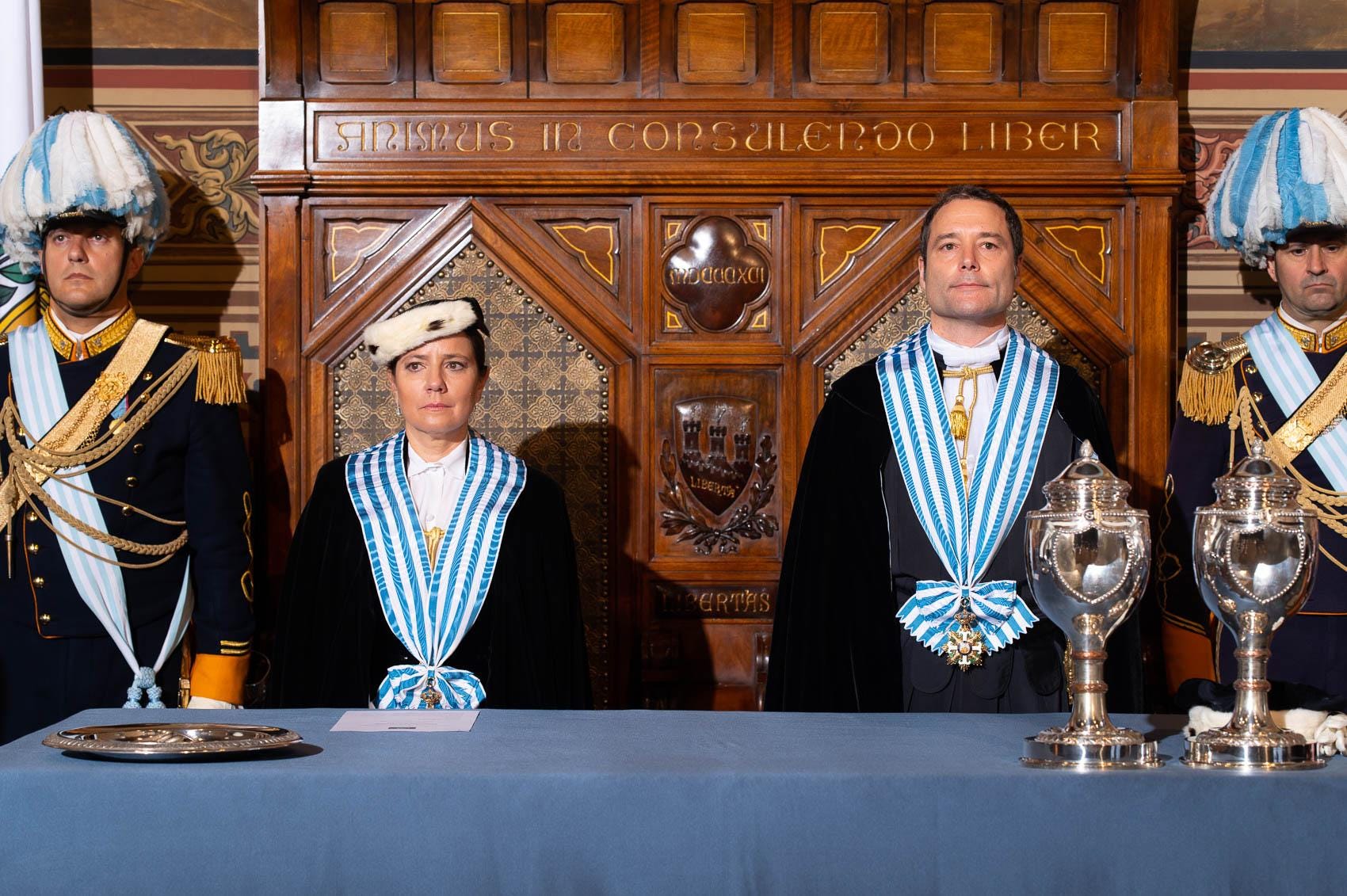
San Marino’s modern political system may be its greatest contribution to the international collection of wonderfully strange governments.
The country has a 60-member parliament called the Great and General Council.
That council elects two Captains Regent, who serve together as San Marino’s heads of state.
Their term lasts six months.
Not four years. Not six years.
Six. Months.
New Captains Regent take office every April 1 and October 1 in an elaborate investiture ceremony.
The system descends from the officials appointed in 1243 and reflects a political idea found in ancient Rome and medieval Italian republics: power is safer when divided, shared, and quickly returned to the public.
No single leader gets much time to build a personal throne. No one person formally represents the entire republic alone. The result is less a presidency than a temporary civic responsibility.
For a country founded upon suspicion of outside control, it makes sense that San Marino would also be cautious about concentrating power inside its own walls.
How Does a Country This Small Make Money?
The easy answer is tourism.
San Marino’s mountain views, medieval towers, historic streets, museums, ceremonies, stamps, and collectible coins attract visitors from nearby Italy and around the world.
The country uses the Euro despite not being a member of the European Union. Through agreements with the EU, it can issue limited quantities of Sammarinese Euro coins.
Because those coins are produced in comparatively small numbers, collectors want them.
San Marino also produces its own postage stamps, turning the symbols of sovereignty into products people will pay to own.
Banking and financial services became another major part of the economy, aided by the country’s independence and close connections to Italy. But the banking sector grew too large, developed serious vulnerabilities, and contracted after the global financial crisis.
Here is the surprising part. San Marino is not merely an ancient fortress supported by banks, tourists, and gift shops. It manufactures things.
Manufacturing accounts for roughly one-third of the country’s economic output, about one-third of its employment, and more than half of its exported goods. Its companies produce machinery, electronics, ceramics, furniture, clothing, construction materials, and other specialized products.
Tourism and services remain important. So do retail, finance, technology, and cross-border commerce with Italy.
Thousands of workers commute into San Marino from surrounding Italian communities.
The country may be tiny, but its economy functions less like an isolated medieval relic and more like a compact industrial district with its own foreign policy.
Is San Marino a Major Player at Anything?

Politically, San Marino is not directing the affairs of Europe. Militarily, it is not frightening anyone. Its men’s national football team spent decades ranked among the weakest in the world. But influence is not always measured by territory, population, or firepower.
San Marino is a major player in survival.
It preserves one of the world’s longest republican traditions. Its government still carries institutions developed during the Middle Ages. Its historic centre and Mount Titano are recognized by UNESCO as evidence of the continuity of an independent republic dating back to the thirteenth century.
It also possesses one of the greatest Olympic efficiency stories ever told.
San Marino sent five athletes to the Tokyo Olympics. They brought home three medals.
Alessandra Perilli won bronze in women’s trap shooting, becoming the first Sammarinese athlete to win an Olympic medal. Her achievement made San Marino the smallest country by population ever to reach an Olympic podium.
Then Perilli and Gian Marco Berti won silver in mixed-team trap.
Myles Amine added bronze in freestyle wrestling.
Five athletes. Three medals.
For one glorious Olympic Games, the tiny republic turned medals per capita into a competitive event and absolutely dominated it.
Even the football team finally had its moment.
In 2024, San Marino defeated Liechtenstein (another tiny nation) to earn its first competitive victory. It later beat Liechtenstein again, this time 3–1 on the road to win its Nations League group and earn promotion from League D to League C.
San Marino spent more than seventeen centuries surviving Europe. Apparently, Liechtenstein was the final boss.
Why San Marino Matters
San Marino is easy to treat as a novelty.
A country small enough to cross during lunch. A medieval skyline surrounded by modern Italy. A football team people support because winning a single match feels historic. But San Marino represents something much larger than its borders.
History usually rewards expansion. We remember the empires that conquered the most territory, commanded the largest armies, and placed the greatest number of people beneath one flag.
San Marino followed a different strategy. It survived by understanding its limits.
It defended itself when necessary, negotiated when possible, sheltered people when doing so reflected its values, and resisted opportunities to become larger when expansion threatened its future.
Its great national accomplishment was not conquering its neighbors. It was preserving enough space for its people to continue governing themselves.
Sixty-One Square Kilometres of Stubborn Independence
Maybe Saint Marinus founded a Christian community on Mount Titano in 301. Maybe the precise date emerged later as history blended with religious tradition and national memory.
Either way, the community associated with his name became something extraordinary.
Empires rose around it. Popes occupied it. Napoleon offered to enlarge it. Garibaldi sought shelter within it. Italy formed around it. Fascism reached inside it. War passed through it.
And San Marino remained exactly where it was: Sixty-one square kilometres of mountain, memory, and stubborn independence.
The Ctrl+Binge Question
If you had governed San Marino in 1797, would you have accepted Napoleon’s offer of more territory—or kept the republic exactly as small as it was?