He went up the mountain.
Just to get away for a bit.
Had a drink.
Fell asleep.
And when he woke up…
The world had changed.
The Story Everyone Knows
If you’ve ever heard of Rip Van Winkle, you probably remember the basics.
Rip is a laid-back, good-natured guy living in a small village in colonial America. He’s not lazy exactly… just not interested in responsibility. Especially not the kind his wife keeps reminding him about.
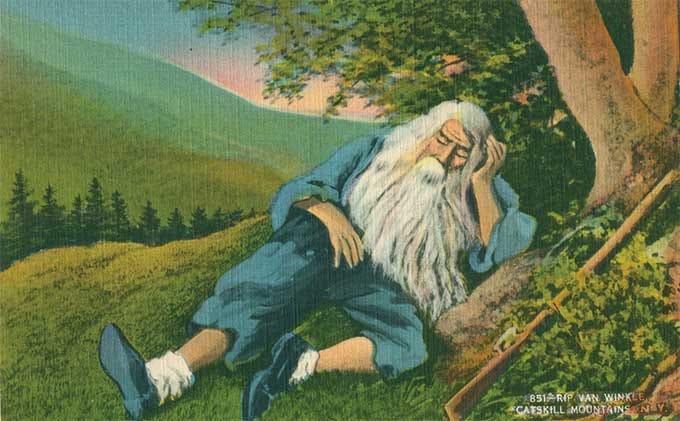
So one day, he heads into the mountains — the Catskills — to get some peace and quiet.
Up there, he meets a strange group of men playing a silent game of ninepins. They offer him a drink.
He takes it.
He falls asleep.
And when he wakes up… it’s been 20 years.
His beard is long. His gun is rusted. His village is different. The American Revolution has happened. The king’s portrait is gone. The entire identity of the place has shifted.
Rip didn’t just take a nap.
He skipped an era.
That’s the version we all remember.
But that’s not all there is to it.
When Washington Irving published Rip Van Winkle in 1819, America itself was still figuring out what it was.
This wasn’t just a quirky short story.
It was one of the first pieces of distinctly American folklore — built intentionally.
Irving wasn’t just telling a tale.
He was creating mythology for a brand-new country.
The mysterious men Rip encounters in the mountains?
They’re often interpreted as the ghosts of Henry Hudson and his crew — figures tied to early exploration of the Hudson River.
That matters.
Because it places Rip’s sleep right between two worlds:
- The old, colonial past
- The new, independent America
Rip doesn’t just wake up in a different time.
He wakes up in a different identity.
And Rip himself?
He’s not exactly a hero.
He avoids responsibility.
He escapes conflict.
He drifts.
His “reward” is essentially time travel — but without any control over it.
And when he comes back?
He doesn’t adapt.
He just… tells his story.
And becomes a local legend.
That’s a very different kind of protagonist.
There’s also a quieter reading of the story.
Rip’s wife — often portrayed as nagging or harsh — represents structure, expectation, responsibility.
The mountains represent escape.
Rip chooses escape.
And the cost?
He loses 20 years of his life.
That’s not magic.
That’s consequence.
And then there’s the ambiguity.
Did Rip really sleep for 20 years?
Was it supernatural?
A dream?
A tall tale he told to explain disappearing?
Irving never confirms it.
Because the uncertainty is the point.
The story works whether you believe it or not.
Why It Matters
Rip Van Winkle endures because it taps into something very human.
The desire to pause.
To step away.
To skip the hard parts.
To wake up when things are different.
It’s the fantasy of escape.
But it also asks a quiet question:
What do you lose when you check out?
Time doesn’t stop just because you do.
And when you come back…
You don’t always recognize the world — or your place in it.
The Modern Connection
Rip Van Winkle shows up everywhere — even if we don’t call it that.
Any story where someone “misses time” echoes it:
- Characters waking up in the future
- Time skips in anime and games
- Even memes about “I blinked and 10 years passed”
It’s the same core idea:
You weren’t ready for change…
so change happened without you.
In a world that moves faster every year, that hits even harder now.
Question for Readers
If you could skip ahead 20 years…
No stress. No struggle. Just wake up in the future…
Would you take that deal?
Or is living through the time… the whole point? 😴