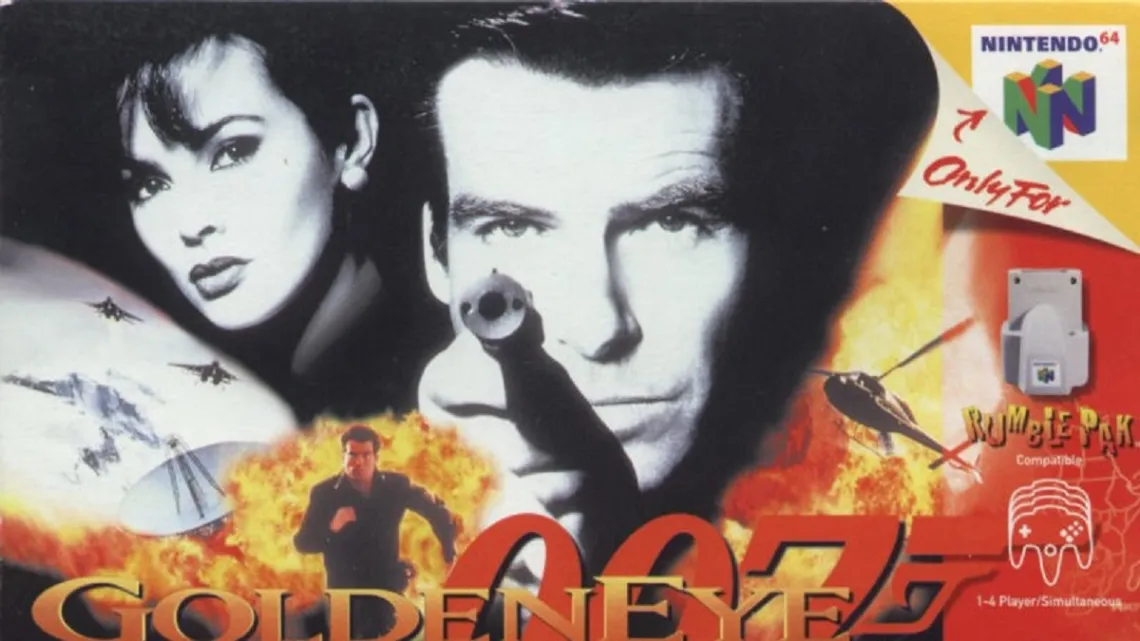
The first rule was simple:
NO LOOKING AT MY SCREEN.
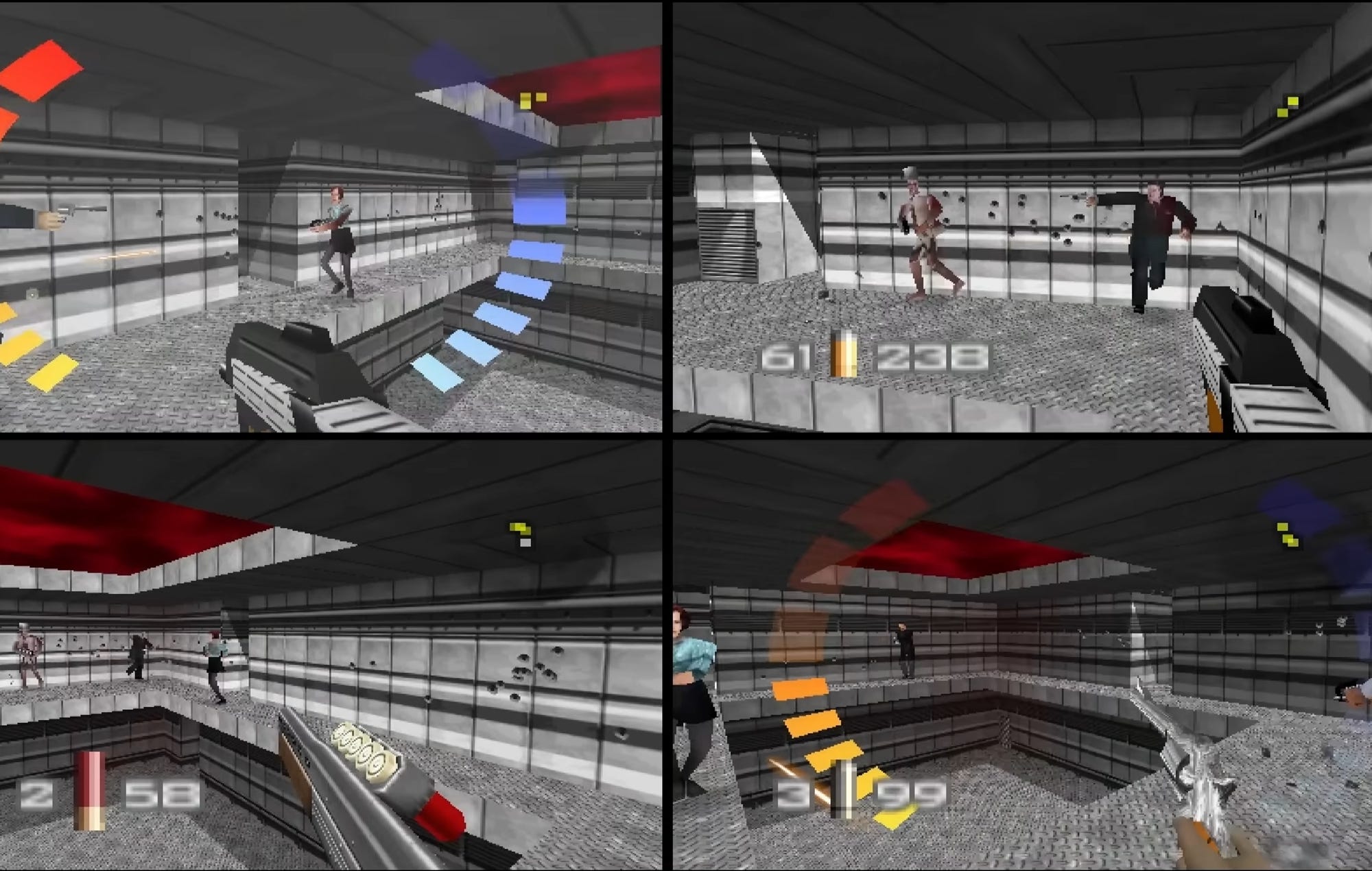
Before Halo became the console-FPS standard, there was a room full of kids staring at four tiny rectangles on a CRT.
Facility. Archives. Complex. Proximity mines. Slappers only. Somebody picking Oddjob and immediately becoming a war criminal.
The GoldenEye Everyone Remembers
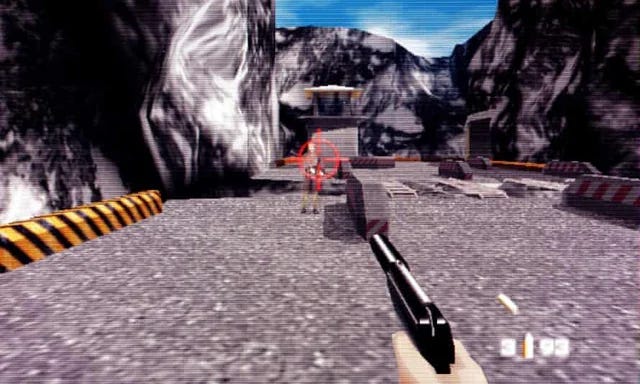
For an entire generation, GoldenEye 007 is remembered less like a video game and more like a place.
It was the floor in front of a television. The N64 controller resting awkwardly in your hands. Four players sharing one screen while each person made an extremely serious promise not to look at the other three sections.
Nobody kept that promise.
Someone knew exactly where the body armor spawned. Someone always wanted explosives. Someone insisted they had not been watching your screen despite turning the corner already firing. And if the player using Oddjob won, the victory was immediately placed under protest.
That is the familiar version of GoldenEye: a multiplayer phenomenon powered by proximity mines, karate chops, house rules, accusations, and friendships that somehow survived all of it.
That version is completely true.
It is also only half the cartridge.
More Than Four Tiny Screens
Released for the Nintendo 64 in 1997, GoldenEye 007 did not merely overcome the reputation of licensed games. It helped demonstrate that a first-person shooter could feel at home on a console.
The genre already existed there. Games such as Doom and Turok had made the trip from computer monitors to television screens. GoldenEye was not the first console shooter, and its control scheme was not the final answer.
What it did was make the genre understandable, social, and personal to millions of players who had never considered themselves PC-shooter fans.
GoldenEye taught them how to read a three-dimensional combat space. It asked them to learn patrol routes, prioritize targets, manage ammunition, aim under pressure, memorize maps, and understand how sound could bring an entire room of guards crashing down on them.
Then it handed them three more controllers.
Bond Gets a Mission, Not a Shooting Gallery
Rare could have simply recreated the largest action scenes from the 1995 movie and called it a day.
Instead, the developers asked what playing as James Bond should actually feel like.
The answer was not constant gunfire. Bond infiltrates facilities, photographs evidence, plants trackers, rescues hostages, meets contacts, destroys equipment, steals documents, and uses gadgets supplied by Q Branch. Sometimes the correct move is to shoot. Sometimes pulling the trigger on the wrong person or computer can fail the mission.
That objective-based structure separates GoldenEye from the corridor shooters surrounding it. Each level feels like an assignment rather than an obstacle course. The Dam, Facility, Bunker, Archives, Jungle, Control, and Cradle are not simply collections of enemies. They are locations Bond must understand.
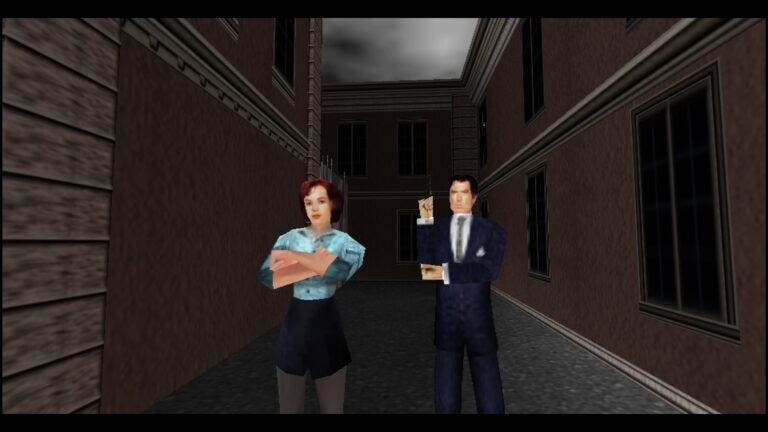
The game follows the movie’s battle against Alec Trevelyan and the GoldenEye satellite, but it expands that story by allowing players to inhabit its spaces. Bond is joined by Natalya Simonova, threatened by Xenia Onatopp and General Ourumov, irritated by Boris Grishenko, and briefed by M, Q, and Moneypenny.
The character models may be blocky and the storytelling economical, but the fantasy is remarkably complete:
You are not watching Bond escape the Facility.
You are finding the door decoder, planting the explosives, trying not to shoot Dr. Doak, and escaping it yourself.
Difficulty That Changes the Assignment
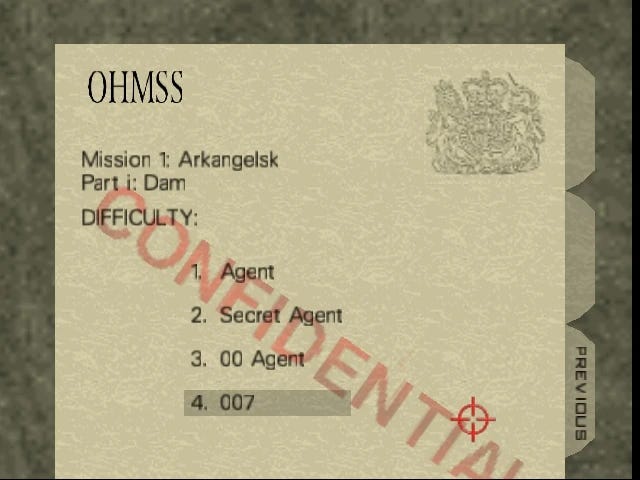
One of GoldenEye’s smartest ideas is also one modern games rarely imitate.
Changing the difficulty does not merely give enemies more health or make their bullets hurt more. Moving from Agent to Secret Agent and then 00 Agent adds objectives to the mission.
A straightforward escape becomes a larger operation. A room that could previously be ignored may contain equipment that must be photographed, destroyed, or recovered. The player must explore more carefully and understand how every part of the level connects.
Difficulty changes the assignment itself.
That system gives the campaign unusual replay value. Completing a stage once does not mean the player has seen everything it asks of them. Timed challenges can also unlock cheats, turning familiarity with a mission into its own form of progression.
The game rewards mastery without needing an experience bar. You become stronger because you become a better agent.
Guards Who Notice You
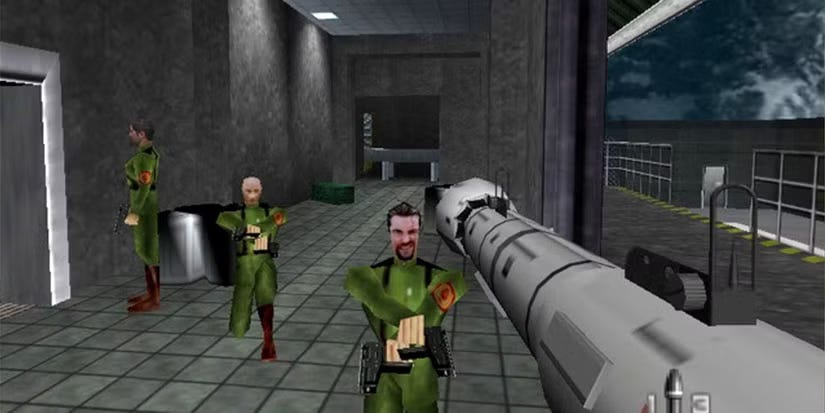
GoldenEye also understood that enemies did not need brilliant artificial intelligence if they could convincingly react to the player.
Guards patrol, investigate sounds, activate alarms, surrender, flee, roll away from gunfire, or stagger differently depending on where they have been hit. Fire a quiet weapon carefully and Bond may remain undetected. Charge through a hallway spraying bullets and reinforcements can turn a controlled operation into panic.
Those reactions make every encounter readable.
Shoot a guard in the arm and he grabs it. Hit him in the leg and his body responds. Knock off a hat, trigger an alarm, or alert someone in another room, and the game immediately communicates that something has changed.
The stealth is simple by modern standards, but it gives the player options. You can move carefully and feel like a professional agent—or fire the KF7 Soviet in a concrete hallway and discover that subtlety has officially left the building.
Either way, the game reacts.
The Multiplayer That Was Never Supposed to Rule the World
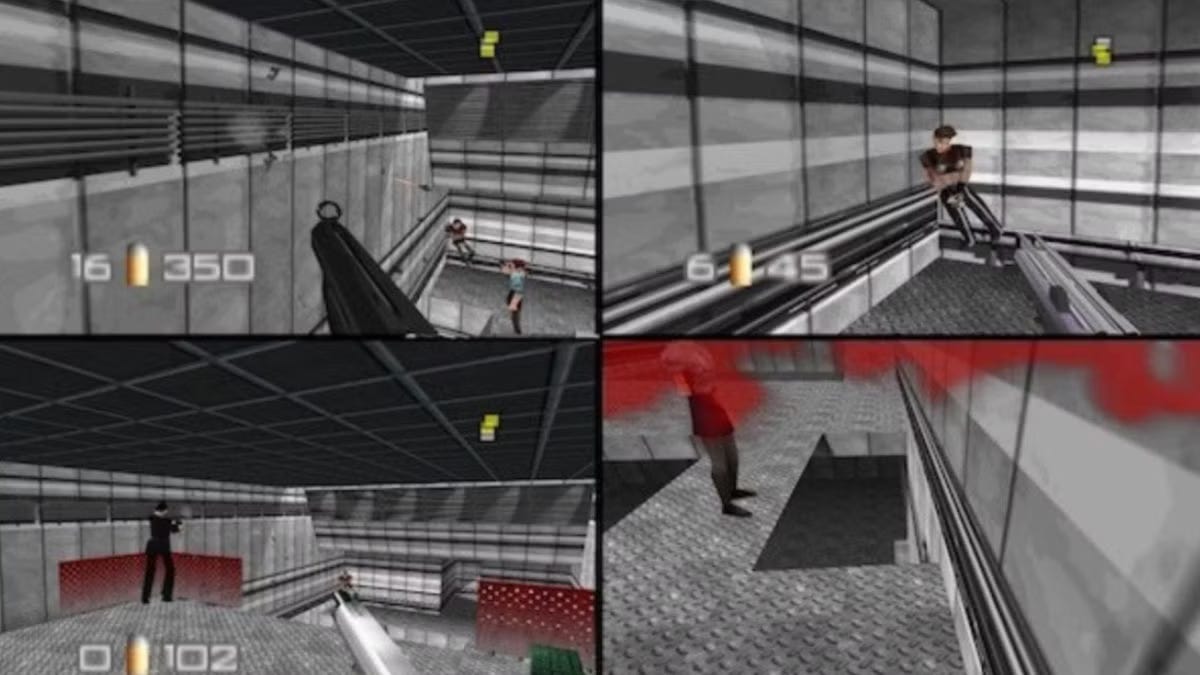
Then there is multiplayer.
The mode that would define countless weekends was added remarkably late in development. Programmer Steve Ellis built much of it in the final stretch, without the kind of prolonged planning or executive supervision we would expect for the game’s most culturally enduring feature.
Perhaps that explains why it feels like a toy box.
Characters, weapons, arenas, and rule sets can be mixed into matches that are competitive, ridiculous, or both. You can hunt the player carrying the Golden Gun, fight over flags, limit the arsenal, fill a map with explosives, or remove the weapons entirely and settle everything with slappers.
It was not balanced like a modern competitive shooter. It was not built around rankings, seasonal rewards, matchmaking, or carefully protected fairness.
The fairness was handled by the people in the room.
- No Oddjob.
- No screen-looking.
- No putting proximity mines on weapon pickups.
- No pretending you did not hear those first three rules.
Four-player split-screen transformed GoldenEye from a strong single-player game into a social ritual. Everyone could see every ambush being prepared. Secrets lasted approximately three seconds. The limited screen space made the action harder to follow, but it also made every match feel crowded, loud, and immediate.
You did not merely defeat another player.
You heard them object from three feet away.
Looking and Sounding Like Bond
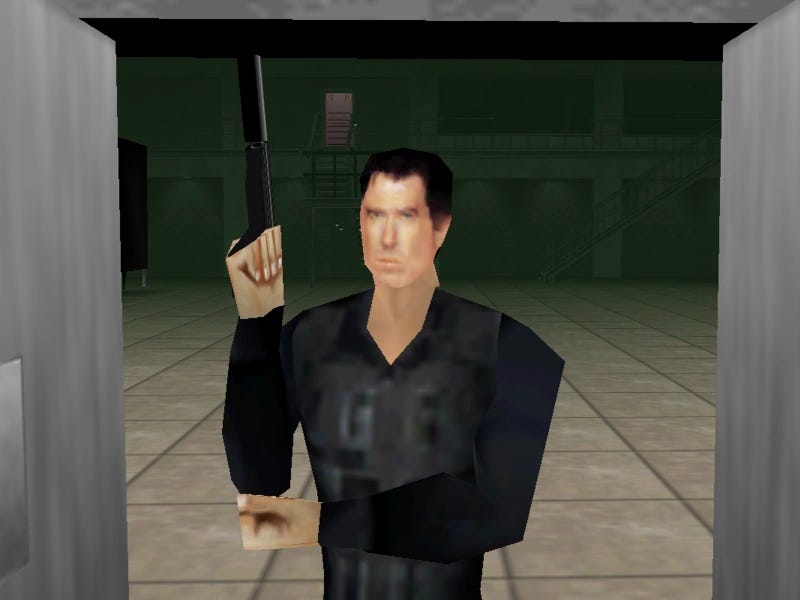
The N64 could not reproduce a movie, so Rare concentrated on the details that made the illusion work.
Levels were informed by photographs and blueprints from the film’s sets, but they were expanded into spaces the player could explore. Some rooms serve no obvious purpose. Corridors double back. Several missions allow different routes through the same environment.
That looseness makes the world feel less like a level assembled for the player and more like a place Bond has entered.
The music completes the transformation. Graeme Norgate and Grant Kirkhope, with a contribution from Robin Beanland, reshape the James Bond theme through the N64’s electronic sound palette. The familiar guitar figure becomes tense, metallic, and strangely hypnotic.
Add the gunshots, ricochets, alarms, opening doors, silenced shots, and distant footsteps, and GoldenEye creates tension with tools that now sound unmistakably like 1997.
Its technology has aged.
Its atmosphere has not.
Why GoldenEye 007 Matters
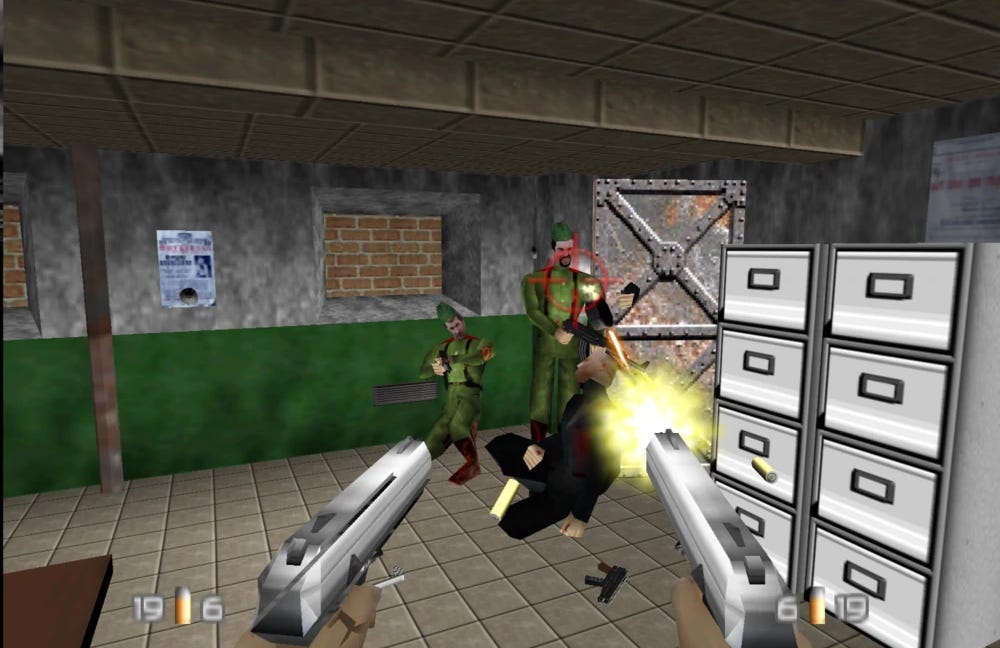
Playing the original version today requires adjustment.
The controls predate the dual-stick standard. Movement and aiming can feel stiff. The frame rate struggles when the action becomes crowded. Enemy faces repeat, environments blur together, and objectives are occasionally easier to fail than understand.
Nostalgia does not erase those limitations.
But judging GoldenEye only by how closely it resembles a modern shooter misses what made it important.
It gave console players a campaign built around objectives, stealth, experimentation, and replay. It offered enemies whose visible reactions made the world feel responsive. It turned difficulty into more than increased punishment. Most importantly, it made the first-person shooter a shared living-room experience.
The game did not simply place Doom beside the couch.
It discovered what the couch could add.
The laughter, accusations, improvised rules, controller passing, and direct competition became part of the design. GoldenEye proved that a console shooter could become the game everyone in the room wanted to play—even if only four of them could hold a controller.
From GoldenEye to Halo
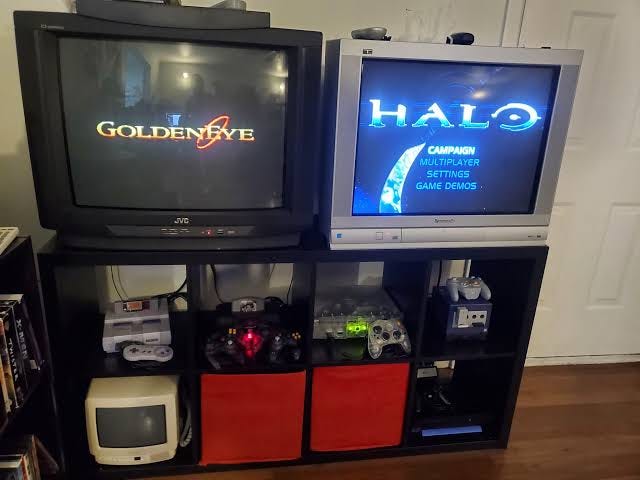
Four years later, Halo: Combat Evolved would establish the control language and combat rhythm that console shooters would carry forward. Halo 2 would help make online console competition a standard expectation.
But those games arrived in a world GoldenEye had helped prepare.
Its most direct family tree runs through Rare’s Perfect Dark and the TimeSplitters series created by former members of the team. Its larger legacy can be felt anywhere a shooter combines cinematic missions, reactive enemies, stealth, gadgets, and multiplayer designed to create stories between players.
The original is also playable again. Nintendo Switch Online + Expansion Pack carries the N64 version, while the Xbox release adds dual-analog controls, steadier performance, widescreen presentation, achievements, and resolution up to 4K while preserving local four-player split-screen.
The modern controls make it easier to revisit.
They cannot recreate the original conditions.
For that, you would need a CRT, three friends, four controllers, one copy of GoldenEye, and a room where everybody is lying about which part of the screen they are watching.
The Question
What defined your GoldenEye multiplayer nights: a favorite map, a specific weapon, a sacred house rule, or one friendship-ending violation nobody was ever allowed to forget?
And be honest.
Were you looking at my screen?