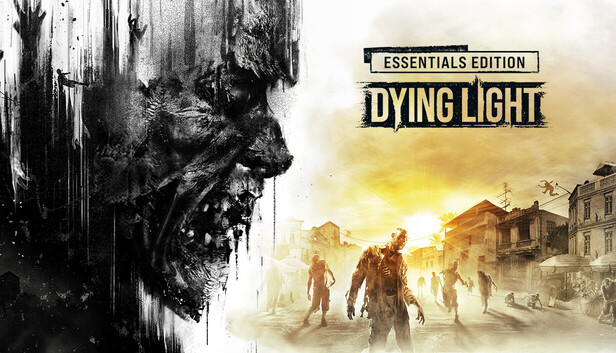
The sun is setting over Harran. Your watch starts beeping.Somewhere behind you, something screams.
Good night. Good luck.
FAMILIAR VERSION
Most people can describe Dying Light in four words:
The zombie parkour game.
That reputation is understandable. When Techland released Dying Light in 2015, its biggest selling point was obvious. This was an open-world zombie apocalypse where you could climb buildings, leap between rooftops, slide beneath obstacles, and dropkick the undead into another zip code.
For anyone who had not played it, the game looked like Dead Island crossed with Mirror’s Edge. Find weapons. Smash zombies. Collect supplies. Run across rooftops. Repeat until Harran is either saved or reduced to a collection of creatively dismembered corpses.
That description is not wrong.
It simply leaves out the most important part.
Parkour is not Dying Light’s gimmick.
Parkour is your weapon—and when night falls, it may be the only weapon keeping you alive.
DEEP DIVE
Movement Is Survival
In most open-world games, roads tell you where to go. In Dying Light, roads tell you where not to go.
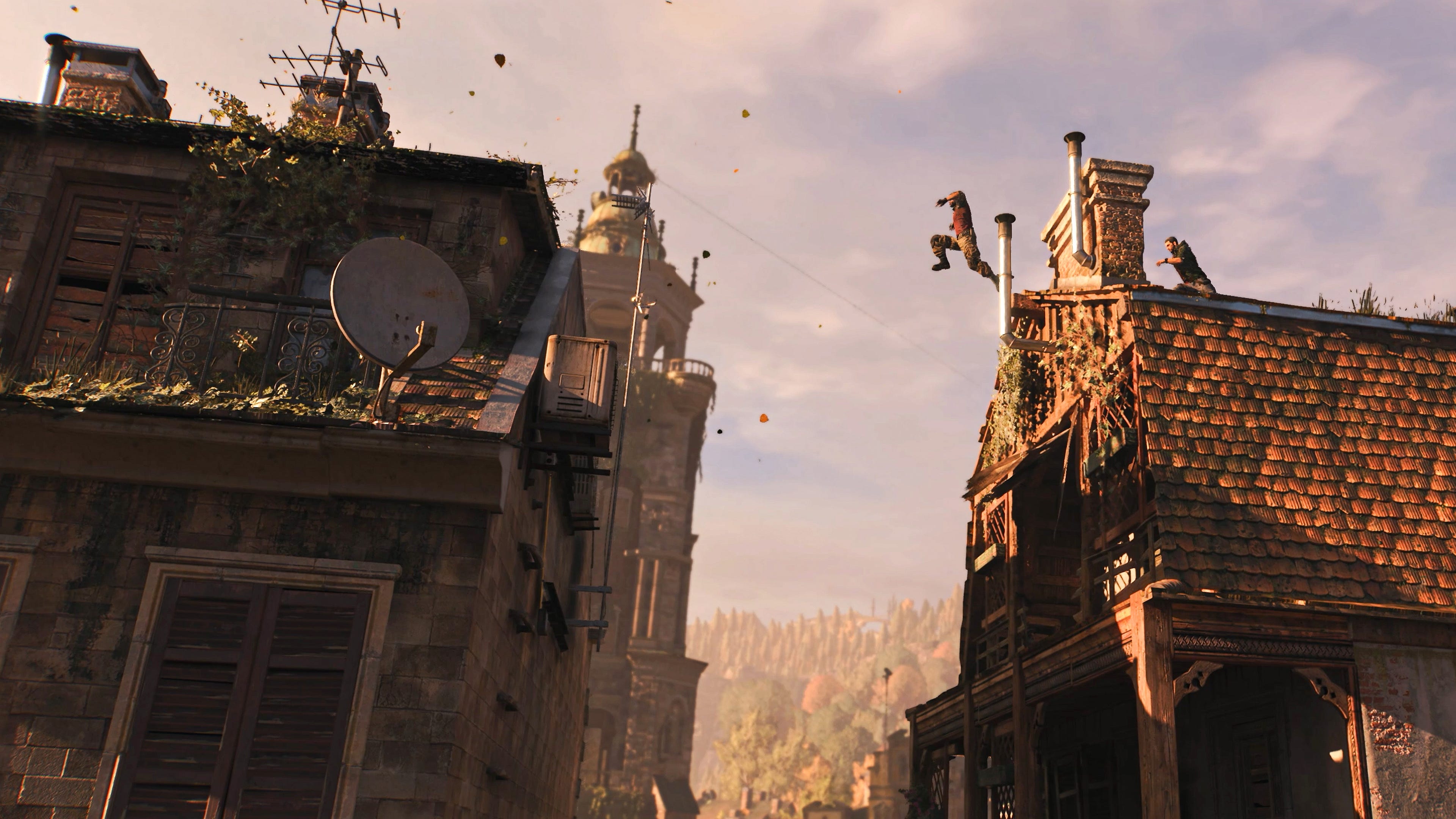
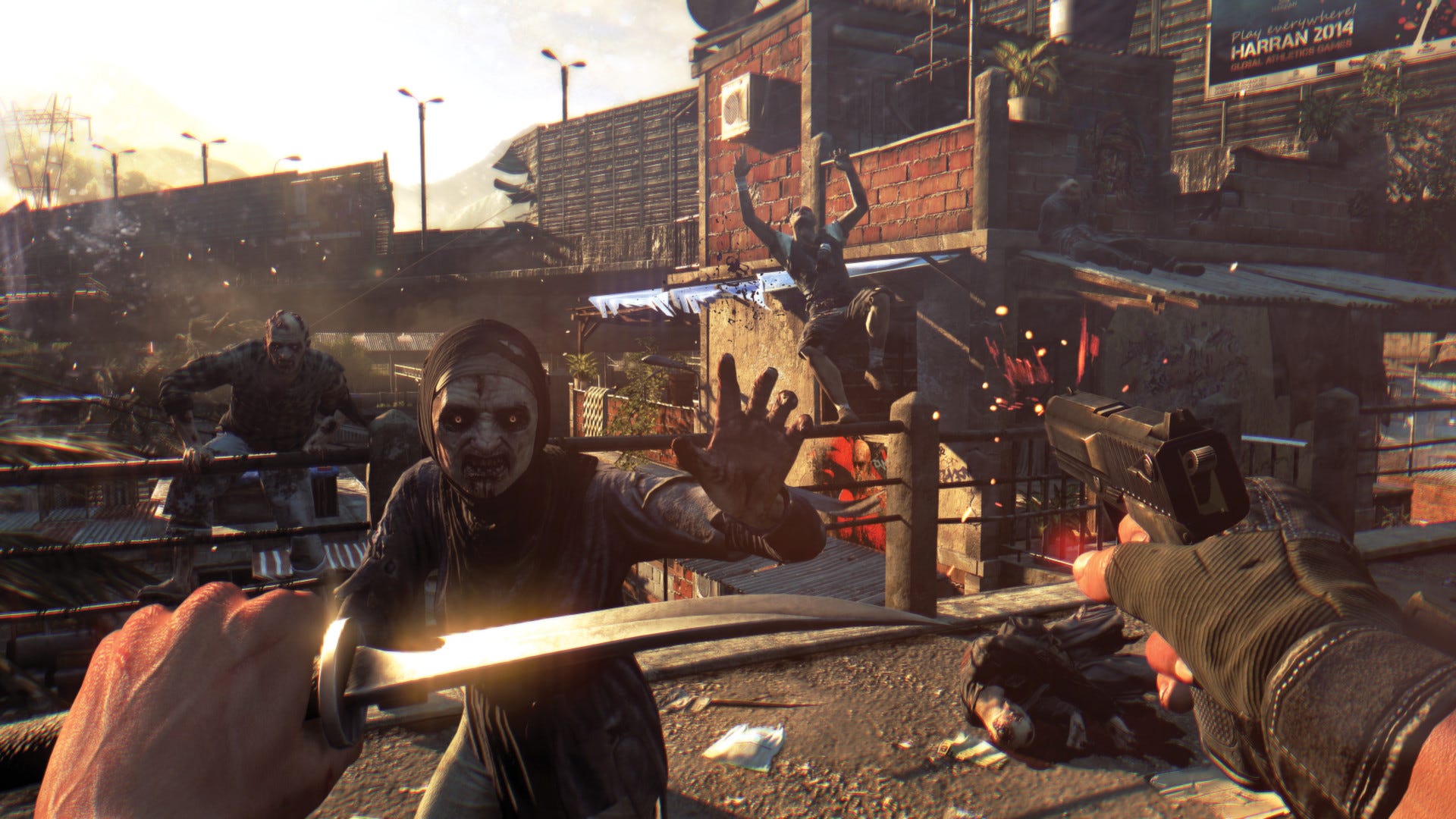
The streets of Harran are packed with infected, abandoned vehicles, overturned barricades, and narrow spaces where one mistake can leave you surrounded. The safest route is rarely the most direct one. Survival means climbing onto a van, jumping to an awning, grabbing a drainpipe, pulling yourself onto a balcony, and continuing across the rooftops.
The floor is not lava. The floor is zombies.
At first, Kyle Crane moves like someone who has never attempted any of this before. Jumps feel uncertain. Climbing drains his stamina. Distances are difficult to judge. A ledge that looks reachable can quickly become the final bad decision of your afternoon.
Then something wonderful happens. You improve.
Crane gains new abilities through separate skill trees built around agility, power, and survival. The more you run, climb, fight, and complete missions, the more capable he becomes. Moves that once required careful planning begin to flow together. You vault over one infected, slide beneath another, bounce off a wall, and disappear onto a rooftop before the horde understands what happened.
The game never simply tells you that Crane is becoming a better survivor. It lets you feel it.
Crane grows stronger at roughly the same time that you become better at reading Harran. Eventually, you stop seeing buildings as scenery. Balconies become footholds. Streetlights become escape routes. Vans become launching pads.
The entire city changes because you understand how to move through it.
A City Built for the Rooftops
Harran is more than a generic collection of ruined streets.
It feels hot. Oppressively hot.
Laundry still hangs between buildings. Satellite dishes cover the rooftops. Apartment doors open into lives that ended abruptly. Quarantine walls cut the city off from the outside world while distant smoke reminds you that the disaster stretches far beyond whichever building you are standing on.
There are survivors everywhere, but survival does not look heroic. It looks improvised.
The Tower has become a vertical refuge where people trade supplies, organize dangerous runs, care for the wounded, and wait for medicine that may never arrive. Safe zones must be reclaimed and defended. UV lights become small islands of protection. Every room tells the same story: ordinary people attempting to build something resembling a community while the rest of the city collapses around them.
That atmosphere matters because Dying Light understands that a zombie apocalypse should not feel empty.
It should feel abandoned.
There is a difference.
An empty world has nothing to say. An abandoned world is filled with evidence that someone was just there—and might never be coming back.
Kyle Crane’s Complicated Mission
Kyle Crane does not enter Harran as its chosen hero. He arrives as a GRE operative.
His mission is to locate Kadir “Rais” Suleiman and recover sensitive information that could damage the organization. It is supposed to be a controlled operation: enter the quarantine zone, complete the objective, and follow orders.
Harran immediately ruins that plan.
Crane is attacked, bitten, and rescued by survivors from the Tower. He meets Brecken, the exhausted leader trying to hold the community together; Rahim, an eager young runner desperate to prove himself; and Jade Aldemir, one of Harran’s most capable survivors.
The longer Crane stays, the harder it becomes to treat these people as pieces on someone else’s board.
That is the emotional hook beneath all the broken pipes and rooftop chases. Crane begins the game working for an organization that sees Harran from a distance. The people inside the walls do not have that luxury. They need Antizin. They need food. They need safe zones. They need someone willing to leave the Tower and come back alive.
Crane gradually stops asking what the GRE wants from him. He starts asking what the people around him need.
The story may use familiar zombie-apocalypse ingredients, but Crane’s evolution gives it weight. He does not become a hero because somebody declared him special. He becomes one because the mission becomes less important than the people trapped inside it.
Everything Can Become a Weapon
Combat in Dying Light is desperate, physical, and wonderfully disrespectful to the undead.
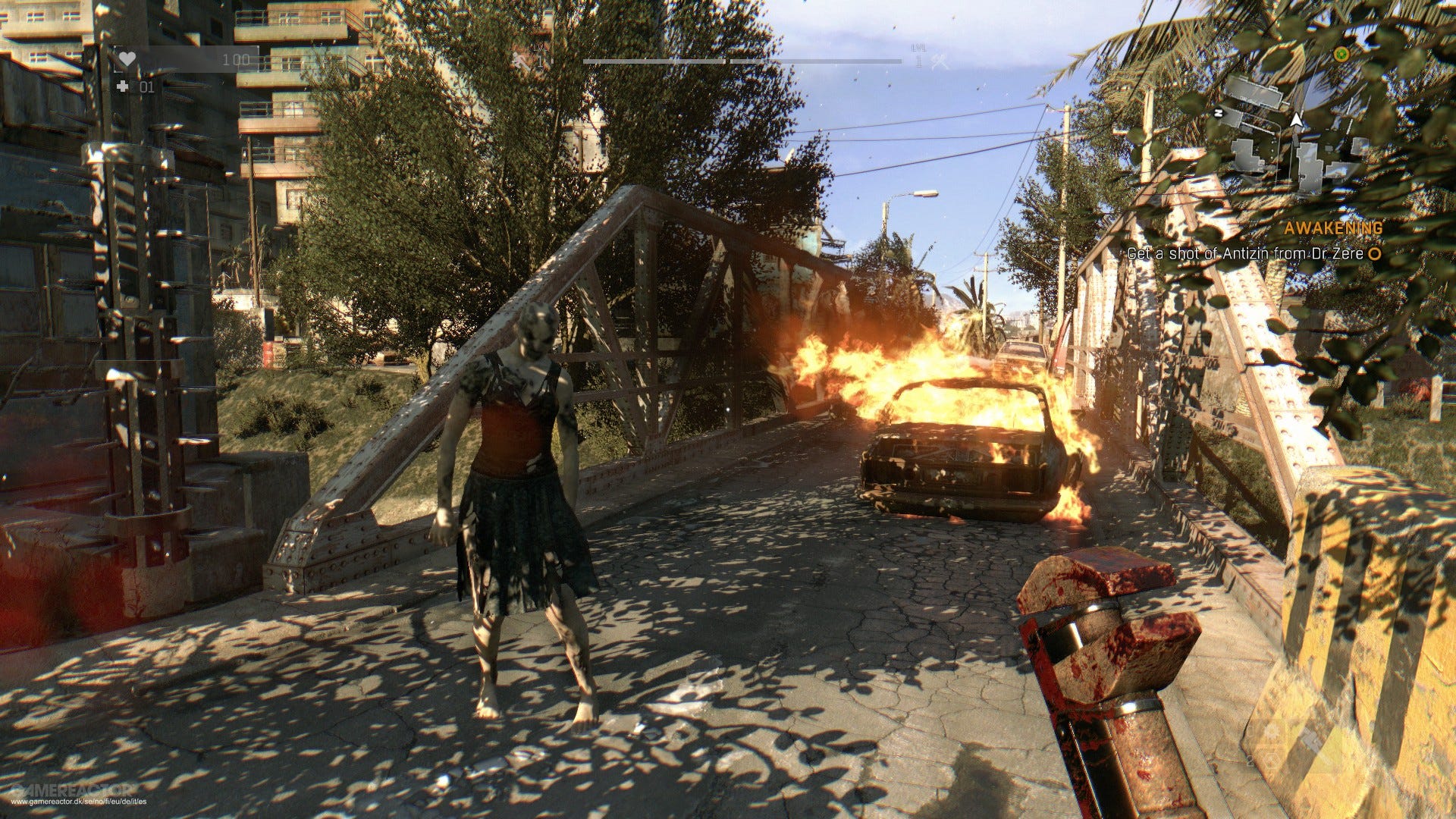
Early weapons are barely weapons at all. Pipes. Wrenches. Table legs. Knives that have seen better days. Each swing consumes stamina, and every weapon eventually wears down. Charging directly into a crowd is usually a terrific way to discover how quickly a survivor can become lunch.
So, you improvise.
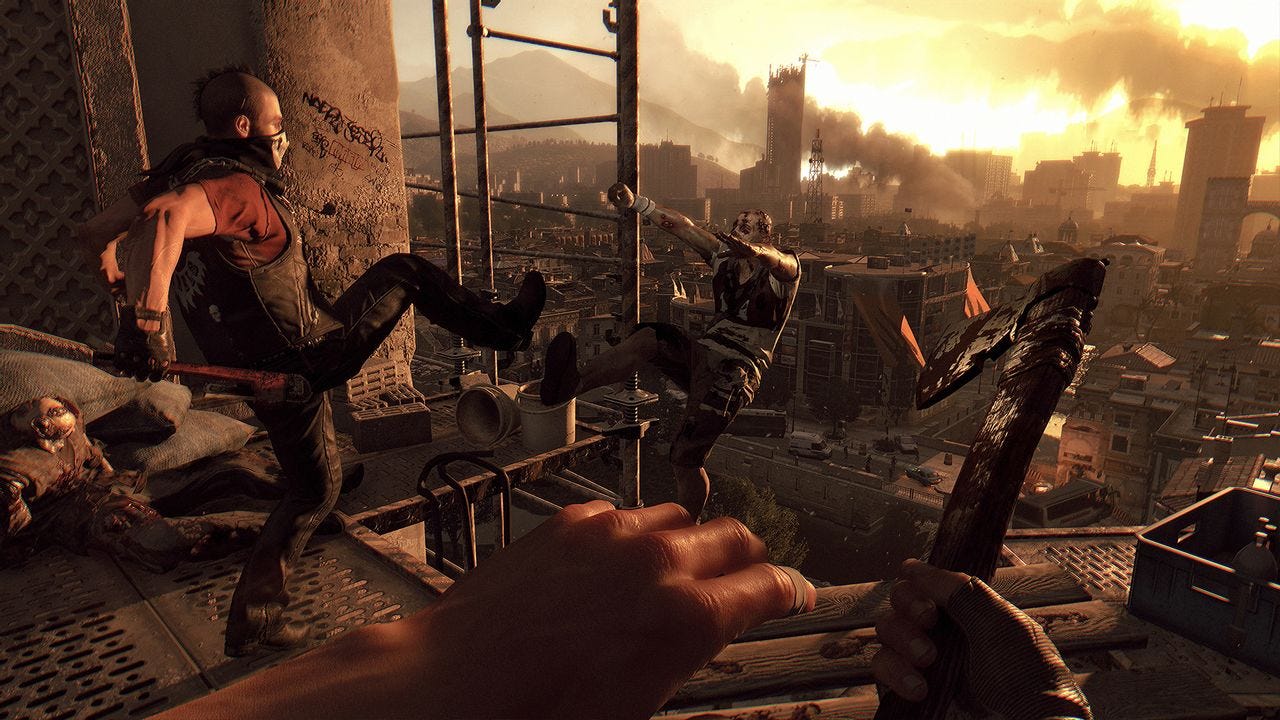
You kick infected into spikes. Lure them toward electrical traps. Throw firecrackers beside spilled fuel. Modify weapons with electricity, fire, or toxic effects. You learn when to fight, when to climb, and when to leave twenty zombies standing in the street wondering where dinner went.
Then there is the dropkick.
There are few problems in Harran that cannot be temporarily improved by planting both feet into a zombie’s chest and launching it from a rooftop.
Even so, the combat remains tied to movement. You are rarely supposed to stand your ground like an action hero. Harran rewards momentum. Strike, dodge, vault, climb, reposition. Your greatest advantage is not necessarily the weapon in Crane’s hands.
It is the escape route behind him.
When the Sun Goes Down
During the day, Harran is your playground.
At night, you are part of the food chain.
That transformation is Dying Light’s masterstroke.
Night does not simply apply a darker filter to the same open world. It changes your relationship with everything around you. Streets that felt manageable become hunting grounds. Familiar rooftops suddenly provide less comfort. Every shortcut becomes a calculation.
And then the Volatiles emerge.
Fast, powerful, and capable of pursuing Crane across the rooftops, Volatiles erase the confidence you spent daylight hours building. A single sighting can become a chase. One wrong turn can attract more of them. Suddenly you are sprinting toward the nearest UV light while screams, footsteps, and heavy breathing close in behind you.
You do not need to see everything chasing you. You can hear it.
That is worse.
Night offers greater rewards but collecting them requires accepting greater danger. The system gives players a genuine choice. Stay inside and wait for daylight—or step into the darkness and discover whether all that training actually means something.
Plenty of games include a day-and-night cycle. Dying Light makes sundown feel like a threat.
The Sound of Harran
The game’s audio completes the illusion.
During daylight, the city hums with distant movement, survivor chatter, groaning infected, and the sudden eruption of violence. At night, every sound becomes information. A growl warns you to change direction. A scream tells you something has spotted Crane. Footsteps reveal that whatever is following him is getting closer.
Paweł Błaszczak’s soundtrack brings a retro electronic pulse to Harran, mixing dread with momentum. It can make the city feel melancholy one moment and deeply hostile the next. The music knows when to build tension, but the game is equally effective when it steps aside and lets the darkness speak for itself.
Silence in Dying Light never means safety. It means you have not heard the danger yet.
The Following Changed the Rules Again
After teaching players to survive by going upward, Dying Light: The Following sent them into the countryside.
The dense streets and crowded rooftops gave way to open fields, rural settlements, and long roads. With fewer buildings available for escape, the expansion introduced a customizable buggy that could be repaired, upgraded, weaponized, and driven directly through crowds of infected.
It changed the rhythm without abandoning the game’s central idea.
Movement still meant survival.
Only now, instead of looking for the next rooftop, players were watching their fuel, maintaining their vehicle, and deciding whether they could cross open ground before something caught them.
The buggy was not merely transportation. It became another survival tool—one that players gradually turned from a struggling machine into the closest thing the apocalypse had to a best friend.
WHY IT MATTERS
Dying Light arrived during an era drowning in zombies.
The Walking Dead was a cultural phenomenon. Left 4 Dead, DayZ, Dead Island, The Last of Us, and countless other games had already asked players to shoot, stab, outwit, or emotionally recover from the undead.
The genre did not need another pile of zombies.
It needed a new way to interact with them.
Techland found it by asking a different question:
What if surviving the zombie apocalypse was less about fighting the infected and more about learning how to move around them?
That single idea gave Dying Light its identity.
Parkour was not stapled onto the apocalypse. It changed how players understood it. A zombie crowd was no longer just an enemy encounter. It was a problem in navigation. A locked door was not necessarily a dead end if there was an open window two floors above it. A city block was not something to cross.
It was something to climb.
That is why people still talk about Harran. The game gave players one of the greatest feelings an open world can provide: the sense that they had genuinely learned how to live there.
MODERN CONNECTION
Eleven years later, Dying Light is still moving.
Techland celebrated the original game’s tenth anniversary in 2025, then released the Retouched Update with visual enhancements and a remastered soundtrack. In July 2026, the studio looked back at why players were still enjoying Harran eleven years after its release.
More importantly, Kyle Crane’s journey did not end behind Harran’s quarantine walls.
After Dying Light 2: Stay Human expanded the series with a new city and a new protagonist, Dying Light: The Beast brought Crane back in 2025 for a standalone adventure set after years of captivity and experimentation. Even the newer game’s approach to traversal carries the original philosophy forward: the environment should not merely contain the action.
Moving through it is the action.
That may be Dying Light’s greatest legacy.
It proved that traversal does not have to be the empty space between missions. Movement can create tension. It can tell a story. It can chart a character’s growth. It can make a familiar genre feel dangerous again.
Plenty of games let us survive the apocalypse.
Dying Light taught us how to outrun it.
CTRL+BINGE QUESTION
What was the first moment in Dying Light that made you realize nighttime was an entirely different game?