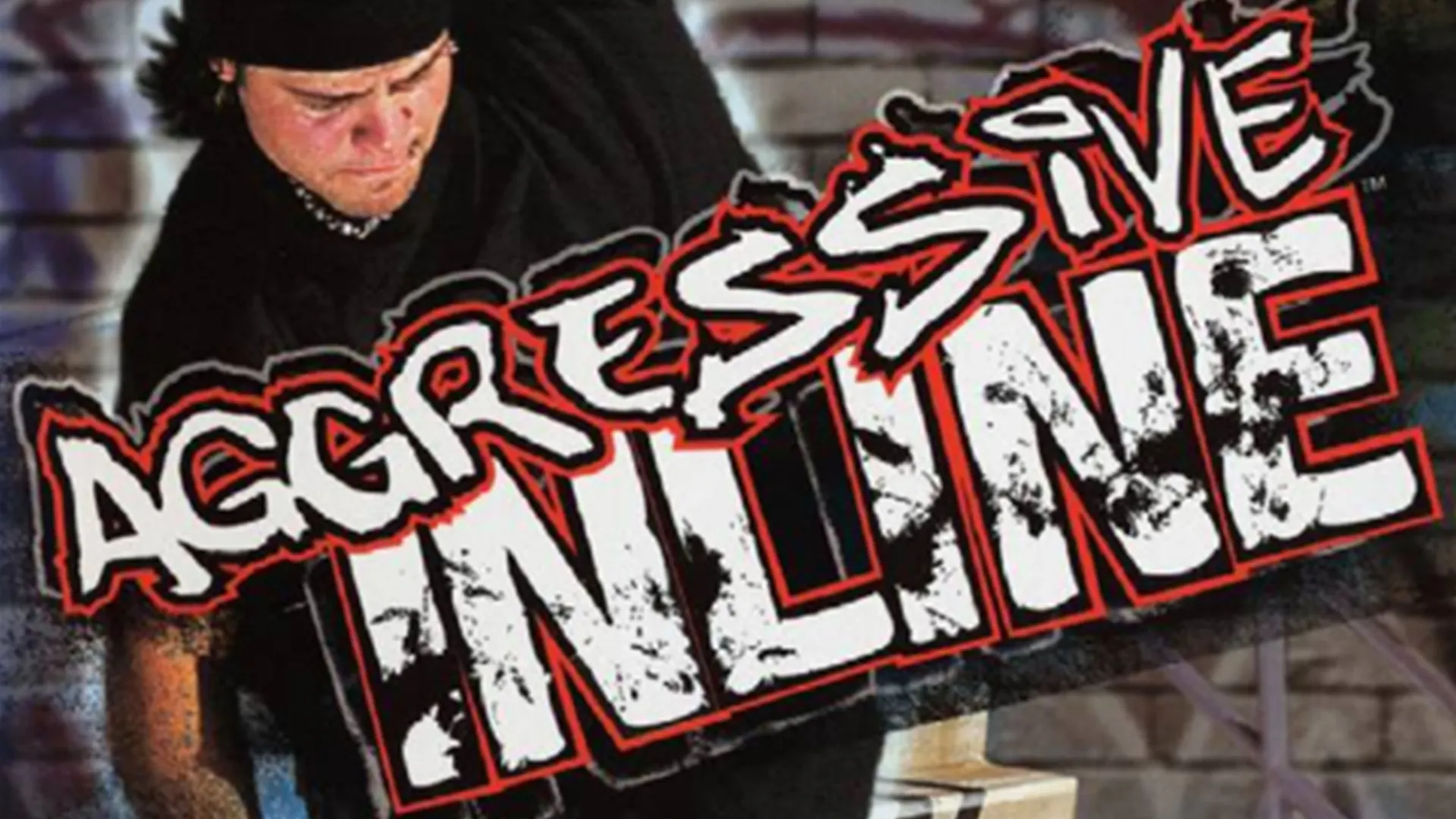
The Juice Meter is draining.
There is a rail on the other side of the street, a car moving just fast enough to grab, and a ramp that almost certainly launches you somewhere the developers never intended.
Standing still is not an option.
In Aggressive Inline, movement is not merely how you play.
Movement is survival.
FAMILIAR VERSION
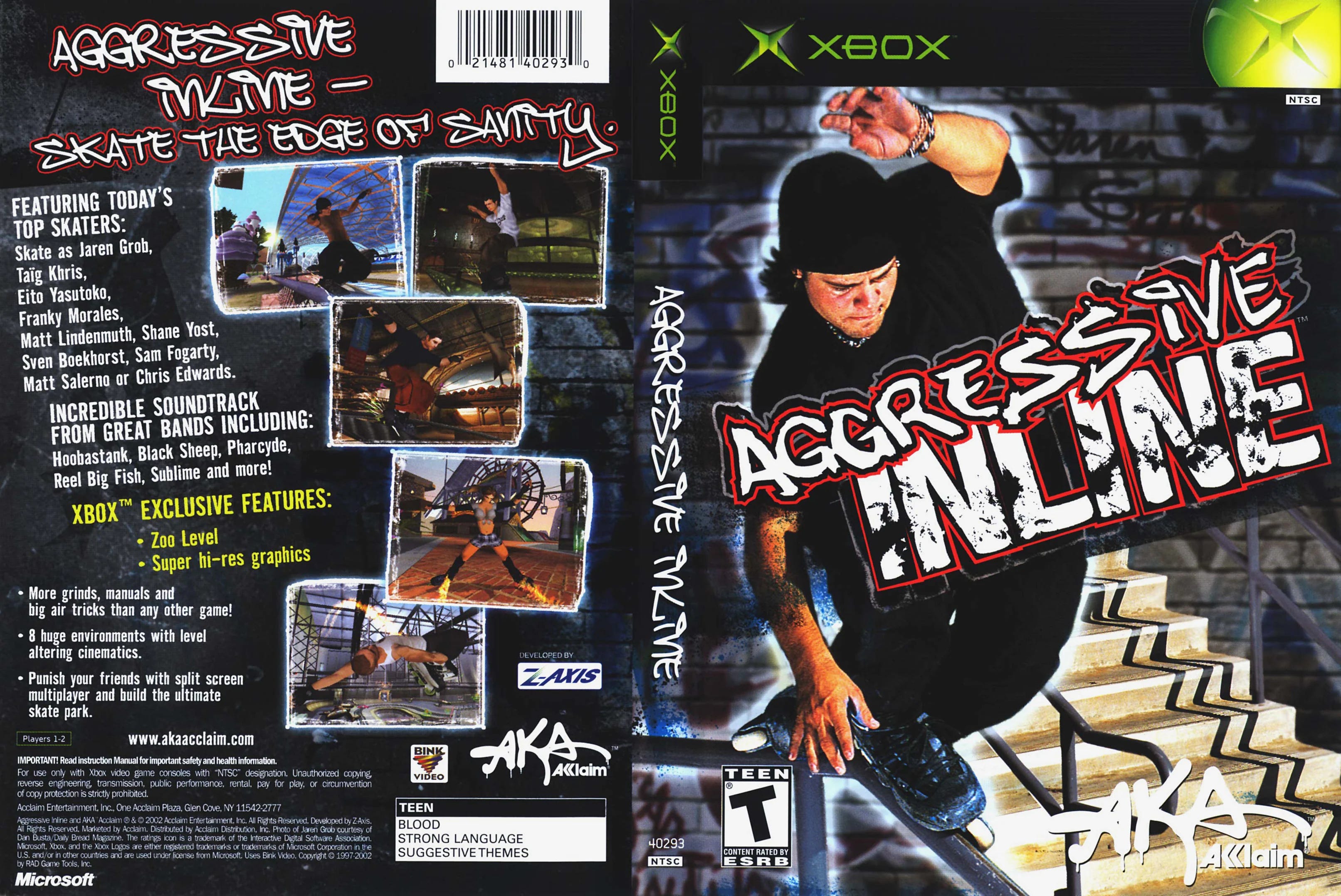
The easiest way to explain Aggressive Inline is also the least interesting:
It was Tony Hawk’s Pro Skater on rollerblades.
That comparison made perfect sense in 2002. Tony Hawk had already taught an entire generation how action-sports games were supposed to work. Players understood grinds, manuals, grabs, spins, special tricks, hidden collectibles, environmental objectives, and the glorious feeling of finding one more connection that transformed a decent combo into something ridiculous.
Then Aggressive Inline arrived with rollerblades, professional inline skaters, huge levels, outrageous trick lines, and a licensed soundtrack loud enough to annoy everyone else in the house.
The influence was obvious.
But calling it a Tony Hawk clone ignores the most important part:
Aggressive Inline understood the formula well enough to start changing it.
It did not simply replace a skateboard with rollerblades. It removed the brakes, opened the levels, turned momentum into a resource, and dared players to see how long they could keep the line alive.
DEEP DIVE
Keep Moving or Go Home
Most action-sports games of the era placed players inside a two-minute run.
The clock started. You completed as many goals as possible, built your score, and tried to squeeze one final combo into the last few seconds before time expired.
Aggressive Inline threw that structure away.
Instead of constantly resetting after two minutes, players could explore its levels at their own pace. Individual challenges might still use timers, but the overall experience was far more open.
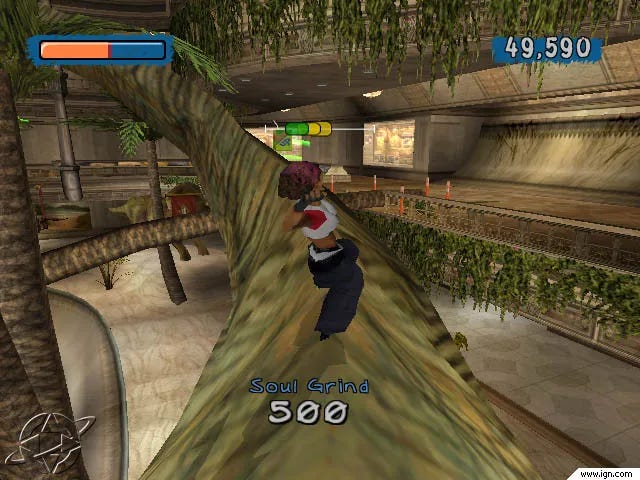
The replacement was the Juice Meter.
Performing tricks filled it. Crashing drained it. Standing around doing nothing caused it to slowly disappear.
If the meter emptied completely, your run was over.
In practice, Juice was rarely an oppressive threat. A decent trick line could keep it healthy, and Juice Boxes scattered throughout the environment gave players another way to refill it.
But mechanically and psychologically, it changed everything.
The game was always whispering the same command: Do something.
- Find a rail.
- Jump a staircase.
- Wall ride a billboard.
- Grab onto a passing vehicle.
- Launch yourself from a ramp that appears to violate several local construction codes.
Just keep moving.
The Juice Meter functioned as both a special meter and a declaration of intent. Aggressive Inline did not want cautious players slowly walking around its levels while staring at a checklist.
It wanted speed.
It wanted improvisation.
It wanted you to look at an entire environment and wonder how much of it could become one continuous line.
Levels Built to Be Broken
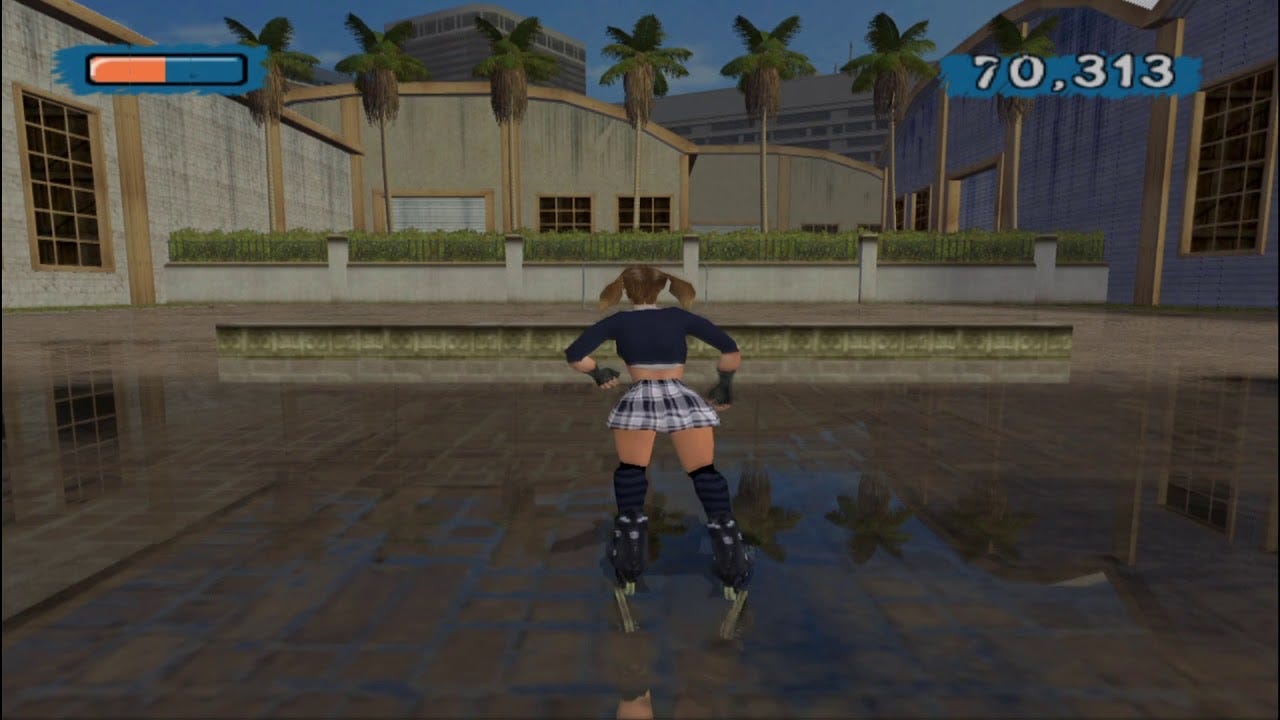
That philosophy would not have worked inside small arenas. Fortunately, Aggressive Inline’s levels were enormous.
The Movie Lot, Civic Center, Industrial Plant, Boardwalk, Tuna Cannery, Airfield, and Museum were not simply collections of ramps placed beside recognizable scenery. They were interactive playgrounds filled with alternate routes, hidden areas, moving vehicles, strange characters, and environmental events waiting for a reckless player to trigger them.
The Movie Lot immediately established the game’s personality.
It was filled with sets, props, hazards, and enough absurd infrastructure to make every corner feel like a different genre. Grind across the right chains and you could release a massive boulder, sending it crashing through the environment and opening another part of the level.
That is not window dressing. The level physically changes because you interacted with it.
The same playful energy carries through the rest of the game. The Boardwalk gives players carnival attractions and seaside chaos. The Tuna Cannery turns an industrial workplace into a maze of machinery and grindable surfaces. The Airfield lets players skitch behind moving vehicles—and even grab onto an airplane taxiing down the runway.
Reality was invited to the meeting. It was not given final approval.
Objectives were often found by skating up to characters inside the level rather than selecting everything from a menu. Hidden challenges rewarded players for experimenting before they even knew what the game wanted from them. Keys opened new sections. Cinematic events changed the environment and created fresh possibilities.
The levels were not only places where tricks happened. They participated.
Learning by Doing
Aggressive Inline also made progression feel connected to the way each person played.
Your skater did not improve only because you accumulated points and purchased a generic upgrade.
Grind often enough, and the grind statistic improved. Skate backward, and the fakie rating increased. Move quickly, and speed developed. Practice wall rides, jumps, and other techniques, and the corresponding abilities became stronger.
It was a simple idea, but it created a satisfying relationship between repetition and growth. You did not merely tell the game what kind of skater you wanted to build.
You showed it.
That allowed each session to feel like practice without turning the game into a simulation. Aggressive Inline was still wildly exaggerated. Its skaters could produce impossible airtime, survive horrifying collisions, and turn ordinary public spaces into personal amusement parks.
But beneath the arcade physics was an understanding every athlete recognizes:
You improve something by doing it again.
Then again.
Then one more time because the last attempt was almost perfect.
Rollerblades Changed the Line
The difference between skateboarding and aggressive inline skating was not merely cosmetic. Rollerblades changed how players read the environment.
Aggressive Inline emphasized enormous airs, long grinds, wall rides, vaults, cess slides, skitching, and the ability to grab horizontal or vertical poles. A railing was obvious. A wall was useful. A pole sticking out of the ground might become a handhold that redirected the entire combo.
The skates allowed the game to feel unusually vertical.
You were not always flowing across the ground and looking for the next ramp. Sometimes you were climbing the environment through tricks, rebounding from walls, catching objects, and using momentum to reach places that initially looked impossible.
That is where Aggressive Inline truly separates itself from the game everyone compared it to.
Tony Hawk helped players see a city as a skate park. Aggressive Inline looked at that same city and asked: What if we could use more of the walls?
Real Skaters, Arcade-Sized Personalities
The roster included genuine stars from the aggressive inline world, including Chris Edwards, Taïg Khris, Jaren Grob, Franky Morales, Shane Yost, Matt Salerno, Sven Boekhorst, and Eito Yasutoko.
For many players, however, the game may have been their first meaningful introduction to the sport. That matters.
The Tony Hawk games helped transform professional skateboarders into household names. Aggressive Inline attempted something similar for athletes whose sport was recognizable but rarely received the same cultural spotlight.
The game did not present aggressive inline skating as skateboarding’s smaller cousin. It treated these athletes like superheroes.
Their tricks were exaggerated. Their personalities were heightened. Their world was loud, colorful, and built specifically around what rollerblades could do.
Even if players arrived because the box reminded them of Tony Hawk, they left knowing aggressive inline skating had its own stars, style, and identity.
The Most 2002 Soundtrack Imaginable
Then there is the soundtrack. Good Lord, the soundtrack.
Aggressive Inline did not settle into one musical genre. It smashed punk, ska, nu metal, alternative rock, and hip-hop together like someone had burned a CD using every song currently dominating their bedroom.
- Reel Big Fish brought “Sell Out.”
- Sublime brought “Wrong Way.”
- Hoobastank brought “Crawling in the Dark.”
- Saliva brought “Your Disease.”
- The Ataris brought “Song #13.”
- The Pharcyde brought “Passin’ Me By.”
- Black Sheep brought “The Choice Is Yours.”
- Eric B. & Rakim brought “Don’t Sweat the Technique.”
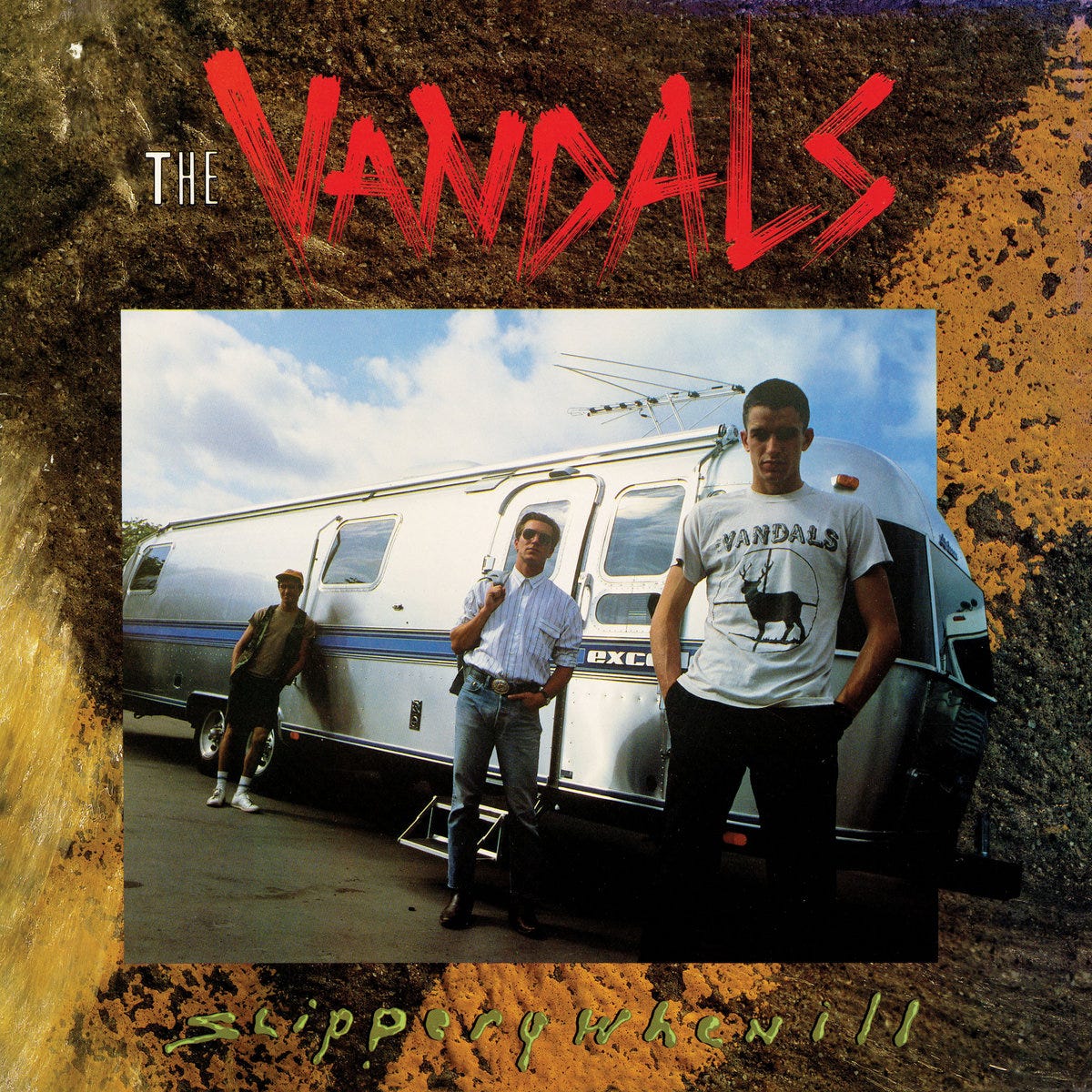
- The Vandals brought “Idea for a Movie.”
- And P.O.D. brought “Youth of the Nation.”
There may be no better way to explain the early 2000s than placing all those songs inside the same extreme-sports game and acting like that combination was completely normal.
Because at the time? It was.
“The Vandals’ Idea for a Movie” captures the game’s reckless sense of humor. It is fast, ridiculous, and practically begs the player to attempt something that will end with their skater bouncing off concrete.
“Youth of the Nation” carries an entirely different weight.
It is slower, darker, and far more reflective than the rest of the game’s chaos would suggest. Hearing it underneath impossible tricks and brightly colored levels creates a strange emotional collision that feels inseparable from the era.
The game does not stop to explain the contrast.
One moment you are laughing at an absurd objective. The next, P.O.D. has changed the atmosphere completely.
That was the power of licensed soundtracks during this period. Songs did not merely accompany the game. They became attached to places, levels, tricks, and memories.
Years later, you might forget the exact objective you were completing. Then “Idea for a Movie” begins, and suddenly you remember the controller in your hands.
It Was Allowed to Be Stupid
There is another ingredient modern retrospectives sometimes overlook: Aggressive Inline was funny. Not delicately witty. Not emotionally restrained.
Stupid. Gloriously, intentionally stupid.
People yelled at you. Objectives became increasingly absurd. Environmental destruction was treated as a reward. The world existed somewhere between an extreme-sports competition and a cartoon where local governments had abandoned all safety regulations.
That silliness gave the game personality.
It understood that nobody wanted a lecture about the proper use of an industrial cannery. We wanted to grind machinery, cause thousands of dollars in property damage, and launch a professional skater over something no responsible adult would have approved.
The game took its mechanics seriously. It did not take itself seriously.
That distinction helped it survive the comparison to Tony Hawk. A lesser game might have copied the controls, changed the equipment, and stopped there.
Aggressive Inline built an entire attitude around momentum, exaggeration, and the joy of discovering one more ridiculous thing the game would allow.
WHY IT MATTERS
Aggressive Inline arrived during the action-sports boom.
After Tony Hawk’s Pro Skater became a phenomenon, practically every extreme sport looked like it might support its own game. BMX, snowboarding, surfing, motocross, scooter riding, and wakeboarding all received attempts at the formula.
Many disappeared because recognizing the structure was not the same as understanding why it worked.
Aggressive Inline understood.
It knew players wanted responsive controls, satisfying progression, memorable music, and environments that could be read as playgrounds. More importantly, it introduced ideas strong enough to change the experience.
- The removal of the standard timer allowed exploration to breathe.
- The Juice Meter encouraged constant motion.
- Statistics improved according to player behavior.
- Objectives existed inside the world.
- Environmental events opened new areas and changed potential trick lines.
Those were not superficial substitutions. They were design choices.
Contemporary reviewers recognized it. Aggressive Inline was not received as a cheap imitation desperately following a trend. It was treated as a legitimate competitor that had found ways to push the action-sports formula forward.
Unfortunately, quality does not always guarantee longevity. There was no Aggressive Inline 2. There was no long-running franchise. No modern remaster arrived to reintroduce the game to another generation.
The genre moved on. Acclaim disappeared. Licensed soundtracks became complicated time capsules. Aggressive inline skating never received the sustained mainstream gaming presence that skateboarding enjoyed.
But the game remained.
Not physically on every modern storefront.
In people.
In the song that immediately brings back a level. In the friend who insisted they could land one more combo. In the memory of realizing that rollerblades changed which parts of the environment were useful. In the disbelief that something this good never received a sequel.
MODERN CONNECTION
Today, extreme-sports games are often discussed through preservation and revival.
Tony Hawk’s Pro Skater returned through remakes and remasters. Smaller and bigger budget skating games found audiences by emphasizing physics, creativity, community, or simulation. Developers continue experimenting with what virtual movement can feel like when the objective is not defeating an enemy but mastering a space.
That renewed interest makes Aggressive Inline feel less like a strange artifact and more like an unfinished conversation.
Its biggest ideas still make sense.
- Open levels that reward experimentation.
- Traversal that becomes a form of expression.
- Progression based on the way someone actually plays.
- Music that gives the experience a cultural identity.
- Environments designed to change beneath the player.
A modern Aggressive Inline would not need to become larger simply because technology allows it.
It would need to remember the original command: Keep moving.
QUESTION
Which Aggressive Inline song or level immediately takes you back to 2002?
A FINAL THOUGHT
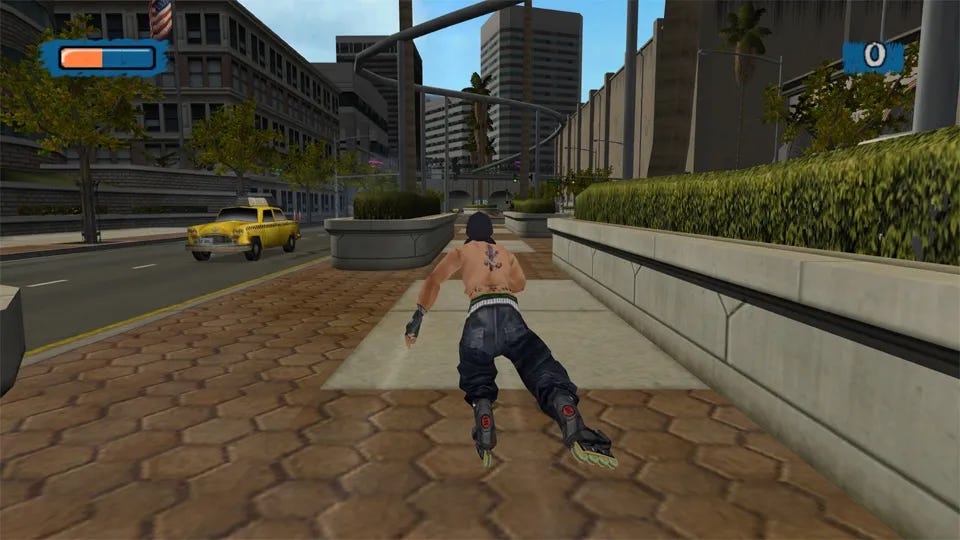
Aggressive Inline arrived in the shadow of gaming’s biggest skateboarder.
It borrowed the controls. It shared the attitude. It understood the assignment.
But once the Juice Meter started draining, the levels began opening, and “Idea for a Movie” kicked through the speakers, it stopped feeling like somebody else’s game.
It found its own line.