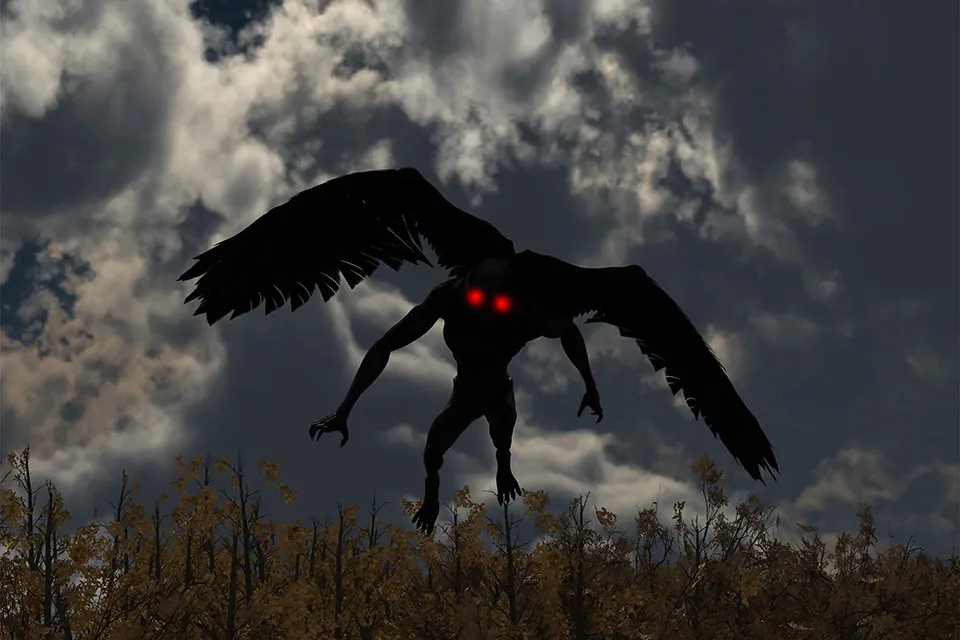
A lot of people have heard of the Mothman. The glowing red eyes. The massive wings. The dark silhouette standing at the edge of a lonely road. A creature watching from abandoned places. A monster lurking in the darkness.
That’s the image that survived. The one on T-shirts. The one in documentaries. The one that ended up on festival posters and souvenir mugs.
But here’s the strange thing: People don’t remember Mothman because of what he did. They remember him because of what happened afterward; A bridge collapsed. Forty-six people died.
And suddenly every strange sighting from the previous year looked different. The giant winged creature stopped being a local monster story. It became something else. Something far harder to explain.
Because if Mothman wasn’t responsible for the disaster… Why was he there before it happened? And that raises a chilling question: What if Mothman was never the disaster? What if he was the warning?
THE FAMILIAR VERSION
The version most people know is surprisingly straightforward. In November of 1966, two young couples were driving near an abandoned TNT manufacturing area outside Point Pleasant, West Virginia. According to their account, they saw something impossible.
- A giant winged creature.
- Roughly man-sized.
- Dark gray.
- With glowing red eyes.
The creature reportedly followed their car at incredible speed before disappearing into the night.
The story hit local newspapers. And then more sightings followed. Residents reported seeing the creature near roads, fields, rooftops, and abandoned buildings. Descriptions varied slightly, but the core details remained consistent:
- Huge wings
- Dark body
- Red eyes
- Unnatural movement
For more than a year, Point Pleasant became ground zero for one of America’s most famous cryptid stories. Then, on December 15, 1967, tragedy struck. The Silver Bridge collapsed during rush hour traffic. Forty-six people died.
The Mothman sightings largely stopped afterward. And that coincidence became the foundation of the legend.
Monster appears. Disaster follows. Monster disappears. Simple. Clean. Memorable. Folklore is rarely this neat.
Then the story gets much stranger…
ORIGINS: THE NIGHT EVERYTHING CHANGED
The first famous Mothman sighting came from Roger and Linda Scarberry and Steve and Mary Mallette. The couples insisted they weren’t making things up. They described a creature standing near an abandoned generator plant. Its eyes reflected brightly in the darkness. Its wings unfolded. And then it began following them.
Newspapers quickly picked up the story. The local press gave the creature a name inspired by the popularity of Batman’s villains: Mothman.
It’s important to remember that nobody called it that at first. The name was created afterward. Like many legends, the branding came later. The fear came first. Once the story entered the public consciousness, additional reports started pouring in.
Some people saw a giant bird. Others described something more humanoid. Some claimed it flew. Others said it seemed to glide. The details shifted. The mystery grew.
And Point Pleasant suddenly found itself at the center of a phenomenon.
THE SILVER BRIDGE

This is where Mothman transforms from a cryptid into a legend. On December 15, 1967, the Silver Bridge connecting West Virginia and Ohio collapsed.
The failure was later attributed to a structural defect in a suspension chain.
- Engineering.
- Metal fatigue.
- Bad luck.
- Nothing supernatural.
But folklore rarely cares about engineering reports. People remembered the timing. For over a year, a strange, winged creature had reportedly been appearing around Point Pleasant. Then came disaster. Afterward, the sightings largely vanished.
To believers, that wasn’t coincidence. It was a pattern. And humans are extraordinarily good at finding patterns. Especially after tragedy. The bridge collapse became inseparable from Mothman. Not because evidence linked them. Because stories linked them.
And stories are often stronger than facts.
ENTER JOHN KEEL
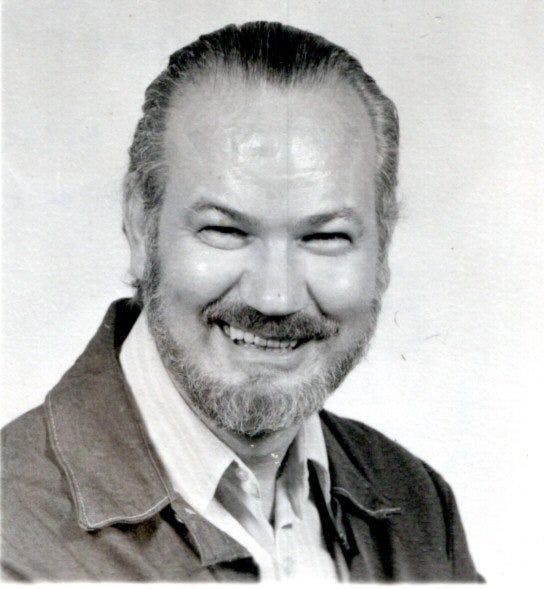
Every great mystery needs someone willing to make things weirder. That person was John Keel. A journalist and paranormal investigator who arrived in Point Pleasant to investigate the sightings.
Keel didn’t think Mothman was simply an unknown animal. He proposed something far stranger. He believed the sightings might be connected to UFO phenomena, psychic experiences, prophetic dreams, and other unexplained events.
His ideas eventually became the basis for the book The Mothman Prophecies. According to Keel, Point Pleasant wasn’t experiencing a monster sighting. It was experiencing a window. A place where reality itself seemed to get strange.
Whether you agree with him or not, his work permanently changed the Mothman story. Because from that point forward, Mothman wasn’t just a cryptid. He became part of a much larger paranormal puzzle.
THE MEN IN BLACK CONNECTION
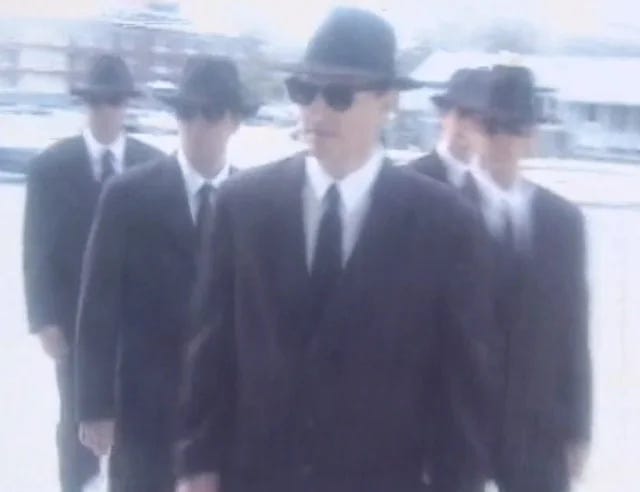
And this is where things get delightfully weird. Long before Will Smith put on sunglasses and started protecting Earth from aliens, Point Pleasant residents reported encounters with mysterious visitors.
People described strange men asking unusual questions. They often appeared uncomfortable. Awkward. Almost as if they were trying to imitate human behavior without fully understanding it.
Witnesses reported bizarre conversations. Odd clothing. Unsettling mannerisms. Some accounts were almost certainly exaggerated. Others may have been misunderstandings. But the stories persisted.
And suddenly Mothman wasn’t connected only to a bridge collapse. He was connected to UFOs. Government conspiracies. Paranormal investigators. And mysterious visitors who may or may not have known more than they were saying. At some point, the story stopped being a cryptid tale.
It became an entire paranormal ecosystem.
THE WEIRD STUFF
This is where Mothman truly separates himself from creatures like Bigfoot.
Bigfoot is mostly one mystery.
Mothman is twenty mysteries stacked on top of each other.
Reports surrounding Point Pleasant included:
- glowing red eyes
- impossible flight patterns
- strange lights in the sky
- prophetic dreams
- unusual animal behavior
- Men in Black encounters
- UFO sightings
- feelings of dread before sightings
Some witnesses described overwhelming fear. Others reported a strange sense of being watched. A few claimed they experienced vivid dreams or premonitions. This is one reason skeptics struggle to classify Mothman. He’s not consistently one thing.
Sometimes he’s a bird. Sometimes a cryptid. Sometimes an alien. Sometimes a supernatural omen. And maybe that’s why the story survives. Because it refuses to stay in a single category.
POP CULTURE TAKEOVER
Most cryptids fade away. Mothman got a movie. The Mothman Prophecies turned the story into mainstream horror.
Then came
- Documentaries.
- Television specials.
- Podcasts.
- Internet deep dives.
- Conspiracy videos.
And eventually…
- Memes.
Today Point Pleasant embraces the legend. There’s a giant Mothman statue. A yearly Mothman Festival. Merchandise and tourism. The whole package. Which might be the most American thing imaginable.
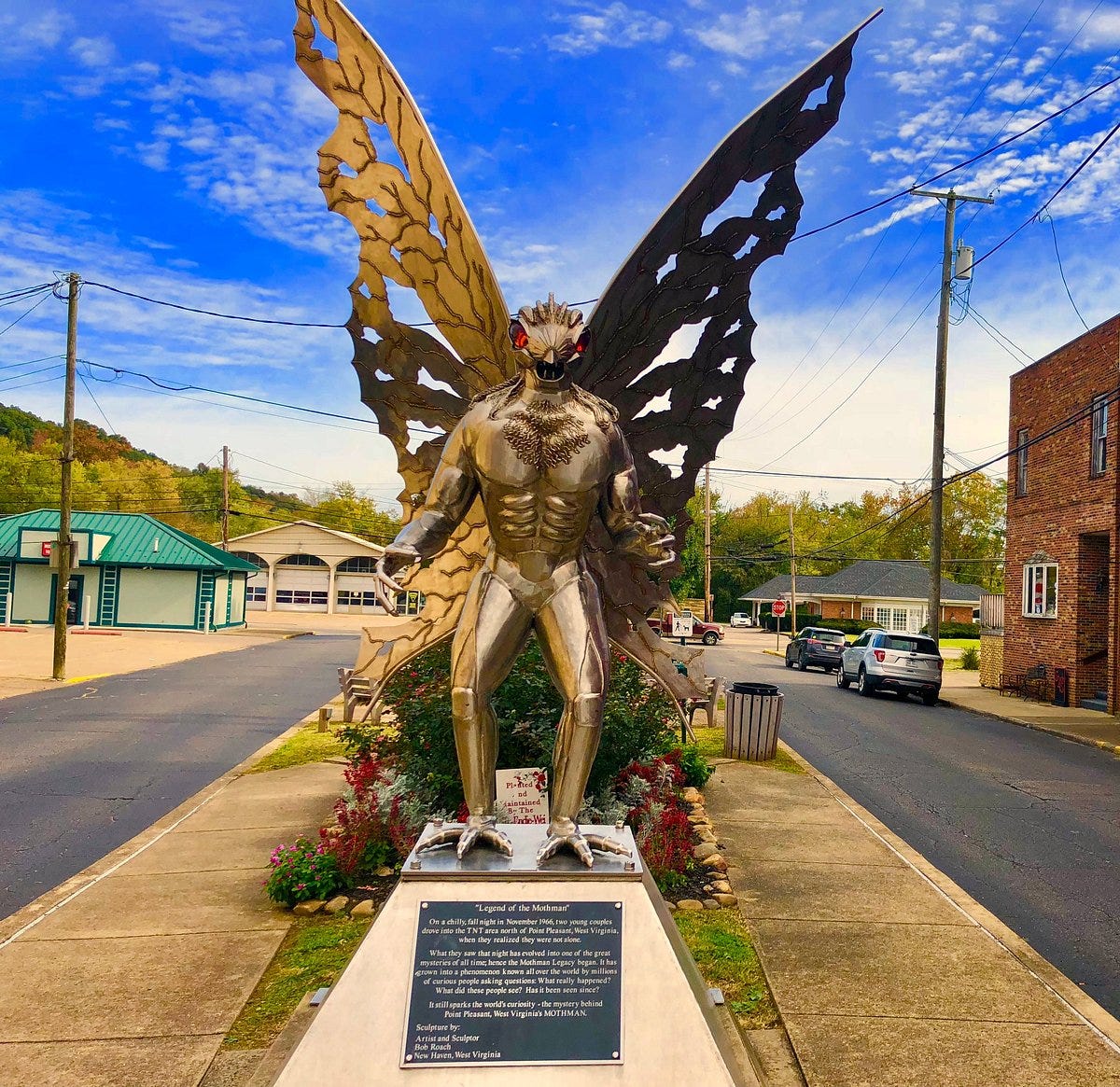
A mysterious winged omen appears before a tragedy. Half a century later, people are buying coffee mugs. But that’s what folklore does. Stories evolve. Monsters become mascots. Fear becomes identity.
And legends find new ways to survive.
WHY WE KEEP TELLING THIS STORY
Mothman isn’t really about a monster. He’s about uncertainty. He’s about the feeling that something is wrong before you know what it is. He’s about looking backward after tragedy and wondering whether the signs were always there.
Most monster stories ask: “What lives in the dark?” Mothman asks: “What if the dark is trying to tell us something?” That’s a very different kind of fear. One is physical. The other is existential.
Whether Mothman was a bird, a hoax, mass hysteria, or something genuinely unexplained almost doesn’t matter anymore. The story survived because it touches something universal. The desire to find meaning. The hope that warnings exist. The fear that we might miss them.
CTRL+BINGE CONNECTION
This is why Mothman feels more like the X-Files than Bigfoot. Bigfoot asks: What’s in the woods? Mothman asks: What if reality is stranger than we think? You can see echoes of that idea everywhere.
- Supernatural anime.
- Cosmic horror.
- Silent Hill.
- Twin Peaks.
Stories where the mystery matters more than the monster. Because Mothman isn’t scary because he’s huge. He’s scary because nobody can agree on what he actually is. And uncertainty is one of humanity’s oldest fears.
FINAL PUSH
Maybe Mothman was a misidentified owl. Maybe he was a crane. Maybe he was a hoax. Maybe he was something else entirely. But nearly sixty years later, we’re still talking about him. Not because we solved the mystery. Because we didn’t. And sometimes the stories that survive aren’t the ones with answers. They’re the ones with questions.
THE QUESTION THAT LINGERS
What’s more terrifying: A monster that causes disasters? Or a monster that only appears to watch them happen?