Long before Luke Skywalker.
Long before Darth Vader.
Long before the Empire ever existed.
There was a Star Wars story that asked a dangerous question:
What happens when the hero and the villain might be the same person?
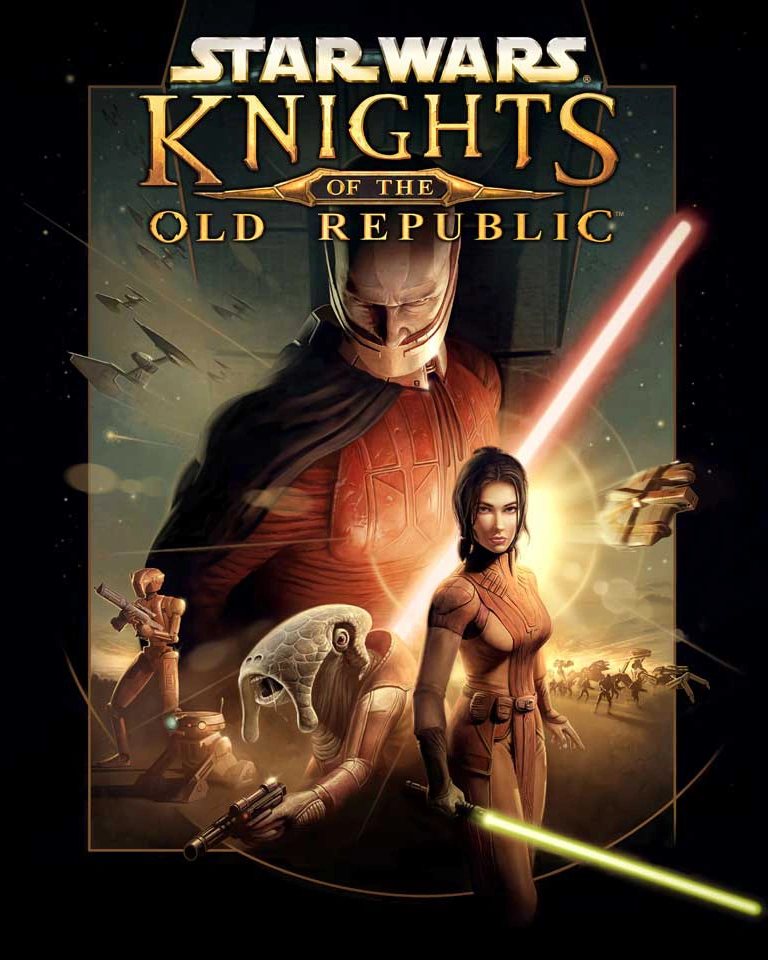
This week, we’re revisiting Star Wars: Knights of the Old Republic — one of the most beloved RPGs ever made, and the game that proved Star Wars could tell stories far beyond the movies.
Ask most gamers about Knights of the Old Republic and you’ll usually get one of two responses.
Either:
“That’s one of the greatest RPGs ever made.”
Or:
“Is that the one with the big twist?”
For years, KOTOR has carried an almost mythical reputation.
Released in 2003 by BioWare, it arrived during an era when Star Wars games were everywhere. Flight sims, shooters, lightsaber games, strategy games—you name it.
At first glance, KOTOR looked like another attempt to capitalize on the franchise.
A Star Wars role-playing game.
Sounds neat.
Move on.
Except players didn’t move on.
Twenty-three years later, people are still talking about it.
The twist gets most of the attention. The morality system gets remembered. The ability to become a Jedi gets highlighted.
And if you’ve never played it, you might assume it’s simply “Mass Effect before Mass Effect.”
That’s not entirely wrong.
But it misses why KOTOR became legendary.
Because KOTOR isn’t remembered for letting you be a Jedi.
It’s remembered because it understood something fundamental about Star Wars:
The Force isn’t interesting because it’s powerful.
It’s interesting because of what it reveals about people.
Mechanics — A Role-Playing Game Wearing a Jedi Robe
At its core, KOTOR is a classic role-playing game.
You create a character.
You assemble a party.
You travel from world to world completing quests, making decisions, and developing relationships with your companions.
Combat isn’t the fast-paced action modern players might expect.
Under the hood, it’s heavily inspired by tabletop RPG systems.
Every attack, ability, and Force power is influenced by statistics, character builds, and strategic choices.
You don’t just swing a lightsaber.
You build a Jedi.
Or a Sith.
Or something in between.
The gameplay loop becomes addictive because every decision feels personal.
Do you help someone?
Exploit them?
Show mercy?
Seek power?
The game constantly asks who you’re becoming.
Story & Characters — The Secret Sauce
KOTOR begins like a fairly standard Star Wars adventure.
The Republic is losing a war against the Sith.
The Jedi are stretched thin.
And you’re just another soldier caught in the middle of it all.
At least that’s what the game wants you to believe.
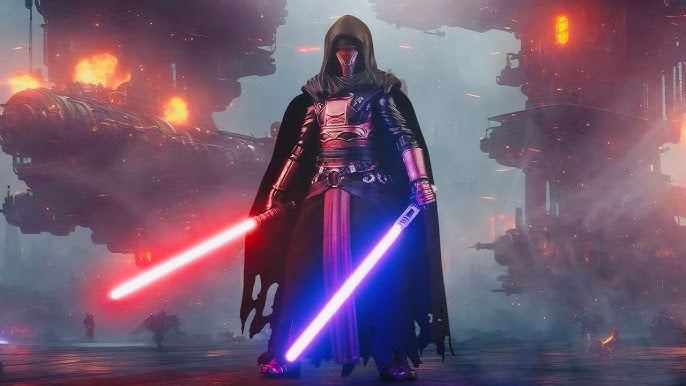
As the story unfolds, you’re chasing the legacy of Revan — a former Jedi Knight who became one of the most feared Sith Lords in galactic history.
Revan isn’t just a villain.
He’s a ghost hanging over every conversation.
Every battle.
Every political decision.
The galaxy is still trying to recover from the choices he made.
Then KOTOR delivers one of gaming’s most famous reveals:
You are Revan.
Not his apprentice.
Not his descendant.
Not someone carrying his legacy.
You.
The Jedi Council erased your memories after Revan’s defeat and rebuilt your identity from the ground up.
Suddenly the game transforms.
The central question is no longer:
“Can we stop the Sith?”
It’s:
“Can a person truly become someone else?”
That question elevates everything.
Because now every Light Side or Dark Side choice becomes personal.
Are you choosing your future?
Or rediscovering your past?
And that’s why Revan remains one of the most beloved characters in Star Wars history.
Not because he’s powerful.
Because he’s one of the franchise’s greatest explorations of redemption.
World, Visuals & Atmosphere — A Galaxy Untouched by the Movies
One of KOTOR’s greatest strengths is its setting.
This is Star Wars nearly four thousand years before the films.
That distance gives the game freedom.
The Republic exists, but it’s different.
The Jedi exist, but they’re different.
The Sith exist, but they’re very different.
Planets like Taris, Dantooine, Korriban, and Manaan feel ancient and mysterious.
You’re exploring a galaxy that feels familiar enough to be Star Wars while remaining unpredictable.
There’s no waiting for Darth Vader to show up.
No checking boxes from the films.
This era belongs to itself.
And because of that, the world feels larger than the Skywalker saga.
Sound & Music — Pure Star Wars Magic
KOTOR deserves tremendous credit for sounding like Star Wars without simply replaying movie tracks.
The score captures that same sense of wonder, danger, and adventure.
The ambient sounds of starports.
The hum of lightsabers.
The mechanical chatter of droids.
Every piece contributes to immersion.
The voice acting also deserves recognition.
In an era when many RPGs still relied heavily on text, KOTOR committed to bringing its characters fully to life.
HK-47 alone remains one of gaming’s most quoted characters.
Meatbags know exactly what I’m talking about.
Choice, Consequence, and the Dark Side
One of the reasons KOTOR still resonates is because it understands temptation.
Many games offer good and evil choices.
KOTOR makes them feel meaningful.
The Dark Side isn’t presented as cartoon villainy.
It’s presented as efficiency.
Control.
Power.
The ability to get what you want right now.
That’s much more interesting.
And much more dangerous.
The game understands that villains rarely think they’re villains.
That’s pure Star Wars.
And it’s why player choices still matter decades later.
WHY IT MATTERS
What makes the Revan twist endure isn’t the surprise itself.
It’s what happens afterward.
Most twists exist to shock the audience.
KOTOR uses its twist to change the meaning of every decision you’ve already made.
Every act of kindness.
Every selfish choice.
Every conversation.
Suddenly the game isn’t asking whether Revan was good or evil.
It’s asking something much more uncomfortable:
If your memories disappeared tomorrow, would you still be the same person?
That’s pure Star Wars.
The Light Side and Dark Side have always been less about powers and more about identity.
About whether people are prisoners of their past.
Or capable of choosing something better.
KOTOR may be set thousands of years before the films, but few Star Wars stories understand that theme better.
MODERN CONNECTION
You can still see KOTOR’s fingerprints all over modern gaming.
Mass Effect.
Dragon Age.
Baldur’s Gate 3.
Every RPG built around meaningful choices, party relationships, and player-driven identity owes something to KOTOR.
And from a Star Wars perspective?
The game helped prove fans wanted stories beyond the movies.
Today we have television shows, novels, comics, and games exploring every corner of the galaxy.
KOTOR helped open that door.
It showed Star Wars wasn’t just one family’s story.
It was a universe.
A massive one.
And sometimes the most compelling stories happen thousands of years before the opening crawl.
QUESTION
Let’s settle this one.
If you were handed a lightsaber and the Force tomorrow…
Would you stay on the Light Side?
Or would the temptation of the Dark Side eventually win?