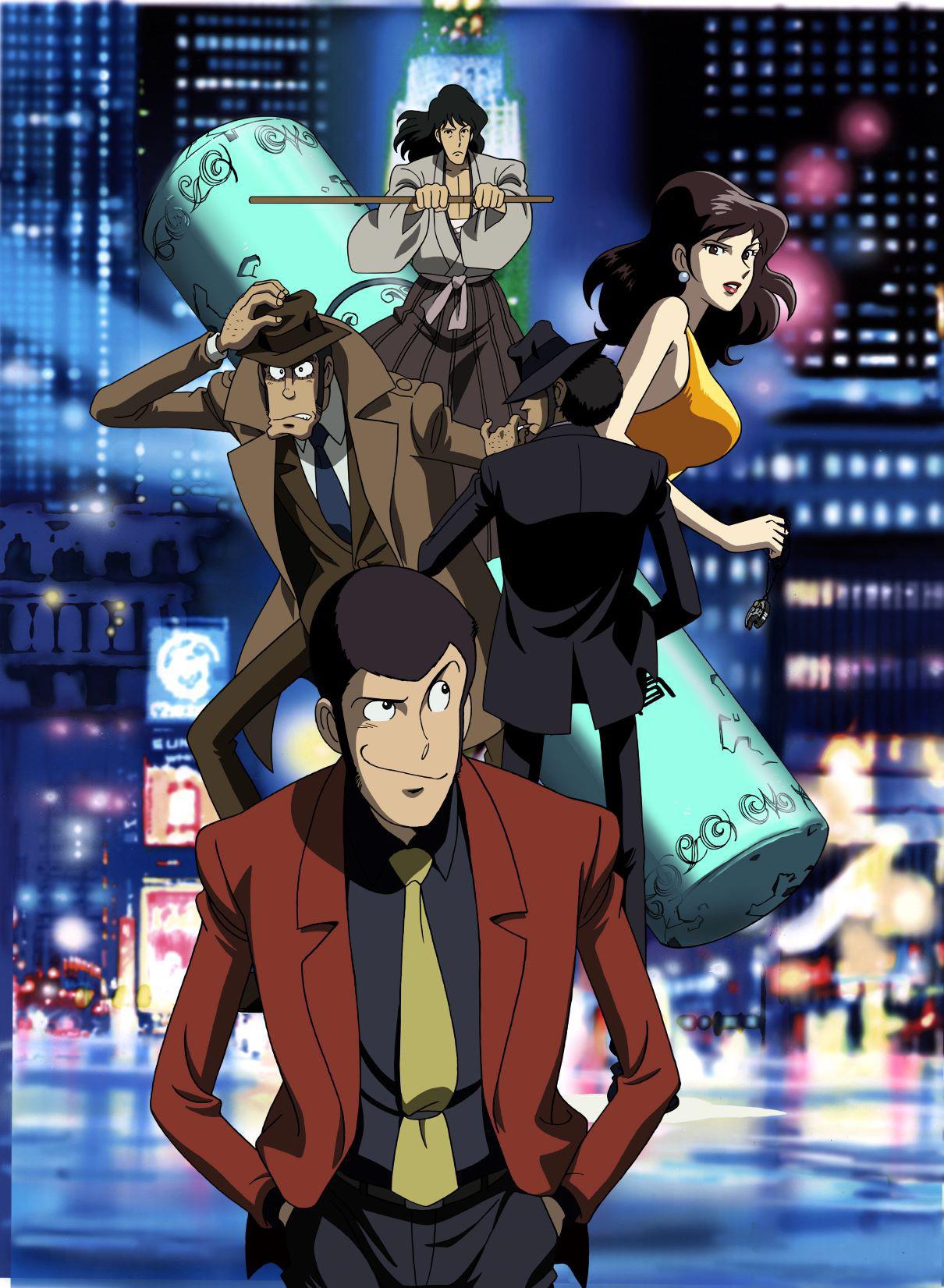
He’s a thief.
A flirt.
A walking disaster in a colored blazer.
And somehow?
One of anime’s coolest men.
At first glance, Lupin the Third feels like chaos in human form. A grinning criminal mastermind outrunning Interpol, seducing danger, stealing impossible treasures, and somehow escaping explosions he probably caused. It looks goofy. It looks old-school. It looks like the kind of anime your “real anime fan” friend swears is essential while everyone else quietly nods and pretends they’ve seen it.
But here’s the thing:
Lupin the Third isn’t just some dusty legacy franchise anime fans keep on life support out of obligation.
This thing still moves.
It still entertains.
And more importantly…
It still feels cool.
Because beneath the slapstick, car chases, disguises, double-crosses, and enough impossible heists to bankrupt half the planet, Lupin is one of manga anime’s foundational playgrounds.
James Bond if he was a disaster bisexual raccoon.
Scooby-Doo if the gang committed felonies.
Ocean’s Eleven if everyone was slightly more insane.
And somehow, after more than fifty years?
It still works.
So the real question is:
How does a franchise about the same lovable idiot criminal and his weird little crew keep surviving decade after decade?
Let’s crack the vault.
If you’ve never touched Lupin the Third, here’s the simplest version:
It’s about a world-famous gentleman thief named Arsène Lupin III—a descendant (or spiritual successor, depending on how legally nervous we’re being) of the legendary fictional thief Arsène Lupin.
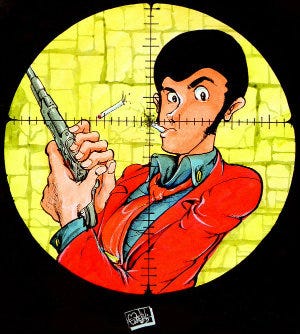
Lupin is brilliant.
Lupin is reckless.
Lupin is charming.
Lupin is catastrophically unserious.
And he spends his life stealing impossible things.
Treasures.
Artifacts.
Secrets.
Government tech.
Priceless jewels.
Occasionally common sense.
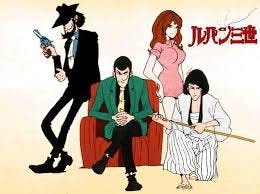
He’s joined by a recurring crew that anime fans eventually come to adore:
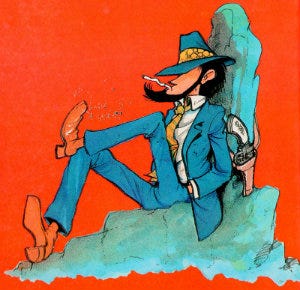
Daisuke Jigen — the impossibly cool gunman with the fedora.
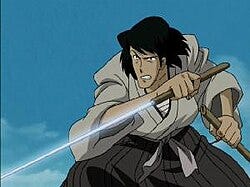
Goemon Ishikawa XIII — stoic samurai sword god.
Fujiko Mine — femme fatale, thief, manipulator, occasional ally, recurring problem.

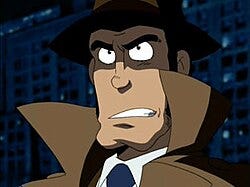
Inspector Zenigata — the Interpol detective whose entire existence revolves around screaming “LUPIN!” and somehow being more lovable every time.
That’s the gang.
And much like Scooby-Doo, they get remixed across multiple series, movies, specials, and interpretations.
Different eras.
Different tones.
Same iconic weirdos.
One story might feel like slapstick comedy.
Another feels like spy thriller.
Another becomes heartfelt adventure.
Another gets weirdly stylish and mature.
But the core question stays the same:
Can Lupin steal the impossible before the world catches him?
Usually while making everyone’s lives worse.
Most people think Lupin the Third is just old anime nonsense.
The “your dad’s anime” starter pack.
Cheap animation.
Corny jokes.
A horny cartoon thief.
Some car chases.
A detective yelling.
A samurai doing anime nonsense with a sword.
And honestly? That perception doesn’t come out of nowhere.
Because depending on what clips or screenshots you’ve seen, Lupin absolutely can look ridiculous.
This is a franchise where a master thief can go from pulling off a brilliant international heist… to disguising himself in a way that should fool literally nobody.
This is a world where Zenigata can be a competent international detective one minute and full cartoon chaos the next.
This is a franchise where tone can swing from goofy sitcom energy to genuine suspense.
If your anime experience starts with modern battle shonen, Lupin can initially feel like stepping into another universe entirely.
No power scaling spreadsheets. No chosen one prophecy. No transformation sequences every six episodes. No tragic orphan screaming about destiny.
Just grown adults making terrible criminal decisions.
And yes, that can make it feel lighter.
Less “important.”
Less emotionally serious.
Like something fun, but maybe not essential.
Like anime comfort food.
Like a franchise you “respect” historically without ever actually watching.
That’s the surface read.
And it’s understandable.
But it’s also incomplete.
Because Lupin the Third doesn’t survive for fifty-plus years because anime fans are nostalgic.
It survives because the formula is absurdly flexible.
Underneath the comedy is one of anime’s most adaptable storytelling engines:
A perfect cast.
An instantly recognizable premise.
And enough tonal elasticity to become almost anything.
That’s why it works.
And why it keeps working.
CHARACTERS
Main Character: Lupin Himself
Lupin should be exhausting.
On paper, he’s a nightmare.
Cocky.
Immature.
Womanizer.
Chaotic.
Self-sabotaging.
Criminal.
And yet?
He’s magnetic.
Because Lupin isn’t cool in the polished “look how badass I am” anime protagonist sense.
He’s cool because he feels alive.
He improvises.
He panics.
He jokes.
He fails.
He survives through wit, instinct, luck, and sheer refusal to behave normally.
He’s Bugs Bunny with a criminal record.
Han Solo if Han somehow got less responsible.
That unpredictability makes him incredibly watchable.
Supporting Cast
Jigen
This man is weaponized charisma.
Fedora.
Five o’clock shadow.
Dry wit.
Marksman perfection.
He’s the guy who makes lighting a cigarette look tactical.
Every group needs someone grounded enough to make the chaos believable.
Jigen is that anchor.
Cool without trying.
Goemon
Anime has a long history of “the stoic swordsman.”
Goemon is one of the greats.
He’s absurdly competent.
Ridiculously serious.
And unintentionally hilarious because he exists in a world full of idiots.
Watching Goemon maintain samurai dignity while Lupin behaves like a gremlin is endlessly entertaining.
Fujiko Mine
Here’s where Lupin gets interesting.
Because Fujiko is not “the girl.”
She is absolutely not here to be anyone’s prize.
She’s often smarter than everyone.
More manipulative than everyone.
And possibly the most dangerous person in the room.
Different versions of Lupin interpret her differently, but when she works?
She absolutely sings.
Zenigata
Zenigata should be a joke.
And sometimes he is.
But the best versions understand something crucial:
Zenigata isn’t just comic relief.
He’s Lupin’s mirror.
The law chasing chaos.
Order pursuing freedom.
Routine pursuing improvisation.
And somehow, despite everything?
You root for him too.
That’s hard to pull off.
Emotional Chemistry
This is where the franchise wins.
The gang chemistry is immaculate.
The sniping.
The betrayals.
The reluctant teamwork.
The weird affection.
They feel lived-in.
Like old coworkers who absolutely should’ve quit each other decades ago.
That familiarity is the secret sauce.
WORLDBUILDING
This is not One Piece.
Let’s be clear.
You’re not getting encyclopedic lore.
No elaborate mythology.
No cosmic ruleset.
No “Episode 872 callback reveals hidden kingdom politics.”
That’s not what Lupin is doing.
Instead, the world works like a global playground.
Europe.
Casinos.
Museums.
Castles.
Spy agencies.
Airports.
Secret labs.
Luxury trains.
International crime dens.
Random islands.
The setting changes constantly.
And that’s actually a strength.
Because the real “worldbuilding” isn’t geography.
It’s vibe.
This universe runs on adventure logic.
Anything is possible if it makes the story more fun.
That flexibility keeps the franchise fresh.
One week is a jewel heist.
Another is espionage.
Another is treasure hunting.
Another becomes unexpectedly emotional.
Modern entries especially sharpen the international flavor.
And because the franchise spans decades, you can actually watch its aesthetic evolve alongside changing eras of filmmaking and animation.
That’s weirdly fascinating.
Does the world feel “deep”?
Not in lore-heavy terms.
Does it feel alive?
Absolutely.
Because every setting feels like a stage waiting for Lupin to ruin it.
ACTION / POWER SYSTEM
No anime power system here.
No chakra.
No nen.
No cursed energy.
No transformations.
And honestly?
That’s refreshing.
Action in Lupin works because it’s grounded in creativity, not escalation.
Car chases.
Shootouts.
Heists.
Sword fights.
Getaways.
Improvised nonsense.
The appeal isn’t “who’s stronger?”
It’s “how the hell do they get out of this?”
That creates a totally different tension.
Jigen brings gunplay.
Goemon brings absurd sword precision.
Lupin brings gadgets, tricks, disguises, and reckless improvisation.
Zenigata brings relentless pursuit.
The action becomes storytelling.
Every chase says something about personality.
Every escape reflects character.
That matters.
And yes, Goemon absolutely breaks the realism scale.
But somehow that just becomes part of the charm.
Because Lupin understands that action doesn’t need bigger explosions to stay fun.
It needs creativity.
EMOTIONAL CORE
So, what is Lupin actually about?
Freedom.
That’s the answer.
Freedom from routine.
Freedom from rules.
Freedom from institutions.
Freedom from predictability.
Lupin represents a kind of chaotic autonomy modern stories don’t always embrace.
He’s not trying to save the world.
He’s not seeking justice.
He’s not destiny’s chosen golden boy.
He just refuses to be boxed in.
That makes him weirdly refreshing.
Zenigata becomes the perfect counterpoint.
Law.
Structure.
Pursuit.
Duty.
And somewhere between them?
You get the franchise’s emotional heartbeat.
Because for all the comedy, there’s an undercurrent of strange affection between predator and prey.
Then there’s the gang dynamic itself.
Lupin isn’t exactly “family” storytelling.
But it absolutely becomes found-crew energy.
A bunch of wildly incompatible people who somehow keep orbiting one another.
And that emotional familiarity matters.
Even when individual stories stay light.
Because the emotional investment comes less from dramatic trauma arcs…
…and more from simply enjoying time with these people.
That’s a different kind of emotional storytelling.
And a valid one.
STYLE / PRESENTATION
Visually, Lupin is a time capsule in the best way.
Depending on the era, you’ll get:
- classic 70s anime grit
- bright adventure energy
- slick modern updates
- stylish noir influences
- occasionally bizarre experimentation
Character design is iconic.
Those jackets alone are anime history.
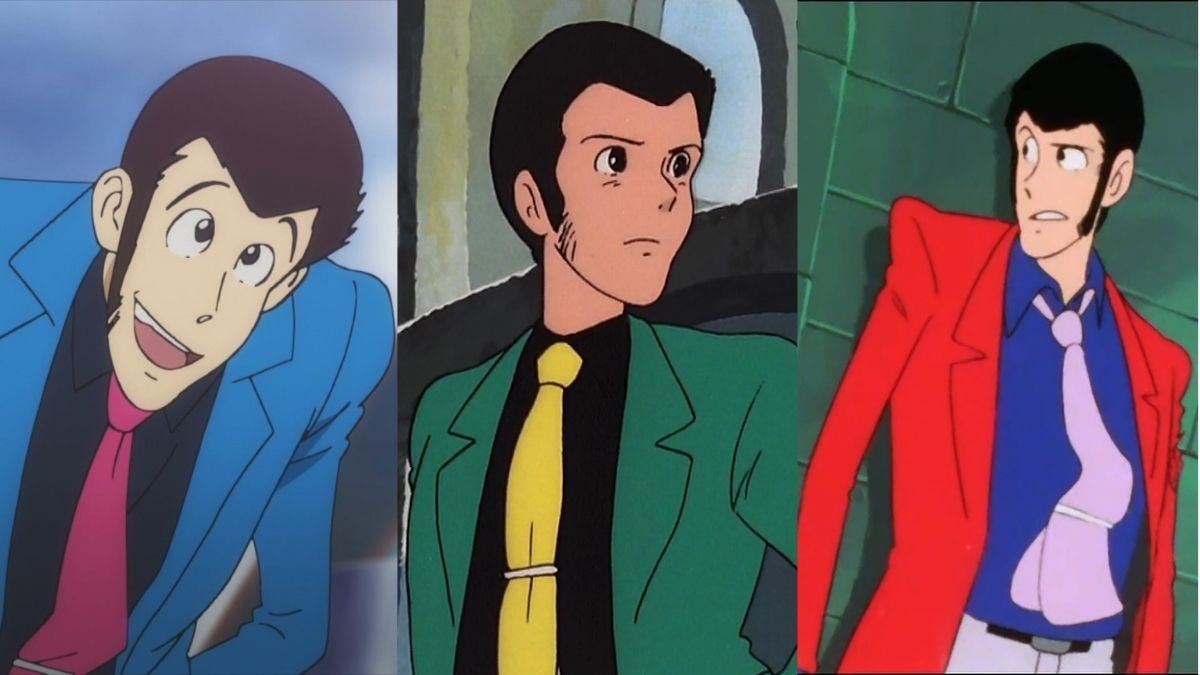
Green.
Red.
Pink.
Blue.
Even casual fans recognize the silhouette.
Music?
Legendary.
The jazz influence absolutely defines the franchise.
That soundtrack identity gives Lupin sophistication most anime simply don’t have.
It feels cool.
Not because the show tells you it’s cool.
Because it sounds cool.
Animation quality obviously varies by era.
That’s expected in a fifty-year franchise.
But when Lupin is firing?
It feels cinematic.
Especially entries like Castle of Cagliostro.
And that tonal flexibility again becomes a strength.
The same franchise can feel whimsical, slick, or mature depending on execution.
That’s rare.
LET’S BE FAIR
Let’s not romanticize this. Lupin is not universally accessible.
If your anime tastes begin and end with modern battle shonen?
This may bounce off hard.
Older animation styles can be a barrier.
Some humor is absolutely era-dependent.
Certain portrayals, especially around women, can feel dated depending on the version.
Tone inconsistency is real.
One interpretation might feel breezy and adventurous.
Another gets darker.
Another gets more absurd.
That flexibility is a strength, but it can also confuse newcomers.
There’s also the franchise sprawl problem.
Where do you start?
What matters?
What’s skippable?
That can create friction.
And because continuity is loose, emotional investment sometimes comes from vibe more than serialized payoff.
If you crave tight serialized arcs?
This may not scratch that itch.
Lupin himself can also be divisive if the womanizing rogue archetype annoys you.
Your mileage will vary.
Not every version handles that aspect equally well.
So yes.
This franchise absolutely has baggage.
But that comes with being this old and this prolific.
WHO IS THIS FOR?
This is for people who love:
✔ stylish heists
✔ classic adventure stories
✔ found-crew chemistry
✔ spy capers
✔ jazzy soundtracks
✔ older anime history
✔ clever escapes
✔ lovable rogues
This is for viewers who miss episodic fun.
For people tired of “save the universe” fatigue.
For fans of Cowboy Bebop, caper films, old Bond vibes, or adventure storytelling.
This may NOT be for you if:
✖ you need tight serialization
✖ you dislike older animation aesthetics
✖ you hate rogue protagonists
✖ you want heavy emotional melodrama
✖ you only want power fantasy escalation
WHY IT MATTERS
Because Lupin the Third helped define anime cool.
Before anime became synonymous with transformations, existential trauma, or endless tournament arcs…
there was this idiot in a blazer.
And that matters.
Because Lupin proved anime could be stylish.
Adult.
Funny.
Adventurous.
Sophisticated.
Flexible.
Its fingerprints are everywhere.
Without Lupin, you can see gaps in the lineage toward:
- Cowboy Bebop
- stylish caper anime
- criminal antihero protagonists
- genre-blending adventure storytelling
It also represents something modern franchises sometimes forget:
Characters can simply be fun to spend time with.
Not everything needs world-ending stakes.
Sometimes you just want to watch charismatic weirdos ruin international infrastructure.
That’s art too.
CTRL+BINGE FINAL TAKE
Lupin the Third isn’t manga or anime comfort food because it’s safe.
It’s comfort food because the recipe works.
A perfect cast.
Flexible storytelling.
Endless style.
And one of the most enduring lovable criminals in fiction.
Is every entry a masterpiece?
Absolutely not.
But as a franchise?
This thing has ridiculous staying power.
And honestly?
That alone deserves respect.
Question for Readers
In an era where every franchise wants universe-ending stakes…
Have we forgotten how fun it is to just watch a crew of charismatic idiots chase adventure?