Snow falling on a quiet route.
A piano starts playing in the distance.
And suddenly… this doesn’t feel like a kid’s game anymore.
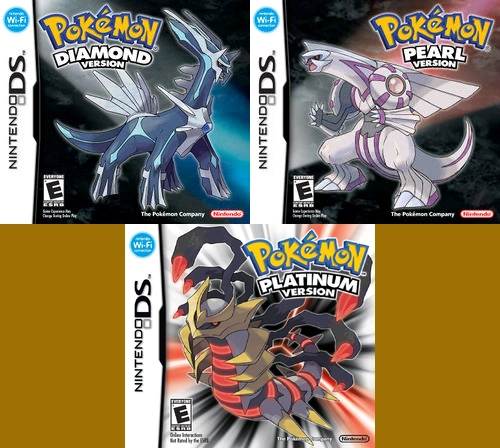
This week, we’re heading to Sinnoh with Pokémon Diamond and Pearl and the definitive upgrade Pokémon Platinum.
The generation where Pokémon didn’t just evolve…
It matured.
Ask people about Gen IV and you’ll usually hear:
“Oh yeah — the slow one. The one with the god Pokémon.”
That’s the reputation.
Diamond and Pearl are remembered for:
- Slower battle speed
- The introduction of online trading and battling
- Legendary Pokémon like Dialga, Palkia, and Arceus
- And a colder, more serious tone compared to earlier games
For some players, this was peak Pokémon — deeper, more strategic, more atmospheric.
For others, it felt like the series started to get a little heavy.
But that shift?
It was intentional.
Mechanics — Where Strategy Took Over
At its core, the loop is still classic Pokémon:
Explore the Sinnoh region, catch Pokémon, build a team, defeat Gym Leaders, and challenge the Pokémon League.
But Gen IV introduces one of the most important changes in the entire series:
The Physical/Special split.
Before this, whether a move was physical or special depended on its type. Now, it depends on the move itself.
That sounds small.
It’s not.
It completely reshapes combat:
- Pokémon can finally use moves that match their strengths
- Team building becomes far more flexible
- Battles become more strategic and less restrictive
Add in:
- Online battles via Nintendo Wi-Fi
- Expanded move pools
- Held item depth
And Gen IV becomes the point where Pokémon fully steps into competitive territory.
Story & Characters — Ambition vs Creation
Sinnoh’s story goes bigger than anything before it.
You’re still a young trainer on a journey, but this time the stakes reach beyond regions and into existence itself.
Enter Team Galactic, led by Cyrus — one of the most cold, detached antagonists in the series.
He doesn’t want power.
He doesn’t want money.
He wants to remake reality.
Using legendary Pokémon like Dialga (time) and Palkia (space), Cyrus aims to create a new world — one without emotion, without spirit.
It’s a chilling motivation.
Because it’s not chaos.
It’s control.
And your role?
To stop someone who genuinely believes the world is better off without the things that make us human.
World, Visuals & Atmosphere — Cold, Vast, and Ancient
Sinnoh feels different the moment you step into it.
It’s colder. Slower. More deliberate.
You’re traveling through:
- Snow-covered routes
- Mountain ranges like Mt. Coronet splitting the region in half
- Ancient ruins tied to legends older than memory
There’s a sense of weight to everything.
This isn’t just a region.
It feels like a place built on history — on myths that existed long before your character arrived.
And when you reach places like the Distortion World in Platinum?
It stops feeling like a Pokémon game entirely.
It feels… cosmic.
Sound & Music — Where Pokémon Found Its Soul
This is where we give flowers.
Once again, Junichi Masuda and the team deliver one of the most memorable soundtracks in the franchise.
But this time, there’s a shift.
The music feels:
- More emotional
- More atmospheric
- More cinematic
Tracks like:
- The haunting Eterna Forest theme
- The intense Champion battle
- The iconic piano melody of Route 209
They don’t just set the mood.
They define it.
Sinnoh sounds like a world with history — and that matters.
Gen IV represents a turning point.
This is where Pokémon stops being just a fun adventure and starts becoming something deeper.
It embraces:
- Complex mechanics
- Heavier themes
- A more serious tone
It trusts its audience to grow with it.
And in doing so, it creates a generation that resonates with players long after they’ve put the game down.
Because Sinnoh doesn’t just ask you to become the best.
It asks you to understand what kind of world you’re fighting for.
You can still feel Gen IV’s influence today.
Modern Pokémon games and, competitive play especially, are built on systems refined here.
And that tonal shift?
You see it everywhere now:
Games that balance:
- Accessibility with depth
- Lighthearted design with serious themes
Even outside Pokémon, RPGs have leaned more into philosophical storytelling and world-building.
Gen IV helped prove something important:
Games made for everyone can still say something meaningful.
QUESTION
Gen IV raised the stakes from “be the best” to “save reality itself.”
So, here’s the question:
Do you prefer Pokémon when it stays personal and grounded…
or when it leans into big, world-altering stakes?