Who, or what, waits inside the Labyrinth?
Half man. Half bull. All monster.
The Minotaur stalks the twisting corridors beneath Crete while fourteen terrified young Athenians search for an exit that does not exist. Then Theseus arrives.
The hero follows Ariadne’s thread into the darkness, kills the beast, and escapes from the maze.
That is the familiar story. But it begins far too late.
Before Theseus entered the Labyrinth, a king broke a promise to a god. A queen was cursed for her husband’s arrogance. An inventor built something that should never have existed. And a child named Asterion was born into a royal family that immediately decided he was too shameful—and eventually too useful—to remain free.
The Minotaur did not choose his parents. He did not ask to become divine punishment. He did not design the Labyrinth. He may not have even received the name by which history remembers him.
“Minotaur” means the Bull of Minos. Not the son of Pasiphaë. Not Asterion. The possession of Minos.
By the time Theseus finally reaches the center of the maze, he is not meeting the creature at the beginning of its story. He is meeting the last surviving consequence of everyone else’s decisions.
THE FAMILIAR VERSION
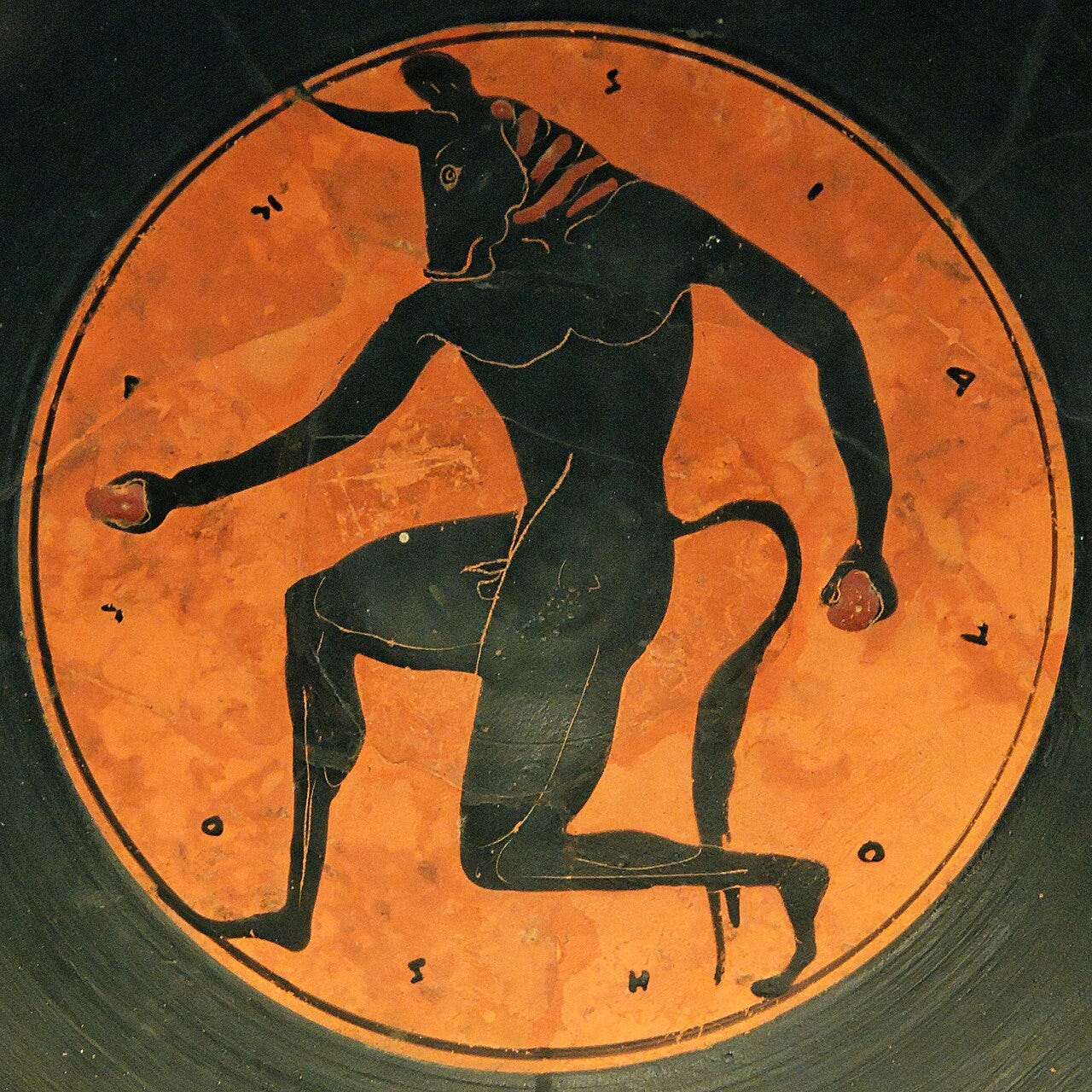
The Minotaur is one of mythology’s easiest monsters to recognize.
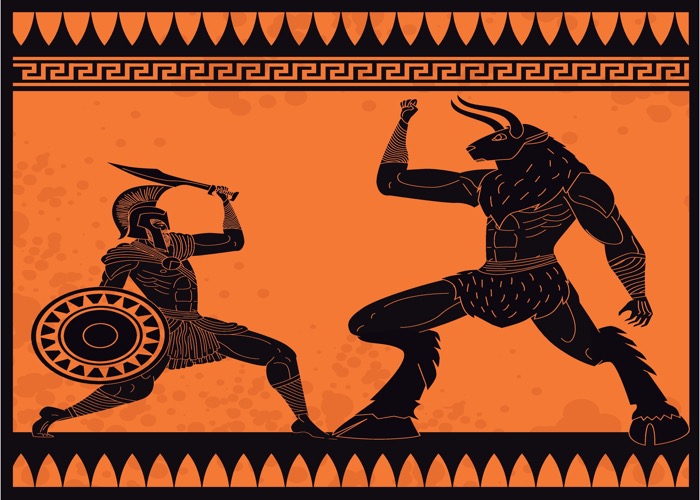
He has the body of a powerful man and the head of a bull. He lives inside an enormous Labyrinth beneath or near the palace of King Minos on the island of Crete.
No one can escape from the maze without help.
At regular intervals, Athens is forced to send seven young men and seven young women to Crete as tribute. They are locked inside the Labyrinth and devoured by the creature waiting at its center.
Eventually, the Athenian hero Theseus volunteers to join them.
Minos’s daughter Ariadne falls in love with him and gives him a ball of thread. Theseus ties one end near the entrance, unwinds it as he travels through the maze, kills the Minotaur, and follows the thread back to freedom.
Hero kills monster. Princess provides the solution. City escapes oppression.
- Clean.
- Memorable.
- Cinematic.
It has survived for thousands of years because it works almost perfectly as an adventure story.
The Labyrinth gives the hero a challenge that strength alone cannot solve. The thread gives the princess an essential role. The Minotaur gives the darkness a face.
But when we focus entirely on Theseus, the Minotaur becomes little more than an obstacle with horns.
He is waiting in the final room because the story needs something for the hero to defeat.
The older mythology gives us something much stranger.
The Minotaur had a mother. He had a name. And his story began as punishment for a crime he did not commit.
Theseus may have conquered the Labyrinth.
But the Minotaur was the one forced to live inside it.
BEFORE THE MONSTER, THERE WAS A PROMISE
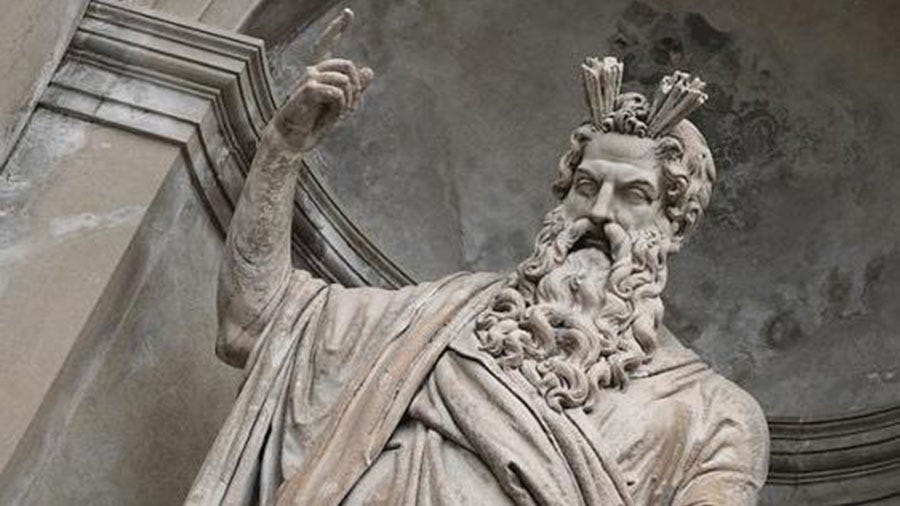
The story begins with Minos fighting for the throne of Crete.
To prove that the gods supported his claim, Minos prayed to Poseidon for a sign. He asked the sea god to send him a magnificent bull from the ocean and promised to sacrifice the animal in Poseidon’s honor.
The god agreed.
A spectacular bull emerged from the sea.
Minos received his divine endorsement, claimed the throne—and then decided the bull was too beautiful to kill.
He kept it.
Another animal was sacrificed in its place.
Minos apparently believed he could ask a god for a miracle, use that miracle to secure political power, and then quietly renegotiate the terms afterward.
Poseidon noticed.
The god’s punishment did not fall directly upon Minos. Instead, Pasiphaë, the king’s wife, was made to desire the bull.
That detail matters.
Pasiphaë is frequently reduced to “the woman who fell in love with a bull,” as though the entire disaster began with her strange appetite. In the traditional account, however, her desire is supernatural punishment inflicted because of her husband’s broken promise.
Minos commits the offense. Pasiphaë becomes the instrument of his humiliation. And their future child receives the sentence.
Greek mythology does this often. Divine punishment rarely confines itself to the person responsible. Curses travel through marriages, bloodlines, kingdoms, and generations until everyone near the original crime is forced to carry part of it.
The Minotaur was not conceived because he did something monstrous. He was conceived because a king believed he could cheat a god.
DAEDALUS BUILDS THE IMPOSSIBLE
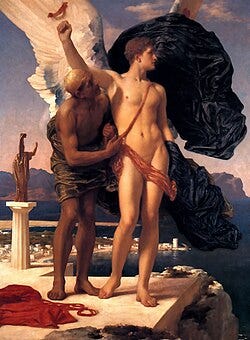
Pasiphaë turned to Daedalus. (Yes, that Daedalus, the one who helped his son Icarus fly)
He was the greatest craftsman and inventor of the age…the mythological engineer called whenever someone needed the impossible made dangerously practical.
For Pasiphaë, he constructed a hollow wooden cow.
The device was covered with the hide of a real animal and placed in the field where Poseidon’s bull grazed. Pasiphaë climbed inside, allowing the curse to reach its intended conclusion.
The story is disturbing by design. It violates the boundaries between human and animal, desire and punishment, nature and technology. But it also introduces a pattern that will define everything that follows.
Whenever Minos faces a problem, Daedalus builds him a machine.
First, Daedalus creates the disguise that allows the Minotaur to be conceived. Later, he creates the prison that allows Minos to hide him. Then his knowledge provides Ariadne with the method that allows Theseus to escape.
Daedalus does not control what people want. He merely makes their impossible desires possible.
In the Minotaur’s story, technology does not defeat the monster. Technology helps create him, contain him, and eventually kill him.
HIS NAME WAS ASTERION
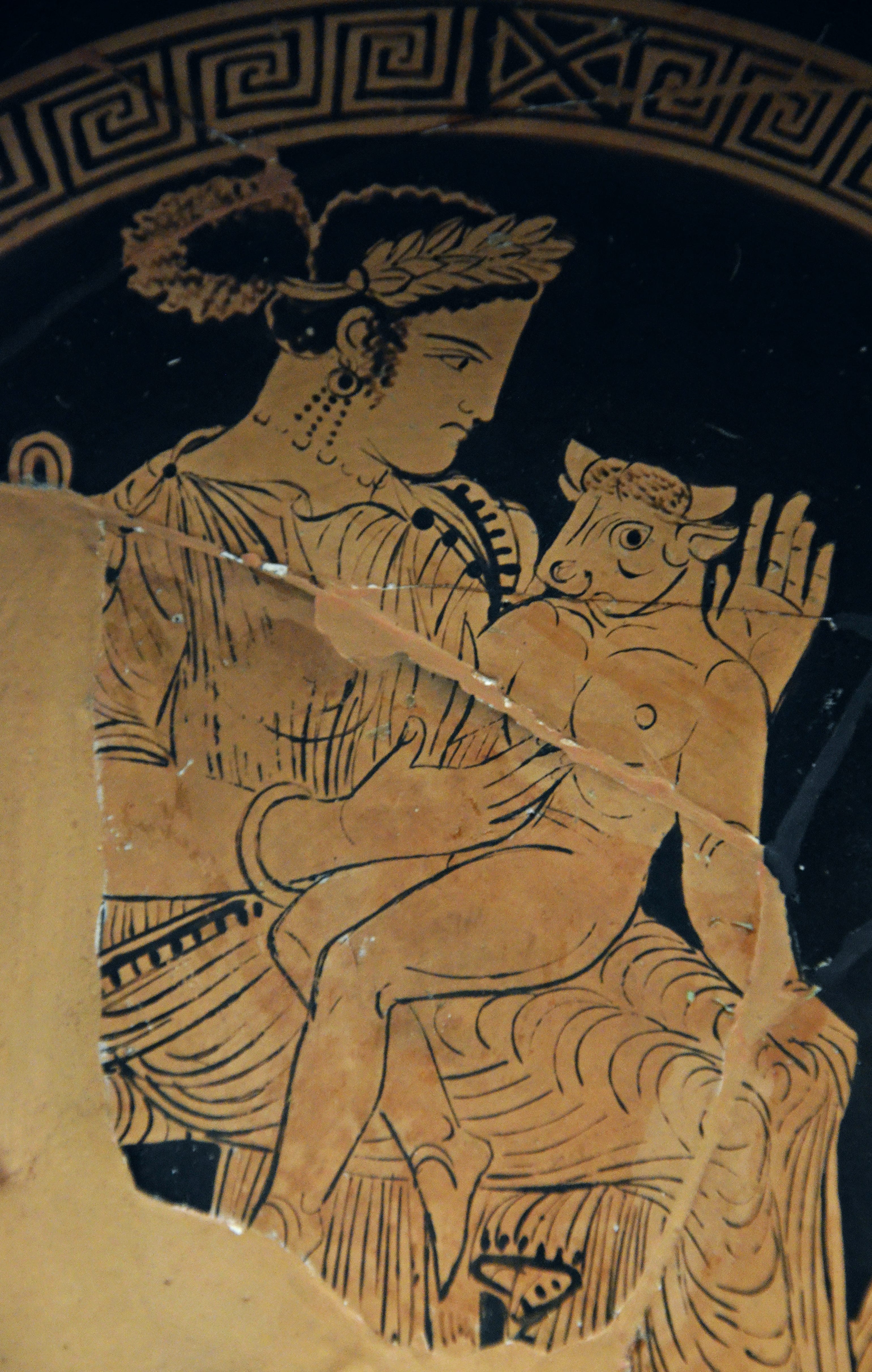
Pasiphaë gave birth to a child who was part human and part bull.
The familiar description gives him a man’s body with the head of a bull, although ancient artists and writers occasionally experimented with the arrangement.
What remained constant was the mixture: A creature trapped between two forms and fully accepted by neither.
He became known as the Minotaur, from Minos and tauros, the Greek word for bull.
The Bull of Minos. Except Minos was not his biological father. The name does not identify who the creature is. It identifies the king who owns the palace, controls the story, and decides where the child will be kept.
Other traditions give the Minotaur a personal name:
Asterion. The Starry One.
It was also the name of Minos’s mortal foster-father, making it an unexpectedly human name within the royal family. Ancient art sometimes depicted the Minotaur wearing clothing decorated with stars, connecting the supposedly mindless beast to that forgotten identity.
The National Archaeological Museum of Greece notes that ancient depictions could even show Pasiphaë tenderly holding the infant Asterion.
That image changes everything.
Before the roaring creature, before the human sacrifices, before the hero and the sword, there was a mother holding her child.
The myths rarely tell us when Asterion became dangerous.
They do not record his first words, if he could speak.
They do not tell us what he understood.
They do not explain whether he was born violent, grew ferocious in captivity, or was transformed into a monster by later storytellers who needed Theseus’s victim to deserve his fate.
We are told what everyone did around him.
We are told almost nothing about him.
Perhaps that silence is the first wall of the Labyrinth.
WHY BUILD A LABYRINTH?
When Asterion grew larger and more dangerous, Minos consulted an oracle and ordered Daedalus to construct the Labyrinth.
This was not simply a locked room. A locked room admits that someone exists behind the door. The Labyrinth was designed to make its prisoner unreachable.
Its passages twisted into one another. Its exit became impossible to locate. Anyone sent inside could be lost long before encountering the creature supposedly contained there.
It served several purposes at once.
- It protected Crete from the Minotaur.
- It concealed the evidence of Minos’s broken promise.
- It hid Pasiphaë’s humiliation.
- It transformed a royal scandal into a secret weapon.
Most importantly, it made the Minotaur dependent upon the person imprisoning him.
Minos controlled the entrance. Minos decided who went inside. Minos turned Asterion from an unwanted child into the enforcement mechanism of Cretan power.
The Labyrinth was therefore more than a cage for a monster. It was a political machine.
Minos could send enemies, prisoners, and tribute into the darkness while keeping his own hands clean. The Minotaur performed the violence, but the king selected the victims.
That distinction is often lost.
The creature eats the Athenians.
Minos feeds them to him.
THE FOURTEEN SENT INTO THE DARK
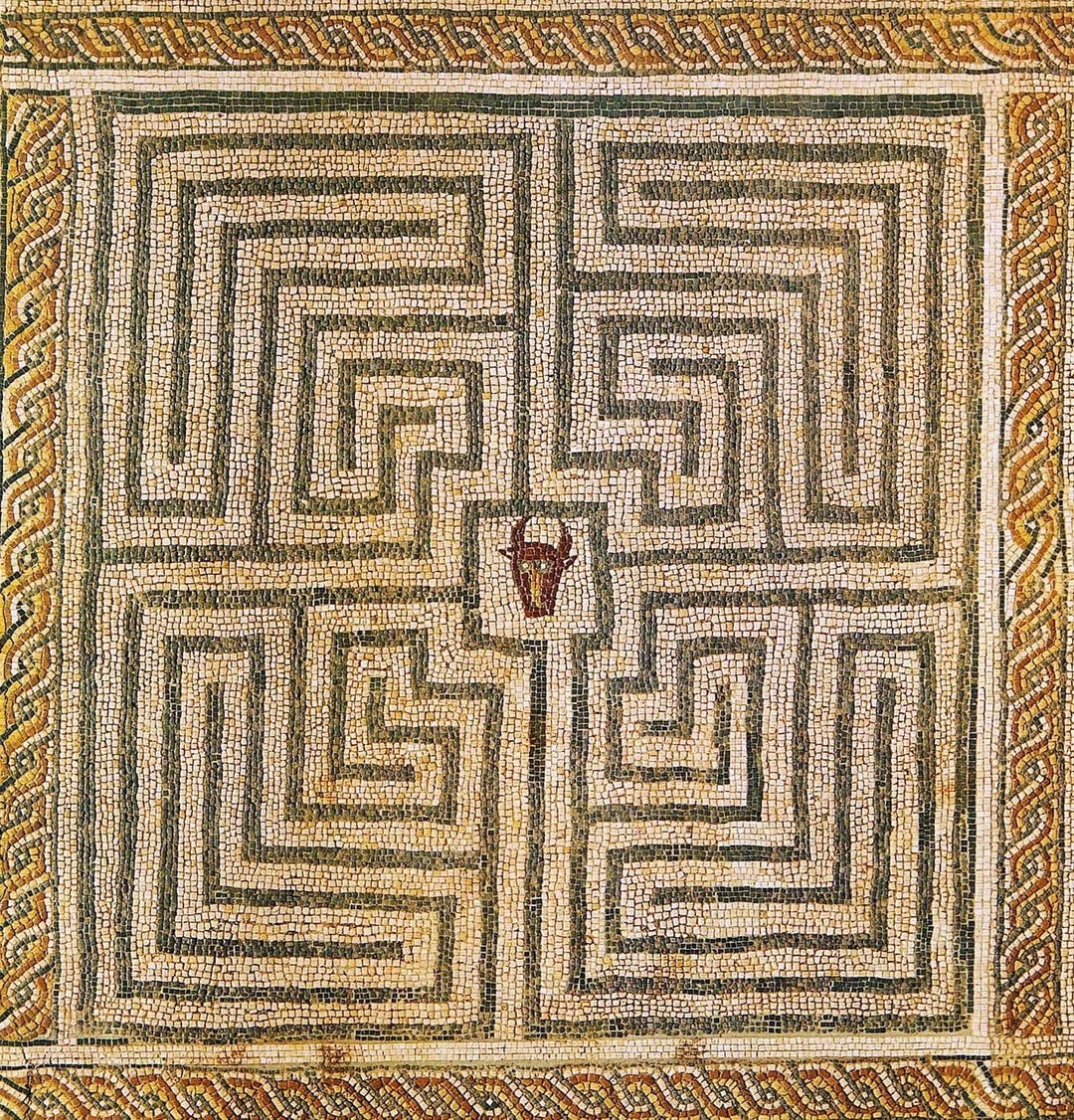
The Athenian tribute began after the death of Androgeus, one of Minos’s human sons.
The details vary.
In one version, Androgeus excelled at athletic competitions in Athens and was murdered by jealous rivals. In another, the Athenian king Aegeus sent him against the dangerous Marathonian Bull, which killed him.
Minos blamed Athens.
He waged war against the city, and divine disaster followed until the Athenians agreed to his terms:
Seven young men and seven young women would be sent to Crete.
Some sources make the tribute annual. Others say it occurred every nine years. The contradiction reminds us that there was never one perfectly fixed version of the myth.
But the purpose remains consistent. The tribute was punishment.
Fourteen young people entered the Labyrinth because one prince had died and Minos possessed the power to make an entire city pay for it.
The Minotaur consequently became the face of a system he did not create.
Athens feared the creature because he waited at the end of the journey. Yet the real machinery of terror extended far beyond him: Minos demanded the tribute. Athens selected the victims. Crete transported them.
The Labyrinth prevented their escape. Asterion was simply the final horror.
That does not make him harmless.
Ancient tradition describes him devouring human flesh. Whatever sympathy we find in his birth or imprisonment does not erase the terror experienced by those sent into the maze.
But it does complicate the clean division between innocent city, noble hero, and evil monster.
Asterion was both victim and killer. The Labyrinth made room for him to become both.
WAS THE LABYRINTH REAL?
This is where mythology and archaeology begin circling one another.
Ancient writers did not always agree about what the Labyrinth was or where it stood.
Homer mentions Knossos and says Daedalus created a dancing floor there for Ariadne, but he does not describe the famous prison.
Herodotus wrote about an enormous labyrinth in Egypt.
Later writers placed the Minotaur’s Labyrinth at Knossos, while still later traditions associated it with caves and quarry tunnels near Gortyn.
Even ancient images disagree with our modern assumptions.
Coins from Knossos depicted maze-like patterns, sometimes with the Minotaur at the center. But several of these designs contain a single winding route rather than branching dead ends.
Technically, that would make them labyrinths rather than mazes: Difficult journeys, but not places where choosing the wrong passage gets you lost.
Then archaeology entered the story.
Beginning in 1900, Arthur Evans excavated the enormous Bronze Age complex at Knossos. It contained staircases, storage rooms, corridors, courts, workshops, chambers, and multiple levels accumulated across centuries.
To someone unfamiliar with its design, it could certainly feel labyrinthine.
Evans named the civilization he uncovered “Minoan” after King Minos. He also interpreted Knossos through the mythology already associated with the site. That helped cement the popular idea that the palace itself had inspired the Labyrinth.
But we should be careful. No underground monster prison has been discovered.
We do not know what the Bronze Age inhabitants of Crete called themselves. Their Linear A writing remains undeciphered, meaning they cannot explain their culture to us in their own words.
Modern scholarship has also questioned how much Evans reconstructed Minoan civilization through assumptions he held before excavating it.
Knossos is real. Its complexity is real. The direct line from palace to Labyrinth is possible, but not proven.
The archaeological site did not prove the myth. It showed us a real world strange and powerful enough to help produce one.
CRETE BELONGED TO THE BULL
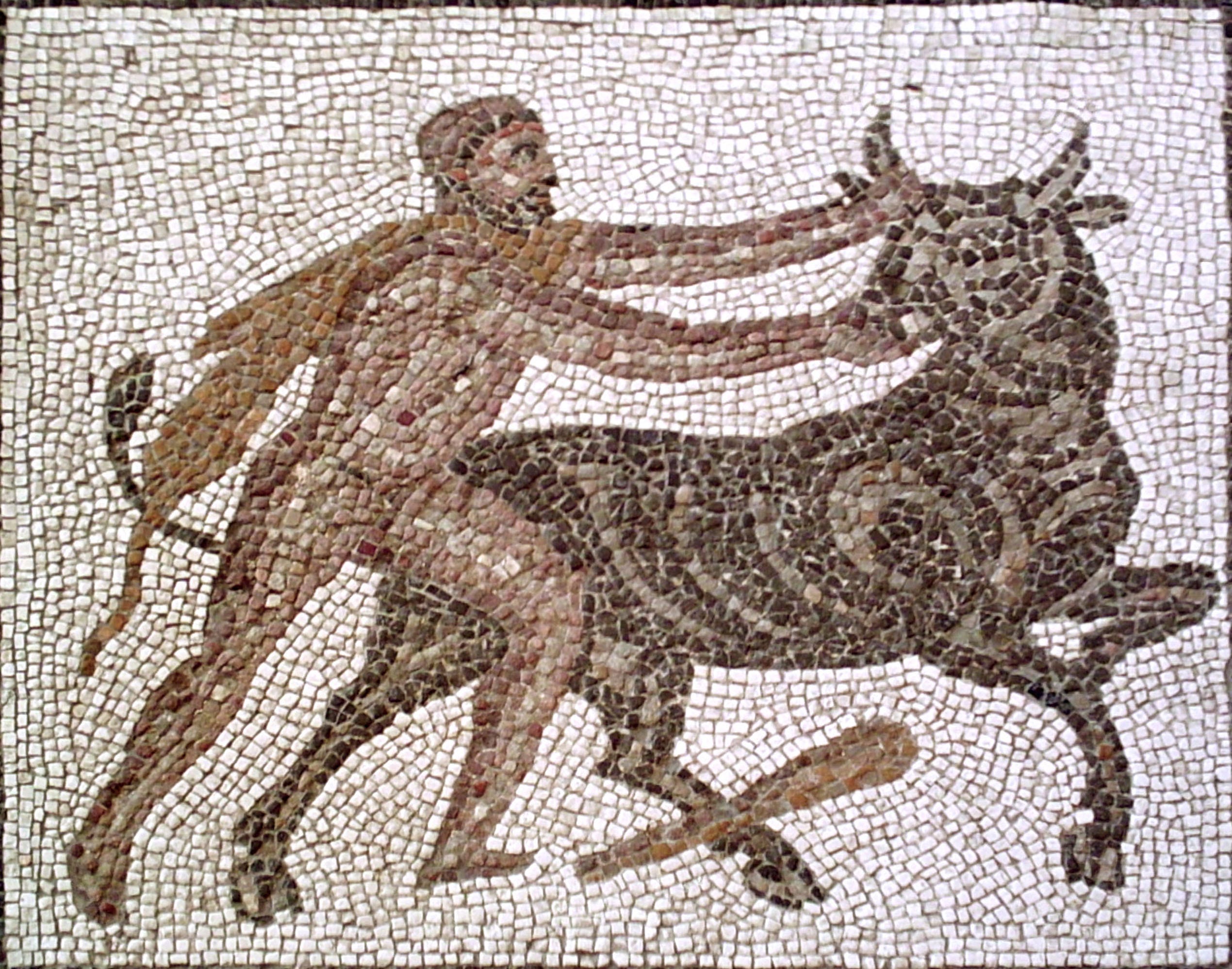
If the Labyrinth remains uncertain, the bull does not.
Bull imagery appears throughout the art and material culture of Bronze Age Crete.
There are bull-shaped vessels, carved bull heads, seals, frescoes, jewelry, and scenes of humans interacting with enormous charging animals.
The most famous example is bull-leaping.
Minoan artworks show athletic figures approaching bulls, grasping or passing over their horns, vaulting across their backs, and landing behind them.
Scholars still debate exactly how these performances worked—and whether every image represents something physically performed—but the variety of surviving scenes strongly suggests that dangerous encounters between humans and bulls held enormous cultural significance.
Imagine how this culture might have appeared to later Greeks.
A powerful island civilization. A vast palace filled with unfamiliar passages. Religious and ceremonial imagery dominated by bulls. Young men and women shown confronting those bulls.
Memories of tribute, maritime power, or political domination.
Centuries pass. The civilization falls. Its writing becomes unreadable. History loses the names but keeps the images.
- A palace becomes a maze.
- A bull ritual becomes a monster.
- Young athletes become sacrificial victims.
A forgotten conflict between Crete and mainland Greece becomes the adventure of a hero who enters the darkness and kills the creature at its center.
We cannot prove that this is how the Minotaur myth developed.
But myths frequently preserve emotional memories long after they lose historical precision.
The Minotaur may not be a distorted photograph of one real event. He may be a collage assembled from many memories of Bronze Age Crete.
THE MONSTER ATHENS NEEDED
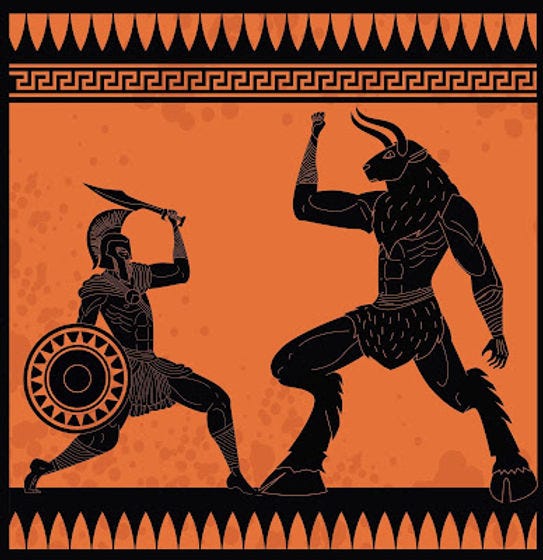
There is another reason to be cautious about the familiar version.
Much of the Minotaur’s story reached us through Greek, and especially Athenian, eyes.
Theseus became one of Athens’s great civic heroes. His victory over the Minotaur was not merely a personal triumph. It symbolized Athens overcoming Cretan dominance and ending the humiliating tribute imposed by Minos.
Ancient Athenian art repeatedly celebrated Theseus defeating the creature. The story helped present Athens as the champion of order, freedom, intelligence, and civilization.
That requires Crete to become the opposite.
Minos becomes the tyrant. The Labyrinth becomes oppression. The Minotaur becomes barbaric violence.
Theseus enters with courage, technology, and Ariadne’s knowledge. He kills the beast and brings the surviving Athenians home.
Athens adopted the myth as part of its own identity, turning Theseus into a model citizen and the Minotaur into the defeated symbol of an older rival.
The hero may have won the fight. Athens won the right to tell everyone what the fight meant.
THEN THESEUS ENTERED THE MAZE
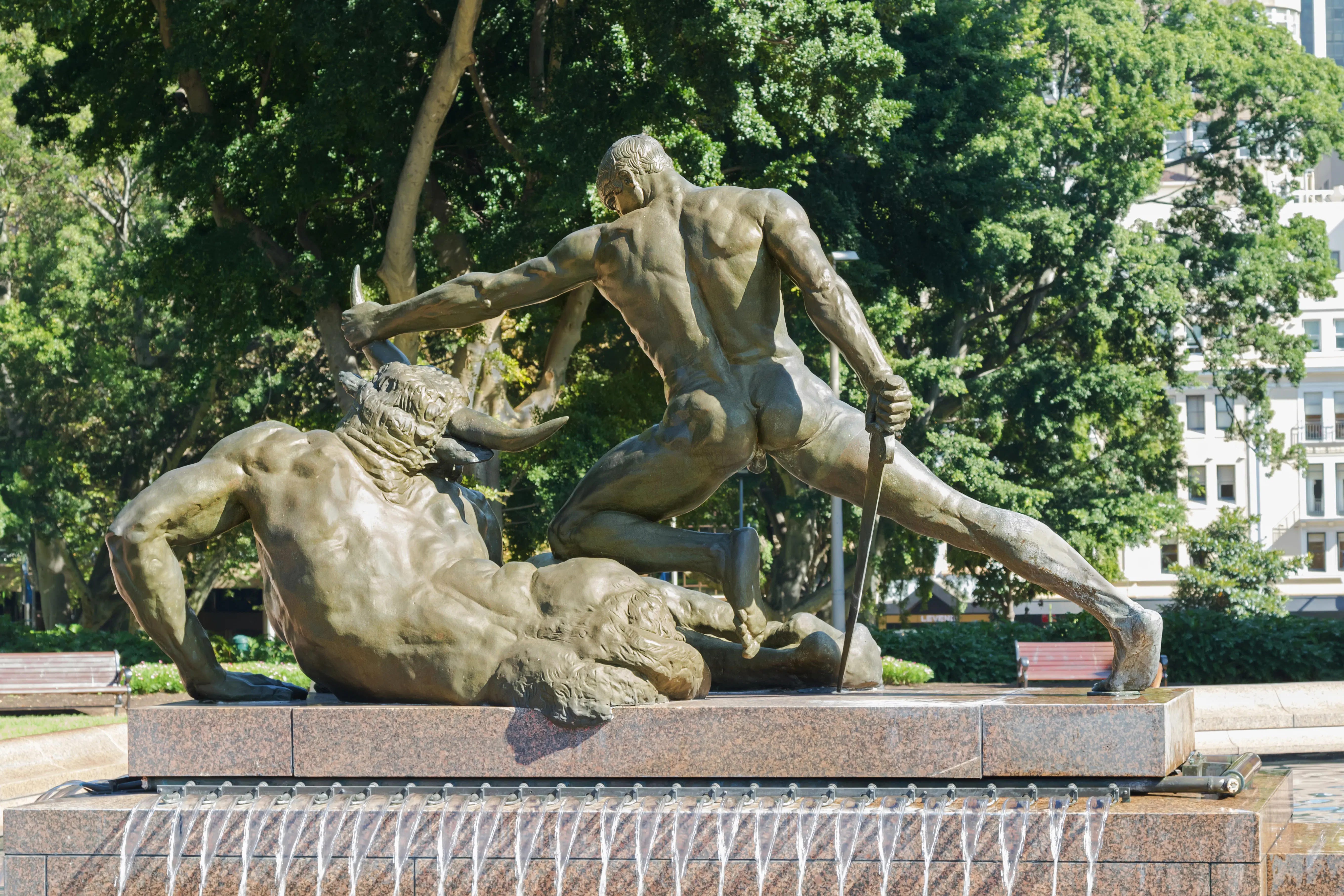
Only now does Theseus arrive.
He volunteers…or, in some versions, is selected, to join the latest group sent from Athens.
Ariadne, daughter of Minos and half-sister of the Minotaur, decides to help him. Following knowledge attributed to Daedalus, she gives Theseus the thread that will guide him back out.
The inventor who helped create Asterion’s body had also built his prison. Now the same intelligence provides the means to penetrate it.
Theseus travels to the center of the Labyrinth and confronts the Minotaur.
Ancient accounts disagree about how he kills him. Some give Theseus a sword or club. Others have him kill Asterion with his bare hands.
That final version feels almost brutally appropriate.
No divine weapon. No magical weakness. No grand conversation. Just the celebrated prince of Athens and the forgotten prisoner of Crete fighting in the dark.
Theseus kills the Minotaur and follows Ariadne’s thread back to freedom.
Asterion never leaves.
His entire recorded life begins with other people deciding what he is and ends when a hero enters his home to prove them right.
WHY WE KEEP TELLING THIS STORY
The Minotaur survives because he represents more than animal rage. He is the part of ourselves we build structures to contain.
- Family shame.
- Political violence.
- Forbidden desire.
- Inherited punishment.
- The consequences powerful people refuse to accept publicly.
Every Labyrinth needs something at its center. Something we can blame for all the bodies that disappear inside it. That is what makes Asterion so tragic.
Everyone calls him the monster because he looks like one. Yet almost every person around him makes a choice that leads someone deeper into the maze.
Minos breaks the promise. Poseidon creates the curse. Pasiphaë seeks out Daedalus. Daedalus enables the impossible. Minos orders the prison. Athens sends the tribute. Ariadne provides the thread. Theseus delivers the final blow.
The Minotaur is the one character the story rarely allows to choose anything.
Perhaps that is why modern retellings increasingly give him a voice. Once the creature begins speaking, the old heroic story becomes much harder to keep neat.
THE CTRL+BINGE CONNECTION
Modern fantasy turned the Minotaur from one singular prisoner into an entire species.
Video games, anime, tabletop RPGs, movies, and fantasy novels now fill their worlds with minotaurs. They are warriors, dungeon guardians, enemy races, honorable champions, and, almost inevitably, bosses waiting at the end of mazes.
We remembered the horns. We remembered the strength. We remembered the Labyrinth. But we frequently forgot Asterion.
Some modern adaptations have begun giving that identity back to him.
Hades calls him Asterius and transforms him into a disciplined warrior fighting beside Theseus in Elysium. Other retellings imagine the story from inside his mind, asking what the maze looked like to the only person who called it home.
Those versions work because the original myth left an enormous silence at its center.
The Minotaur has always possessed one of mythology’s greatest character designs. Now storytellers are finally asking whether he might have also possessed a character.
Theseus entered the Labyrinth as a hero. Asterion entered it as a child. One was given a thread leading home. The other was never meant to find the door.
Perhaps the Minotaur became a monster. Perhaps the darkness, isolation, violence, and human bodies delivered to him made that inevitable.
But before he belonged to the maze, before he belonged to Minos, before he belonged to Theseus’s legend, he had a name.
Asterion. The Starry One.
THE QUESTION THAT LINGERS
Was Asterion imprisoned inside the Labyrinth because he was a monster…
or did the Labyrinth ensure that a monster was the only thing he could ever become?