Another world. A magical kingdom. Monsters roam the countryside. Adventurers gather at guilds. Heroes have been summoned from another world to save the day. And our protagonist has received a unique otherworldly ability.
We’ve been here before.
Surely Mukohda is about to discover that he possesses some legendary magical power capable of reshaping the entire world.
His ability?
Online Grocery.
He can order food and other products from modern Japan.
That’s it.
Except…
Apparently that’s enough to completely break the game.
Because Campfire Cooking in Another World with My Absurd Skill takes practically every ingredient of a traditional isekai and asks a wonderfully mundane question:
What if the guy transported to another world had absolutely no interest in becoming its hero?
Mukohda doesn’t want to defeat the Demon Lord. He doesn’t want a kingdom. He doesn’t want a legendary sword.
He would really just like to make some money, see the world, and figure out what he’s cooking for dinner.
Unfortunately, he also accidentally enters into what can best be described as a catering agreement with a nuclear deterrent.
Welcome to Campfire Cooking.
Dinner will be ready shortly.
The Elevator Pitch
Tsuyoshi Mukohda is accidentally summoned to another world alongside three supposed heroes.
Immediately, something feels off.
The kingdom wants these summoned outsiders to become heroes.
Mukohda takes one look at the situation and essentially decides: Absolutely not.
It’s one of the best decisions made by an isekai protagonist.
Mukohda isn’t a legendary warrior. He’s a Japanese salaryman.
And apparently years of dealing with bosses, bureaucracy and adult life have given him a superpower far more valuable than anything bestowed upon the other heroes:
He can recognize suspicious management.
So Mukohda gets out.
His unique skill, Online Grocery, allows him to purchase goods from his original world using money from this one.
Not exactly the kind of power you’d expect to defeat a Demon Lord.
Then Mukohda starts cooking.
And something smells it.
Something very, very powerful.
The Familiar Version
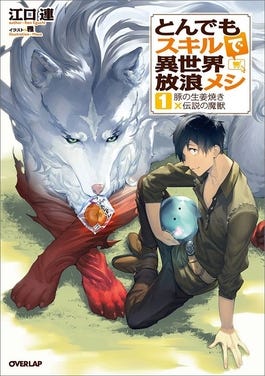
Isekai usually gives us a recognizable trajectory.
Normal person enters another world. Normal person discovers they’re actually incredibly powerful. Normal person becomes increasingly important.
Eventually, kingdoms know their name, armies depend on them, legendary enemies fear them and the fate of the world rests on their shoulders.
Campfire Cooking looks at that trajectory and wanders off toward the grocery aisle.
Mukohda doesn’t reject his old life only to immediately acquire another job saving civilization.
- He wants independence.
- He wants security.
- He wants decent accommodations.
- He wants good food.
- He wants to travel.
And, increasingly…
- He wants everyone to stop bringing him enormous monsters he somehow has to process.
That’s the subversion.
This is still an adventure.
It’s simply built around someone who doesn’t believe being given a second life automatically means he owes the universe a legendary one.
Mukohda — The Salaryman Who Refused the Hero’s Journey
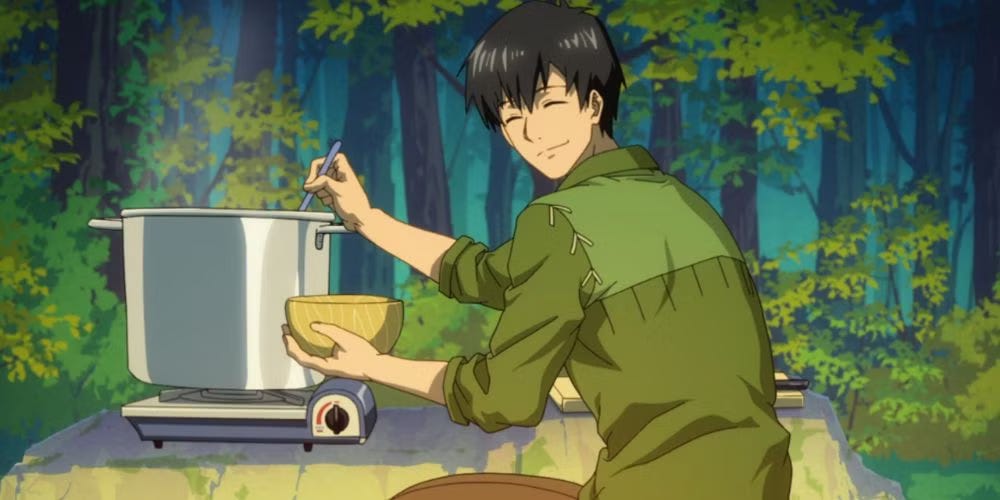
Mukohda is a wonderfully different isekai protagonist precisely because he’s so ordinary.
He’s practical. Cautious. Polite. Occasionally anxious. And extremely good at recognizing when something sounds like considerably more trouble than it’s worth.
He doesn’t arrive in another world and immediately think: Finally! My destiny!
He’s closer to: These people seem sketchy. How do I get out of here?
Outstanding instincts.
And even after Mukohda’s situation becomes increasingly absurd, his priorities remain wonderfully grounded.
Money matters. Travel arrangements matter. Ingredients matter. Baths matter. Beds matter. Having enough food matters.
This man gets transported into a magical fantasy universe and still reaches moments where his primary concern is obtaining the proper equipment to make rice.
There is something deeply relatable about that.
Mukohda isn’t trying to conquer his new world. He’s trying to build a comfortable life inside it.
And then he meets Fel.
Fel — The Nuclear Deterrent That Wants Dinner
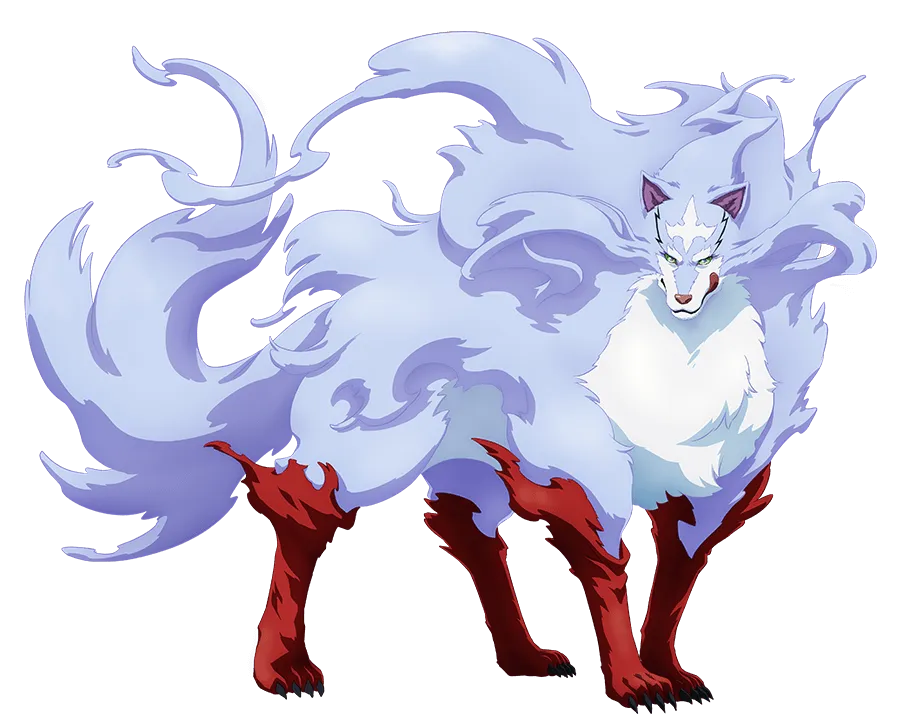
In another fantasy series, encountering a Fenrir could be an entire story arc.
A legendary monster appears. The kingdom panics. Armies mobilize. Our hero trains. Some ancient prophecy gets uncovered. Three episodes later, someone unlocks a new transformation.
In Campfire Cooking?
Mukohda makes dinner. Fel smells it. And suddenly one of the most terrifying creatures in the world would like to discuss a long-term meal arrangement.
That’s the joke.
And somehow it never stops being funny.
Fel is ancient. Powerful. Proud. Impatient. And completely capable of turning most threats Mukohda encounters into historical footnotes.
Which fundamentally changes how combat works.
Mukohda doesn’t really need to become the strongest person in the room. He travels with something that may already be the strongest creature in the surrounding postal code.
But what makes their relationship work isn’t simply that Fel protects Mukohda.
There’s reciprocity.
Fel provides protection, transportation and valuable monster materials. Mukohda provides food.
They negotiate. They argue. Mukohda tells Fel no. Fel complains. Mukohda complains louder. And somehow the legendary Fenrir who could probably flatten the countryside accepts that there are, in fact, rules.
Mukohda doesn’t conquer Fel. He doesn’t dominate him.
They make an arrangement.
Then somewhere along the road, that arrangement starts looking suspiciously like friendship.
Sui — The Goodest Little Slime

And then there’s Sui.
SUIIIIIIIII.
Fantasy has spent decades teaching us that slimes belong near the bottom of the monster hierarchy.
They’re beginner enemies. Experience points with faces.
Campfire Cooking gives us an adorable little slime who joins Mukohda, eats his cooking, learns, grows and gradually becomes alarmingly capable of dissolving anything unfortunate enough to threaten the group.
Sui completes the family.
And once again, Mukohda doesn’t deliberately assemble some elite adventuring party.
It just…happens.
He feeds creatures. They like him. They become (or already are) absurdly powerful. Mukohda becomes increasingly concerned about what his life has become.
Fel may be the nuclear deterrent. Sui is the adorable little weapons program developing beside him. And Mukohda?
He just wanted to make dinner.
The Real Power System Is Cooking
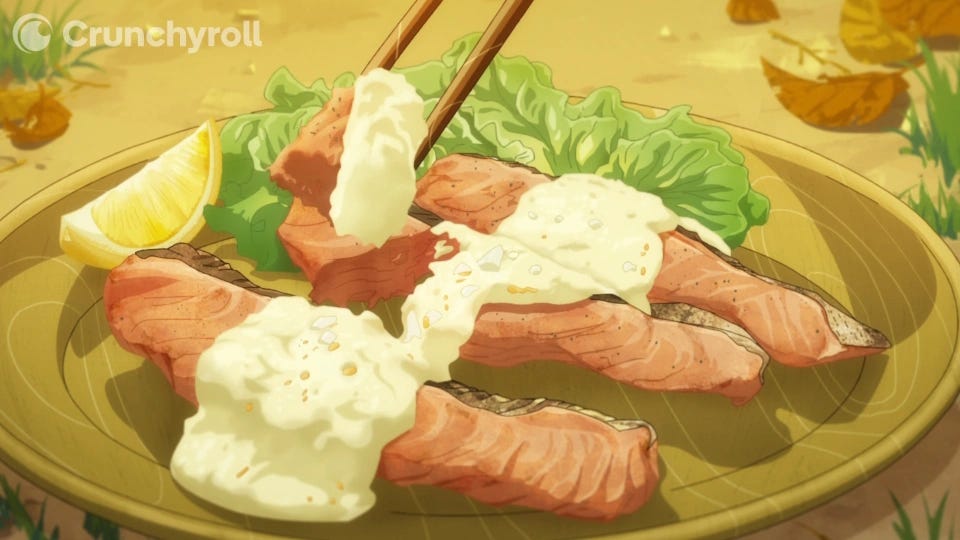
Most isekai power systems ask: How strong can our protagonist become?
Campfire Cooking asks: What’s for dinner?
And somehow food becomes an actual power system.
Ingredients from Mukohda’s Online Grocery can provide temporary stat boosts.
Meals can affect combat performance. Different ingredients create different results. Fel realizes this very quickly. Which means cooking isn’t simply something happening between adventures. It becomes part of the strategy.
But here’s what makes the series work: Food never stops being food.
It’s warm. Comforting. Familiar.
Something people anticipate. Something shared. Something Mukohda understands. And something connecting him to the world he left behind.
His ability has mechanical value. But it also has emotional value.
Mukohda can’t bring his old world with him.
He can bring a little taste of it.
Food Is a Universal Language
Mukohda enters a world where he doesn’t belong.
- Different culture.
- Different currency.
- Different creatures.
- Different rules.
- Different expectations.
He isn’t a diplomat. He isn’t a king. He doesn’t have some grand speech capable of bringing different peoples together.
But he can cook. And everybody understands good food.
Humans understand it. Adventurers understand it. Merchants understand it. Gods understand it. And apparently legendary monsters really understand it.
Food becomes Mukohda’s way of participating in this world without needing to become its Chosen Hero.
He contributes by doing something he’s good at. And that gives Campfire Cooking a wonderfully gentle idea beneath all the comedy:
You don’t have to become the person the world expects you to be in order to have something valuable to offer it.
Mukohda isn’t valuable because he eventually conforms to the hero archetype. He’s valuable because he remains Mukohda.
This World Is Full of Adults With Jobs
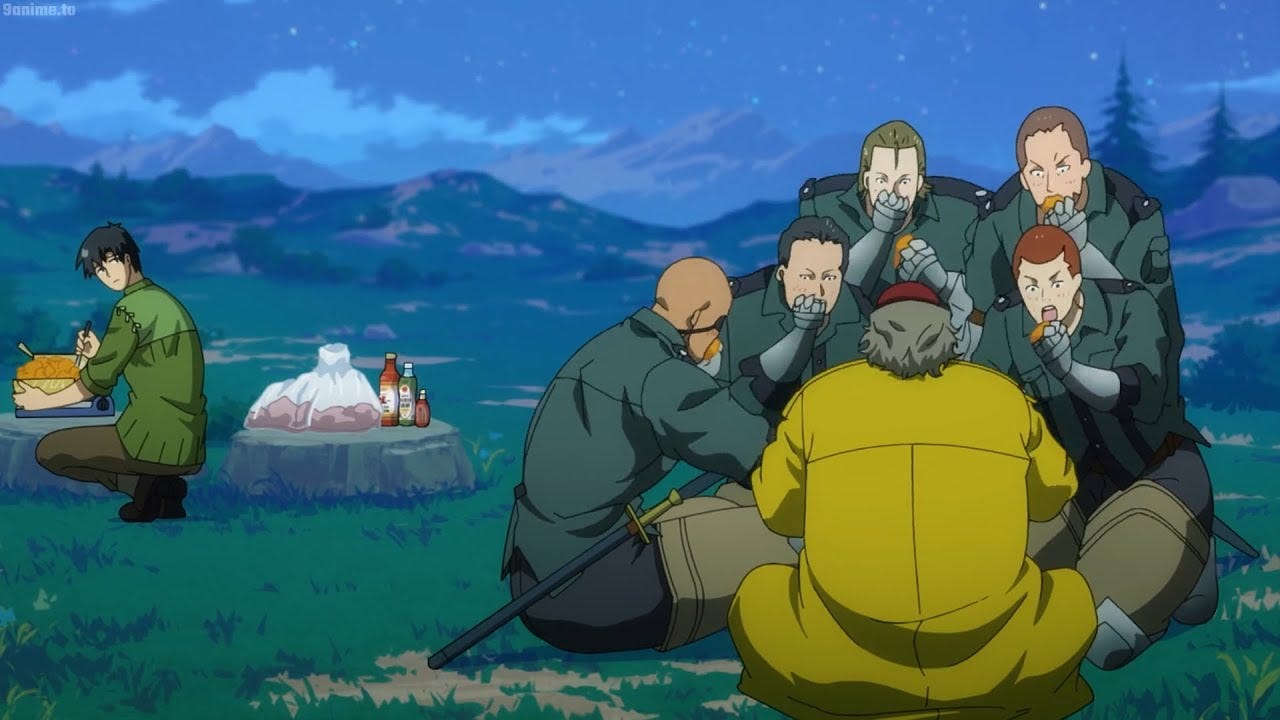
This may sound like a strange compliment.
But one of my favorite things about Campfire Cooking is that its fantasy world feels inhabited by… adults with jobs.
- Guild employees.
- Merchants.
- Butchers.
- Innkeepers.
- Adventurers.
- Officials.
People have responsibilities. They have businesses to run. They understand money. They have things to do tomorrow morning. And remarkably, not every new person Mukohda encounters is secretly planning to betray him.
Sometimes he meets somebody. They’re decent. They conduct business. They help each other. Then everybody goes about their day.
That’s it. That’s the interaction.
There’s something incredibly refreshing about that.
The Merchant’s Guild doesn’t necessarily need to become the headquarters of a secret evil organization.
Sometimes it’s just… the Merchant’s Guild. Fel’s suspicious side-eye notwithstanding.
The result is a fantasy world that feels lived in rather than constructed entirely around the protagonist.
Mukohda keeps meeting people. Normal people. Decent people.
And slowly, he starts building a place for himself among them.
The Adventurer’s Life Without the Hero’s Destiny
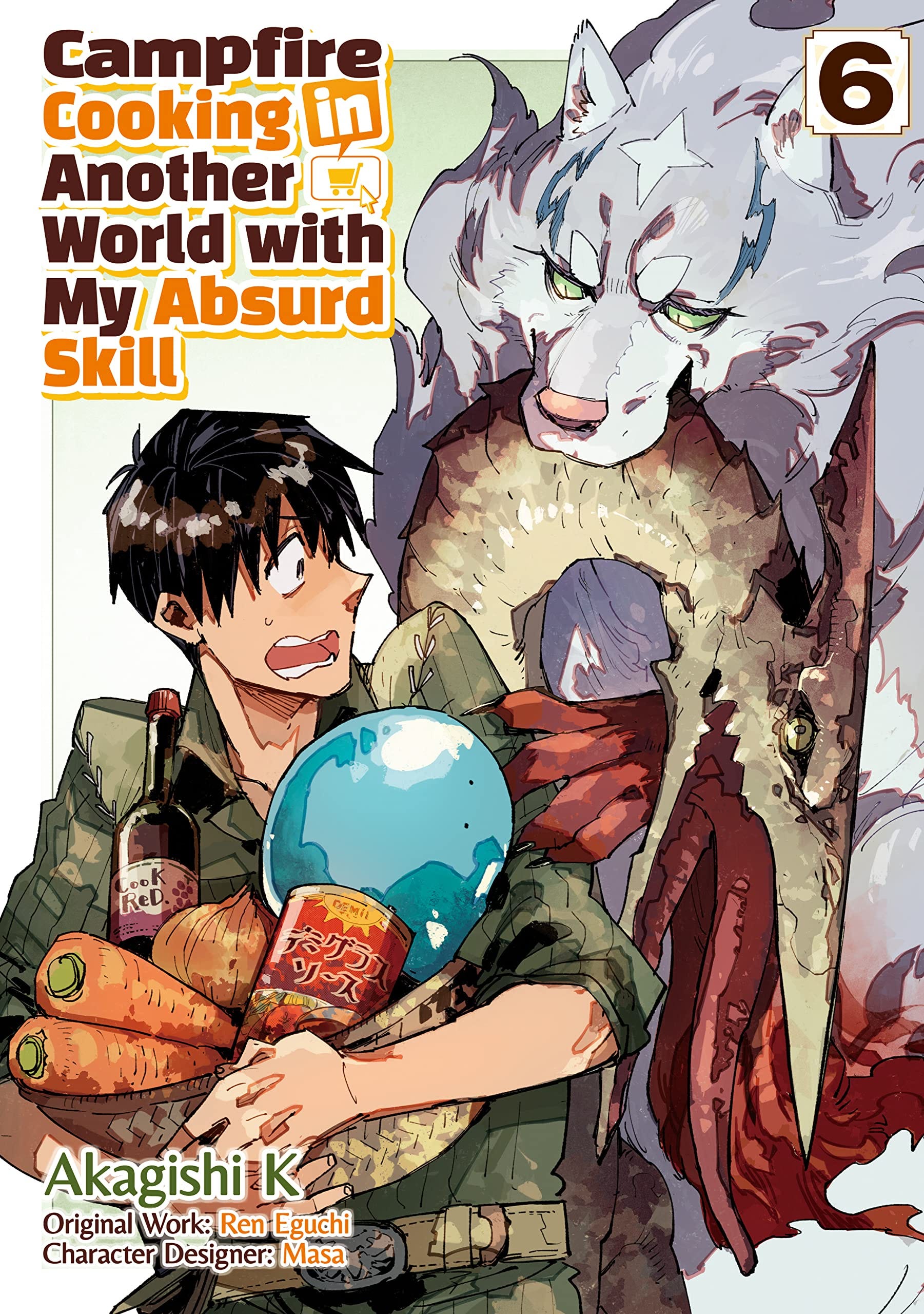
Mukohda still participates in the traditional fantasy machinery.
- There are guilds.
- Quests.
- Monsters.
- Magic.
- Ranks.
- Materials.
- Travel.
- Danger.
He simply interacts with those things differently.
The Adventurer’s Guild isn’t necessarily the place where Mukohda begins his march toward becoming the world’s greatest hero. Sometimes it’s where he needs to register so he can make some money.
The Merchant’s Guild isn’t necessarily hiding some enormous conspiracy. Sometimes Mukohda wants to sell something.
Fantasy infrastructure becomes actual infrastructure. And because Mukohda thinks like a working adult instead of a Chosen One, the mundane details become part of the adventure.
How much is this worth? Where can we stay? What can we sell? How are we getting there? What exactly am I supposed to do with the enormous monster Fel just dropped in front of me?
Those questions make the world feel tangible.
Combat Is Almost Secondary
There are fights in Campfire Cooking. There are dangerous monsters. There are quests.
Mukohda learns magic. Sui becomes increasingly capable. Fel is…Fel. But combat frequently becomes secondary. That’s the joke.
In most fantasy stories: We need food so we’re strong enough to complete the adventure.
In Campfire Cooking: We need to finish the adventure because Fel wants to know what’s for dinner.
Fel will disappear. Something enormous will roar. Mukohda will express concern. Fel will return with something that looks like it requires a municipal permit to transport. And Mukohda’s reaction isn’t: My God! What a legendary victory!
It’s closer to: What the hell am I supposed to do with THAT?!
The monster isn’t always the problem. Processing the groceries Fel keeps creating is the problem. That’s a wonderful inversion.
Feeding a Nuclear Deterrent
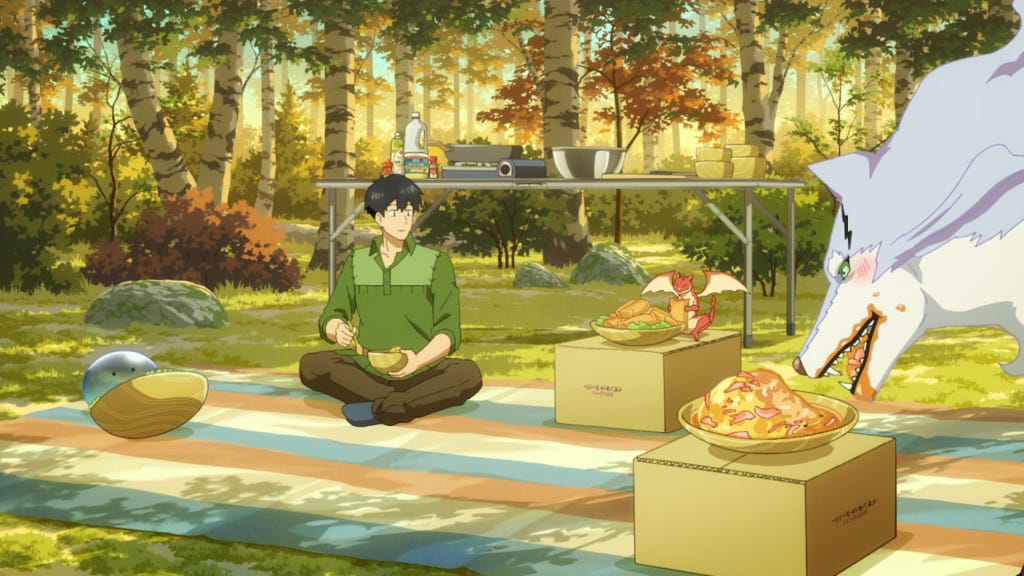
And there’s another funny consequence of Fel’s presence. Mukohda may not want political importance. But traveling beside a legendary Fenrir makes remaining completely unimportant rather difficult.
People notice Fel. Of course they do.
Imagine someone walking into your town with a creature everyone knows could probably level it.
Suddenly Mukohda’s desire for a quiet life collides with the fact that he’s traveling with what amounts to a furry strategic weapon.
But again, the series doesn’t primarily use that relationship to turn Mukohda into a conqueror. Fel doesn’t make Mukohda ambitious. If anything, Fel makes Mukohda’s ordinary concerns even funnier.
He’s traveling with overwhelming power… and worrying about grocery orders.
That’s Campfire Cooking.
The Gods Have Discovered Online Shopping

And because apparently feeding a Fenrir wasn’t enough trouble, Mukohda’s cooking eventually attracts attention from considerably higher places.
The gods notice.
Of course they do. Because apparently divine beings are no more immune to snacks and otherworldly goods than anybody else.
And suddenly Mukohda’s Online Grocery has acquired what can only be described as a divine customer base.
Again, another isekai might use divine attention to reveal that the protagonist has some enormous destiny. Campfire Cooking uses it to create another group of people who want Mukohda to send them stuff.
This man’s greatest superpower may actually be accidentally developing a supply chain.
The Food Looks Ridiculous
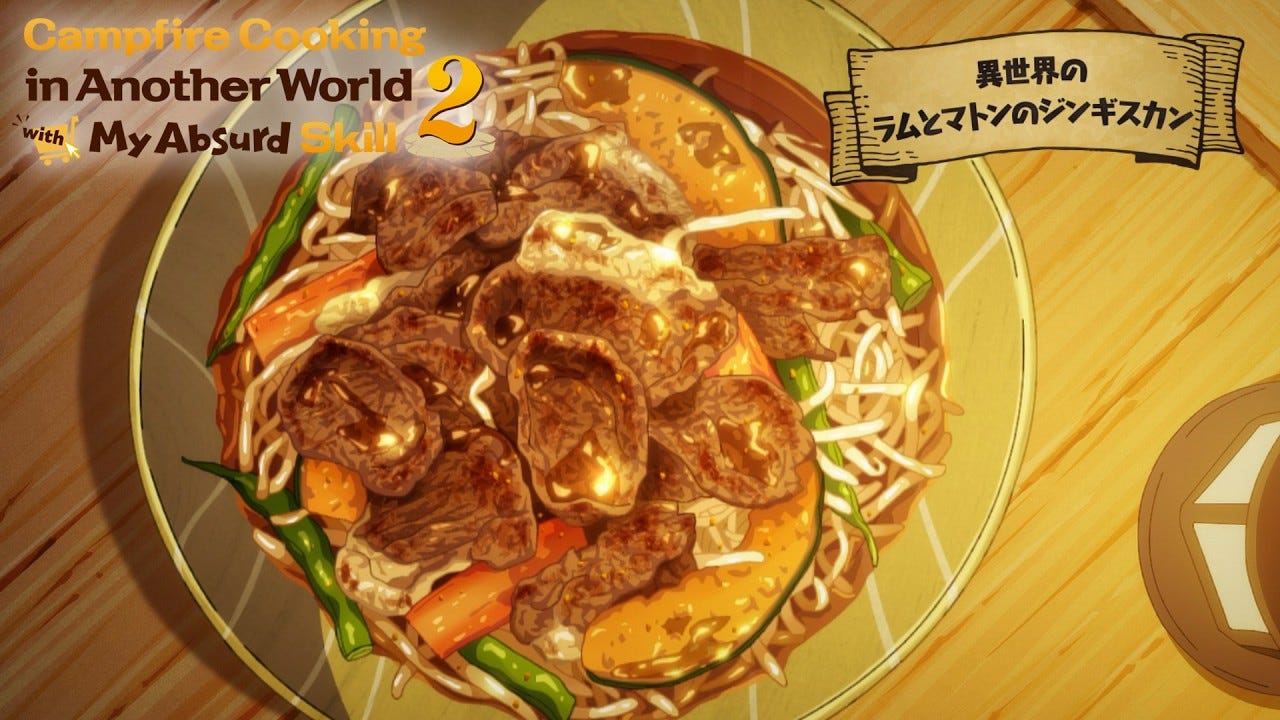
We need to acknowledge reality.
Do not watch Campfire Cooking hungry.
MAPPA understood the assignment.
- Meat sizzling.
- Sauces.
- Steam rising from the pan.
- Crispy edges.
- Mukohda explaining ingredients.
- Plates being assembled.
Fel staring at dinner like he hasn’t eaten in four centuries despite being fed twenty minutes ago.
There are stretches where Campfire Cooking stops feeling like a fantasy anime and becomes one of those cooking videos you encounter online late at night and suddenly think:
I could make that.
Cooking isn’t background decoration. It’s the event. The monster fight gets us the ingredients.
Dinner is the payoff.
The Stakes Are Low. And That’s the Point
Not every episode is building toward the end of civilization.
Sometimes Mukohda needs to reach another town. Sometimes he needs money. Sometimes he wants a bath. Sometimes something needs to be sold. Sometimes Fel wants food. Fel always wants food. Sometimes Mukohda simply wants to make rice properly.
And because we enjoy being around these characters? That’s enough.
Calling Campfire Cooking a story where “nothing happens” misses the point.
Things happen constantly. They’re simply not always historically important.
And most of our lives aren’t historically important either.
- We work.
- Travel.
- Eat.
- Meet people.
- Make friends.
- Solve problems.
- Try something new.
- Complain.
- Laugh.
- Go home.
- Wake up.
- Do it again.
Campfire Cooking takes those ordinary rhythms and puts them inside a fantasy world.
It’s almost a slice-of-life anime wearing isekai armor.
Let’s Be Fair
Campfire Cooking knows what it is. That means it’s also very easy to determine whether it’s for you.
If you’re looking for enormous stakes, this probably isn’t your show. If you need complicated political intrigue, you won’t find much of it here. If you’re waiting for Mukohda to reveal that he’s secretly the strongest warrior in existence and challenge the Demon Lord, you may be waiting a while.
There’s repetition.
Fel gets hungry. Mukohda cooks. Everyone loses their minds because the food is incredible.
Fel kills something absurd. Mukohda sighs. Sui is adorable. Repeat.
But here’s the thing: That’s the comfort.
The repetition becomes part of the rhythm.
This series isn’t constantly trying to surprise you. It’s inviting you to sit down.
Dinner’s almost ready.
Stay awhile.
Who Should Watch Campfire Cooking?
Give Campfire Cooking in Another World with My Absurd Skill a chance if you enjoy:
- Isekai that play with genre conventions
- Fantasy slice-of-life
- Cooking anime
- Found family
- Low-stakes adventures
- Healthy character relationships
- Fantasy worlds that feel lived in
- Ridiculously powerful animal companions
- Adorable slimes
- Stories about ordinary people building satisfying lives
- Food that will make you immediately regret watching on an empty stomach
You may struggle with it if you need:
- Constant action
- High-stakes drama
- Complicated political intrigue
- A traditional hero’s journey
- Rapid plot progression
- A protagonist obsessed with becoming stronger
And if traditional isekai has started feeling a little stale?
This might be exactly the palate cleanser you’re looking for.
The Emotional Core: Build a Life You Actually Want
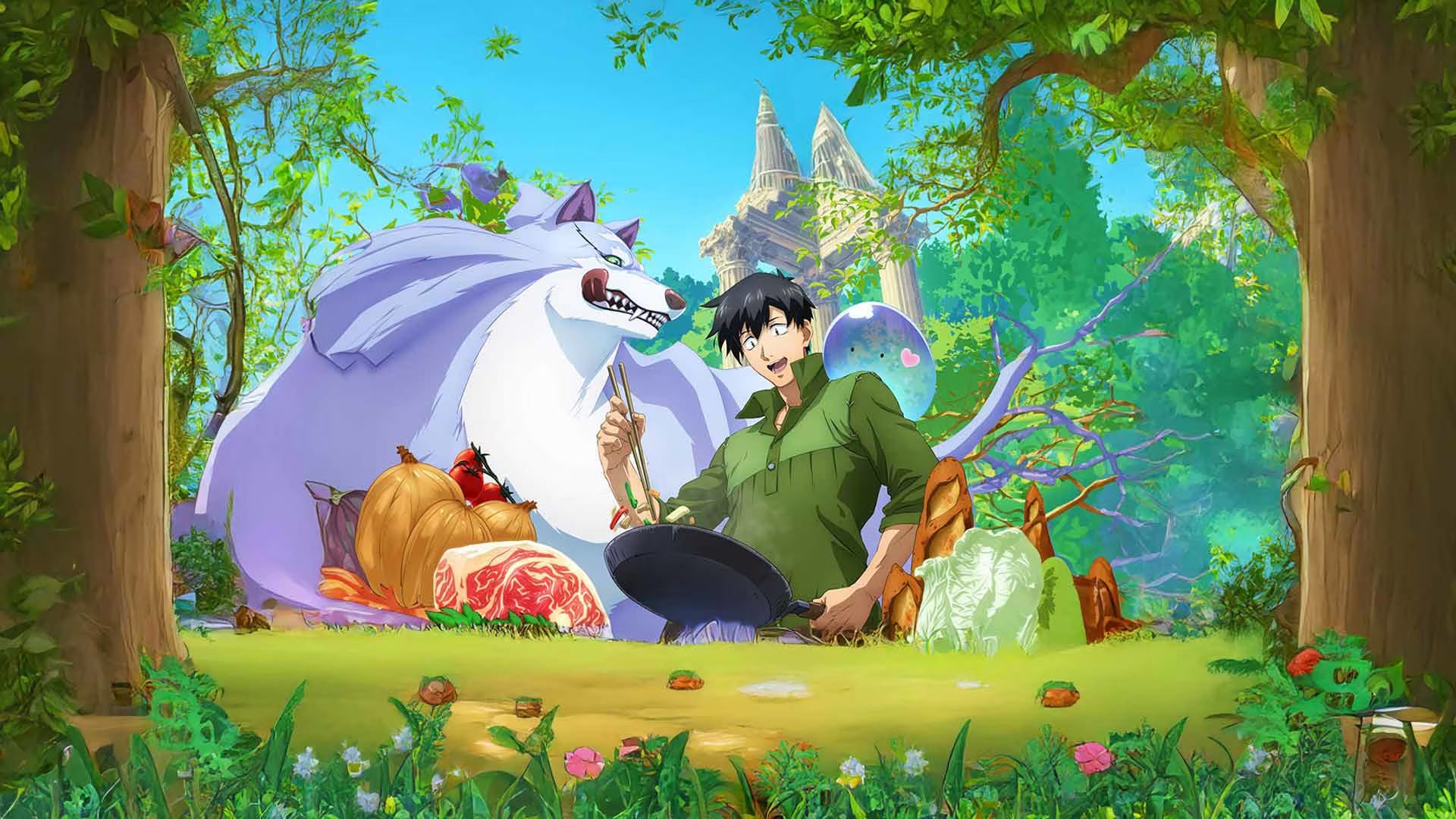
Isekai frequently begins with dissatisfaction.
A protagonist dies or disappears from an ordinary life and receives another chance.
Then the new world immediately hands them another enormous list of responsibilities.
Save the kingdom. Defeat the Demon Lord. Master the legendary power. Become king. Fulfill the prophecy.
Mukohda essentially responds: No thank you.
And then something interesting happens.
He finds work. Travels. Cooks. Meets people. Makes friends. Builds relationships. Acquires a terrifying dog and an adorable slime.
Gets annoyed. Gets comfortable. Finds routines.
And gradually creates a life that actually seems… nice.
Not legendary. Not historically important. Nice.
There’s something surprisingly radical about that for this genre.
Maybe getting another life doesn’t mean you have to become extraordinary. Maybe the gift is simply getting another opportunity to build an ordinary life you actually enjoy.
Mukohda doesn’t need to become a hero to justify being summoned to another world.
He doesn’t need to become the strongest. He doesn’t need everyone to know his name.
He needs people he cares about. Work that provides for him. Food he enjoys making. Places worth visiting. And somewhere warm to sit at the end of the day.
Maybe that’s enough.
Why Campfire Cooking Works
Other isekai heroes acquire legendary swords. Mukohda acquired an online grocery store.
Other heroes tame mythical beasts through combat. Mukohda made one dinner and accidentally entered into a catering contract with a nuclear deterrent.
Other heroes assemble elite parties to defeat the Demon Lord. Mukohda fed a slime.
Other heroes receive the attention of gods because they’re destined to reshape the world. Mukohda essentially introduced the divine realm to online shopping.
And somehow?
It all works.
Because Campfire Cooking understands that escapism doesn’t always mean imagining yourself as the strongest person alive.
Sometimes the fantasy is simpler.
Enough money. Good friends. Interesting places. Something delicious cooking. And no boss telling you that you’re responsible for saving civilization before Friday.
Ctrl+Binge Final Take
Campfire Cooking in Another World with My Absurd Skill takes the traditional isekai formula and quietly walks away from the part where its protagonist is supposed to become a legendary hero.
Mukohda doesn’t want the throne. He doesn’t want glory. He doesn’t want destiny. He wants dinner.
And somewhere along the road, dinner becomes friendship. Friendship becomes family. Travel becomes home. And a second life stops being an opportunity to become extraordinary.
It becomes an opportunity to become happy.
Other isekai heroes are trying to save the world. Mukohda would really just like Fel to stop bringing home monsters bigger than the kitchen. And somehow, that’s exactly why Campfire Cooking works.
Not every adventure needs to end with saving the world.
Sometimes you just need good food, good company, and somewhere warm to sit while dinner cooks.
Join the Conversation
You’re transported to another world tomorrow.
No legendary sword. No Demon Lord assignment. No prophecy. Instead, you get Mukohda’s Online Grocery skill and enough money to get started.
What’s the first meal from our world you’re cooking around the campfire?