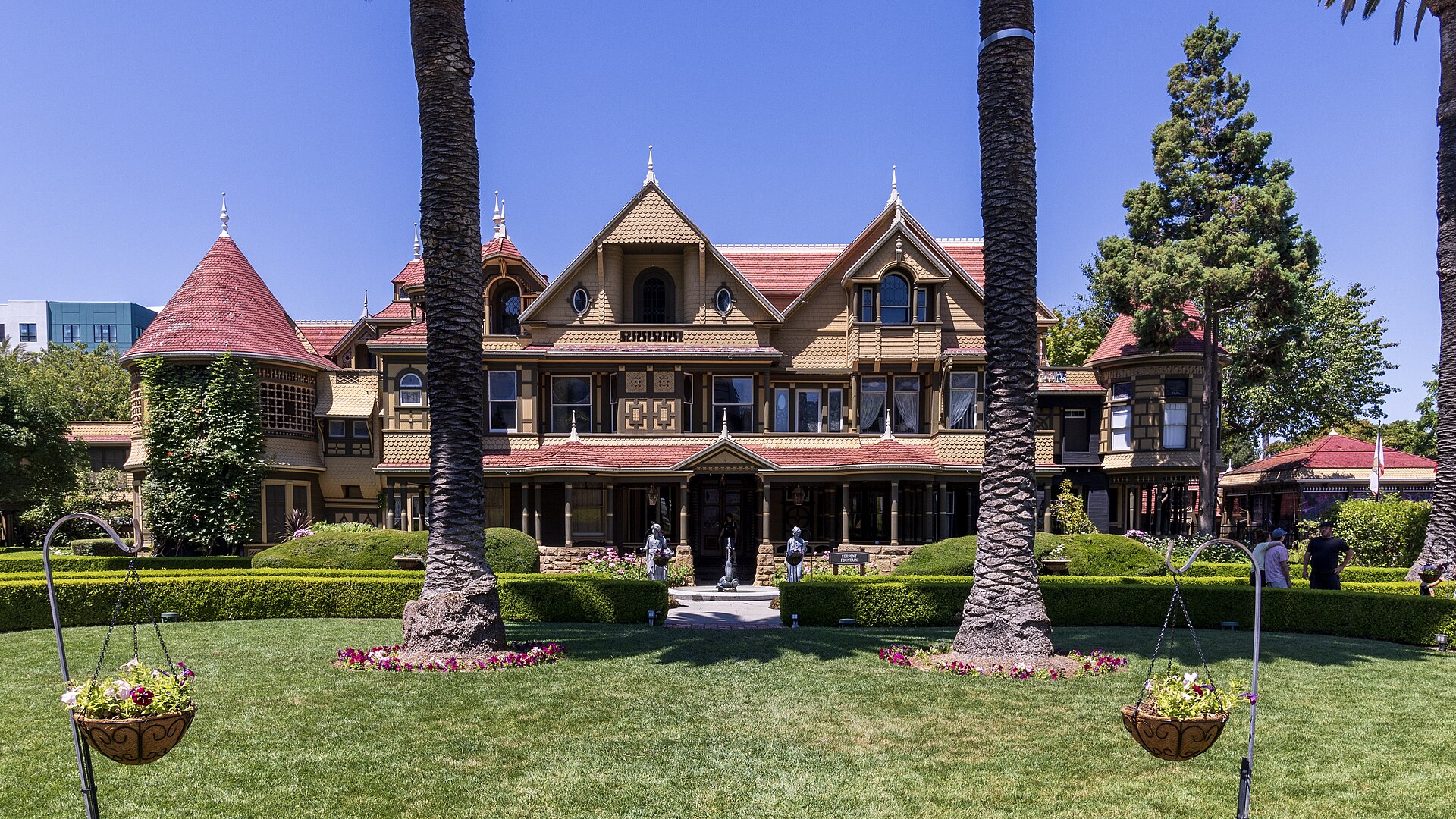
Some houses are built from blueprints. Some houses are built from ideas. The Winchester Mystery House feels like it was built from instructions whispered after midnight.
A staircase climbs directly into a ceiling. A door opens into empty air. Windows look into other rooms. Hallways turn, narrow, double back, and disappear into a mansion that seems to have forgotten where it was originally going.
The house contains 160 rooms, thousands of doors and windows, dozens of staircases, and enough architectural wrong turns to make any floor plan surrender. And, according to legend, that was the point.
Sarah Winchester had inherited a fortune built by one of America’s most famous rifles. After losing her daughter and husband, she was supposedly warned that the dead were coming for her.
The only way to survive was to move west and build.
Never stop. Never finish. Never allow the spirits to find her.
For decades, the mansion grew around her.
Then Sarah died. The hammers stopped. But the story kept building.
Because the Winchester Mystery House may be haunted by rifle victims, construction workers, shadow figures, or the widow who once lived there.
It may also be haunted by something even harder to remove: A legend so perfectly designed that the truth has been wandering through its hallways ever since.
THE FAMILIAR VERSION
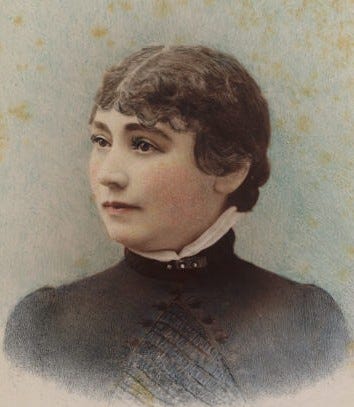
Sarah Winchester was the wealthy widow of William Wirt Winchester, heir to the Winchester Repeating Arms Company.
The family had made an enormous fortune selling rifles.
Those weapons had been carried through war, westward expansion, settlement, violence, displacement, murder, self-defense, and nearly every other part of America’s complicated relationship with the gun.
Then tragedy entered Sarah’s own home.
Her only child, Annie, died only weeks after being born. William later died of tuberculosis.
Sarah inherited the Winchester fortune but was supposedly consumed by grief and guilt over the countless people killed by the company’s weapons.
According to legend, she consulted a spiritualist. The medium told her that the spirits of Winchester rifle victims had cursed her family. They had taken her daughter and husband, and Sarah would be next unless she followed very specific instructions.
Move west. Buy a house. Build continuously.
As long as construction continued, Sarah would live.
Some versions say the house was being built for the spirits. Others claim its bizarre layout was intended to confuse them. A ghost might follow Sarah down a hallway only to find a dead end, a door opening into a wall, or a staircase leading nowhere.
Sarah moved to California, purchased a farmhouse near San Jose, and began expanding it.
Workers supposedly labored around the clock.
Sarah allegedly held nightly séances in a special room, received instructions from the dead, and delivered new construction plans every morning.
The mansion grew for decades.
When Sarah Winchester died in 1922, construction finally stopped.
The house had become an enormous Victorian maze filled with architectural impossibilities, secret passages, supernatural symbolism, and spirits who may still be searching for the woman who built it.
It is a spectacular ghost story. It is also considerably neater than the history.
The strangest rooms in the Winchester Mystery House may have been built from wood. The strangest parts of its story were built from rumor.
THE FORTUNE BEHIND THE FRONT DOOR

Before there was a Mystery House, there was a rifle.
Oliver Winchester, Sarah’s father-in-law, became one of the defining figures in the development and mass production of repeating firearms during the nineteenth century.
The Winchester Repeating Arms Company’s rifles became famous for allowing a shooter to fire multiple rounds before reloading. That made them valuable weapons for soldiers, hunters, law enforcement officers, settlers, outlaws, and anyone else who wanted more than one shot available when things went wrong.
The Model 1873 became so closely associated with western expansion that it was eventually marketed as “The Gun that Won the West.”
That slogan alone carries enough history to haunt a mansion.
To some Americans, the Winchester represented survival, engineering, independence, and the expansion of the frontier. To others, it represented conquest, war, displacement, industrialized violence, and bloodshed.
The rifle became part of American mythology. So did the money it produced.
Sarah Lockwood Pardee married Oliver’s only son, William Wirt Winchester, in 1862. William worked within the family business and stood to inherit its leadership.
That made Sarah part of one of America’s great industrial families. It did not protect her from loss.
THE WOMAN INSIDE THE LEGEND
Sarah and William’s only child, Annie Pardee Winchester, was born in 1866.
She lived for approximately five and a half weeks before dying from marasmus, a condition associated with severe malnutrition and an infant’s inability to thrive.
The grief was devastating.
Then, within a short period between 1880 and 1881, Sarah lost her mother, her father-in-law Oliver, and her husband William.
William died from tuberculosis at only 43.
Sarah inherited company stock and substantial wealth. The often-repeated version claims she received approximately $20 million and earned $1,000 every day from Winchester profits.
Modern biographical research disputes those exact figures. Sarah was unquestionably wealthy, wealthy enough to live independently, acquire numerous properties, and finance an extraordinary building project, but the fortune became exaggerated alongside nearly everything else in her story.
Money did not make Sarah invulnerable. It made her private grief visible.
A widow without children was already an object of sympathy and speculation. A tremendously wealthy widow who avoided public attention, designed her own home, and controlled her own finances was irresistible to Gilded Age gossip.
Sarah did not explain herself publicly. Everyone else was happy to do it for her.
THE MOVE WEST
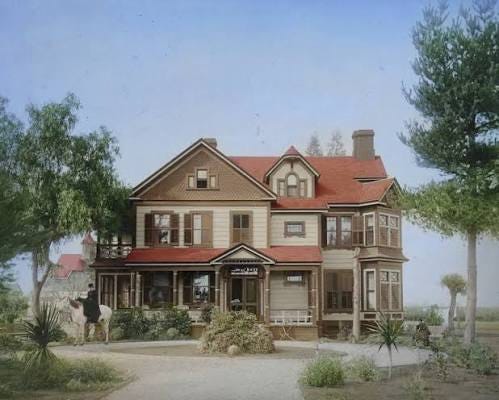
Sarah arrived in California in 1885.
The following year, she purchased a two-story farmhouse near San Jose. The surrounding Santa Clara Valley was then filled with farms, orchards, and open land, not the modern Silicon Valley that would eventually grow around it.
Sarah called her estate Llanada Villa, translated from Spanish to “house on flat land.”
The farmhouse contained approximately eight rooms. It did not remain that size for long.
Sarah began remodeling, expanding, demolishing, rebuilding, and experimenting. Rooms were added one at a time. Wings grew around existing structures. Windows that once faced outdoors suddenly looked into newly constructed rooms. Exterior doors became interior passageways.
The house did not feel designed. It felt accumulated.
At its greatest height, portions of the mansion rose seven stories. Following decades of construction and later earthquake damage, the surviving house contains approximately 24,000 square feet, 160 rooms, 2,000 doors, 10,000 windows, 52 skylights, 47 stairways, 47 fireplaces, 17 chimneys, 13 bathrooms, and six kitchens.
The original farmhouse became almost impossible to identify inside the building that consumed it. That much is real.
But was construction truly happening every minute of every day? Probably not.
THE CONSTRUCTION THAT NEVER ENDED…EXCEPT WHEN IT DID
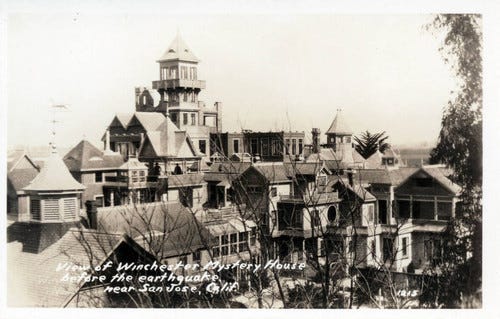
The famous version says carpenters worked in rotating shifts, 24 hours a day, seven days a week, for more than three decades.
If the hammers stopped, Sarah believed she would die.
Construction certainly defined her years at Llanada Villa. Workers remained employed for long periods, and the house underwent relentless alteration.
But “continuous” is not the same as “literally never stopping.”
Research into Sarah’s life found extended pauses caused by weather, health, travel, rest, and changing plans. She sometimes dismissed workers for months. Construction nearly ceased after the 1906 earthquake, aside from repairs and necessary alterations.
The house did not grow because an invisible timer would kill Sarah if someone put down a hammer. A more human explanation may be hiding beneath the ghost story…Sarah enjoyed architecture.
Women were largely excluded from formal architectural education, so she learned by reading magazines, consulting carpenters, studying new designs, and experimenting directly on her own property.
When she disliked something, she changed it. When a room no longer worked, she built around it. When she wanted to test a new idea, she possessed the money, workers, land, and authority to try it.
The project may also have given structure to her life.
Designing the mansion provided Sarah with purpose, creative control, and a way to employ local workers, including during the economic depression of the 1890s.
The house may not have been the product of madness. It may have been the world’s largest sketchbook.
THE STAIRCASE TO NOWHERE
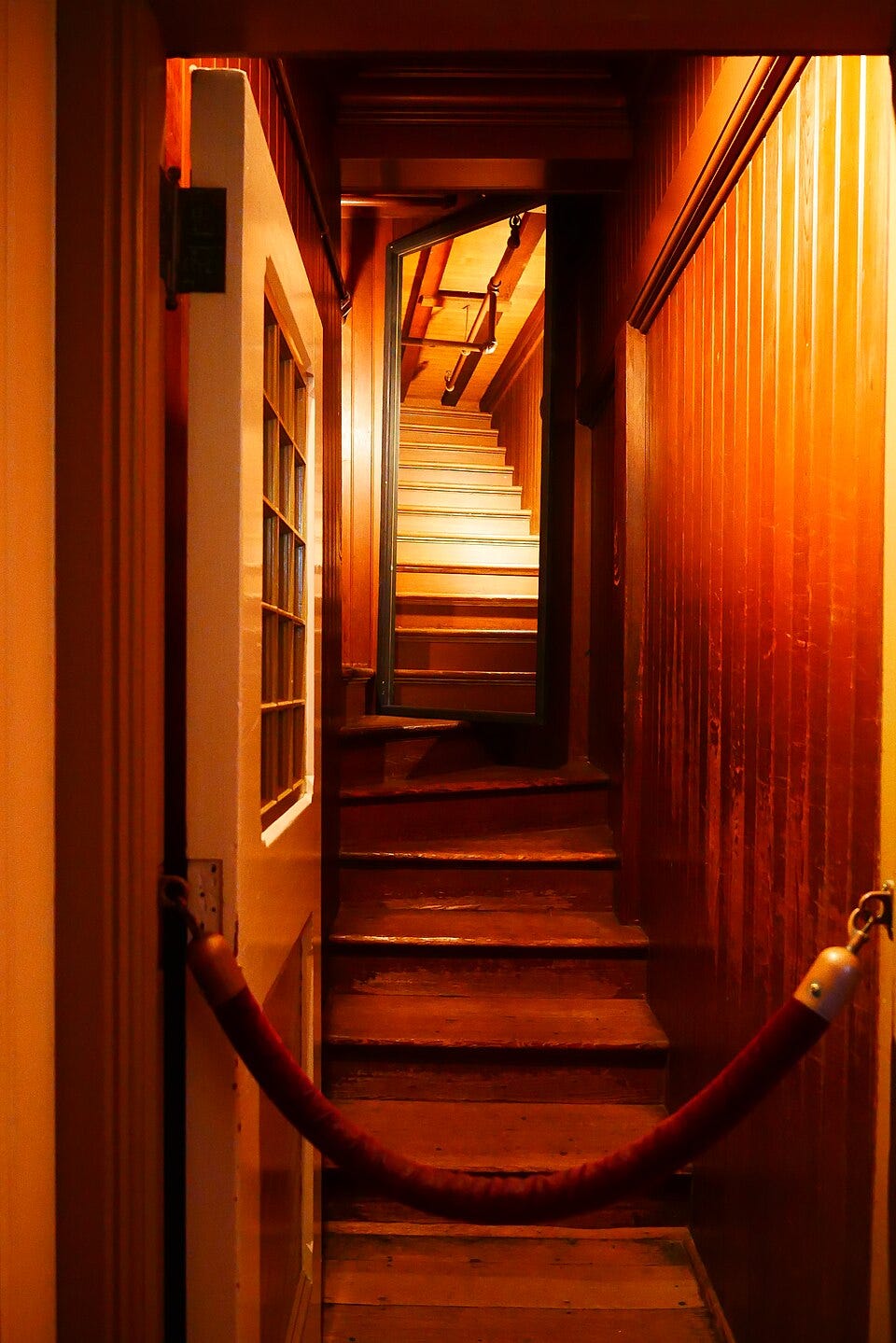
And yet… There really is a staircase that leads nowhere.
The famous Staircase to Nowhere rises several steps before stopping at the ceiling.
The house also contains doors opening into walls, windows between rooms, confusing passages, and at least one notorious doorway that opens from an upper floor into open air.
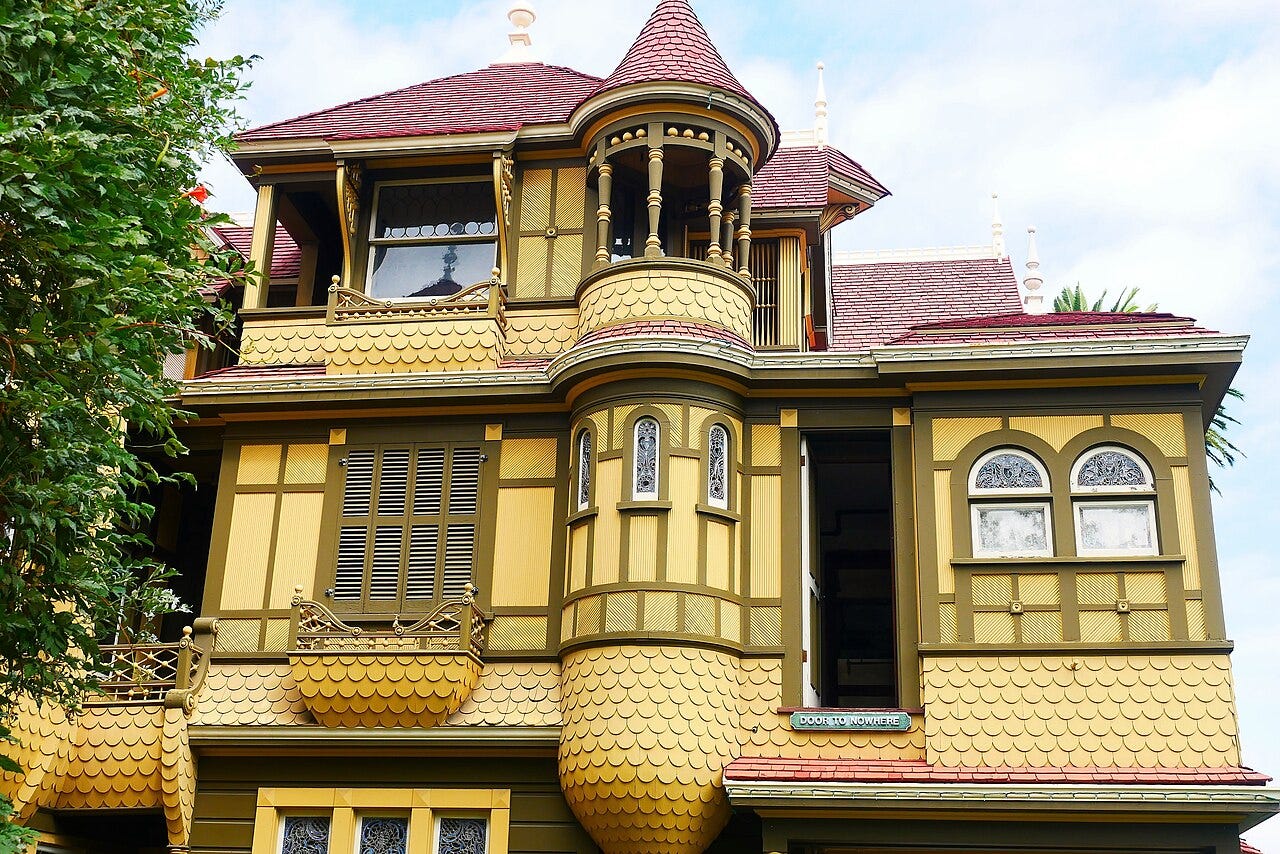
Walk through without looking and gravity finishes the tour.
These features are frequently presented as proof that Sarah was trying to confuse ghosts. But the truth is not contained inside one explanation.
Some oddities resulted from decades of additions. When Sarah built a new wing in front of an older wall, existing doors and windows could be blocked, enclosed, or repurposed.
Some came from experimentation. Sarah was not a trained architect, and she was willing to rebuild work that did not satisfy her.
Others resulted from her physical needs.
Sarah was short and suffered from severe arthritis later in life. The house’s “Easy Riser” staircases use unusually shallow steps, allowing her to climb gradually without lifting her legs very high. One staircase requires dozens of tiny steps to rise only about ten feet.
To an able-bodied visitor, it looks absurd. To someone living with painful joints, it may have been thoughtful engineering.
And then the earth itself redesigned the house.
THE EARTHQUAKE BUILDS ITS OWN MAZE
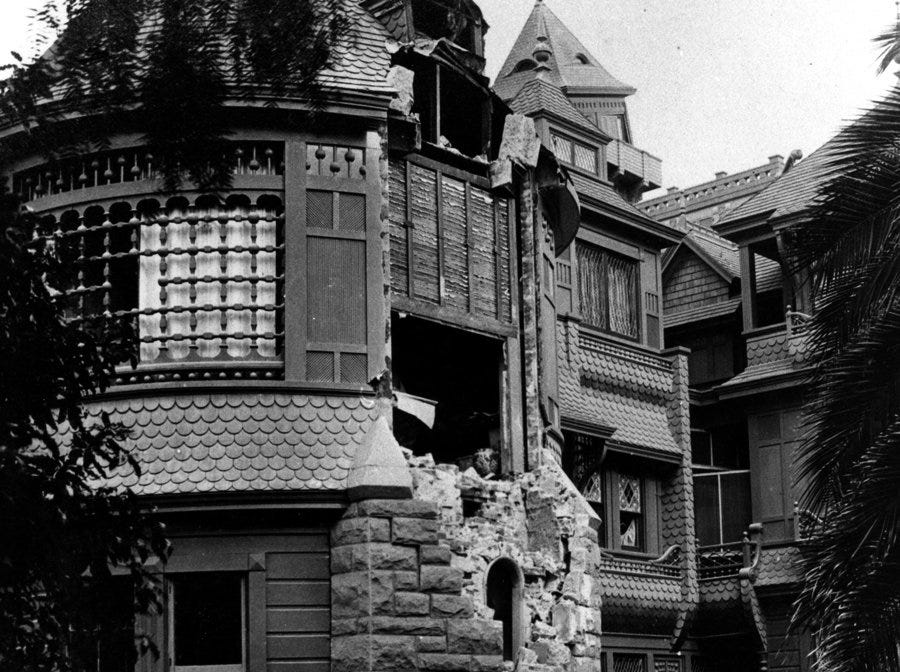
On April 18, 1906, the San Francisco earthquake struck Northern California. Llanada Villa suffered severe damage.
The seven-story tower collapsed. Chimneys fell. Upper floors and sections of the mansion were damaged beyond reasonable repair.
Sarah chose not to restore the house to its previous height. Much of the debris was removed, sections were demolished, and openings were sealed.
Staircases that once continued toward upper rooms now stopped at ceilings. Doors that may have opened onto balconies suddenly faced empty air. Windows and pipes remained where vanished rooms had once surrounded them.
The earthquake did what no ghost needed to do: It turned an unconventional mansion into a genuine architectural puzzle.
Some versions claim Sarah interpreted the disaster as a message from the spirits, that they were angry because she had spent too much time decorating the front of the house.
That explanation is folklore.
What we know is that the earthquake devastated her work. Construction diminished dramatically afterward, and Sarah increasingly spent time at other properties.
The mansion’s broken pathways remained. Future visitors would interpret the damage as design. The house was becoming haunted by its own history.
THE MEDIUM WHO MAY NEVER HAVE EXISTED
The spiritualist is essential to the familiar story.
Depending upon the version, Sarah consulted a Boston medium named Adam Coons, who warned her about the Winchester dead and instructed her to build forever.
There is one problem. Researchers have found no contemporary evidence that Sarah met this man or that a Boston medium matching that identity was advising her.
The name Adam Coons appears to enter the Winchester mythology through a book published in 1967, decades after Sarah’s death.
The more general claim that construction protected Sarah appeared earlier. The Winchester Mystery House’s own timeline identifies an 1895 San Francisco Chronicle story as the first known published account suggesting she built to avoid death. Sarah never publicly answered it, allowing the speculation to spread.
The idea evolved.
- The house was not simply keeping Sarah alive. It was appeasing the victims of Winchester rifles.
- Then it was housing them.
- Then, it’s confusing corridors were protecting Sarah from them.
- Finally, the spirits were giving her the blueprints.
Each retelling added another room to the legend.
Historian Mary Jo Ignoffo’s biography, Captive of the Labyrinth, found no convincing evidence that Sarah was the guilt-ridden, ghost-obsessed spiritualist later stories described. Her letters and surviving records reveal an intelligent, private businesswoman who maintained relationships with relatives, managed investments, supported employees, and cared about medical philanthropy.
The supernatural explanation is wonderfully cinematic. It is also not the only way to understand her.
THE SÉANCE ROOM AND THE NUMBER THIRTEEN
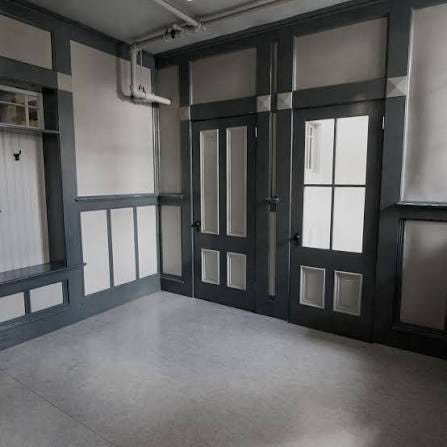
No haunted mansion is complete without a séance room.
At Winchester, the room supposedly contained one entrance and multiple exits so Sarah could escape the spirits after receiving their nightly instructions. She alone possessed the key.
At midnight, she entered. At two in the morning, the bell rang. The next day’s blueprints were waiting.
Again, the documentation refuses to cooperate.
Employees and relatives did not describe Sarah conducting nightly séances. Skeptical investigations report that the so-called séance room had previously served as a gardener’s bedroom.
The famous bell had a practical purpose: calling workers and sounding an alarm during a fire.
Neighbors did sometimes hear strange music at night. But Sarah owned and played a pump organ when she could not sleep.
Then there is the number thirteen.
The mansion contains numerous features connected to thirteen: thirteen bathrooms, thirteen-pane windows, thirteen drainage holes, thirteen hooks, and a chandelier with thirteen lights. According to legend, Sarah was obsessed with the number.
However, researchers note that the association does not appear in print until 1929…seven years after her death. A carpenter who worked at the estate claimed that several of the now famous “thirteen” modifications were made after Sarah died.
A chandelier offers a particularly suspicious clue. It appears to have originally held twelve lights. A thirteenth was added later.
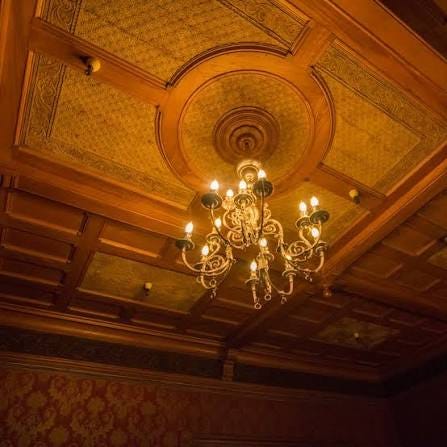
Perhaps Sarah truly liked the number. Perhaps coincidence did some of the work. Perhaps the tourist attraction recognized strong branding when it saw it.
Thirteen is wonderfully marketable. Twelve would have been terrible for the posters.
THE HOUSE OPENS ITS DOORS
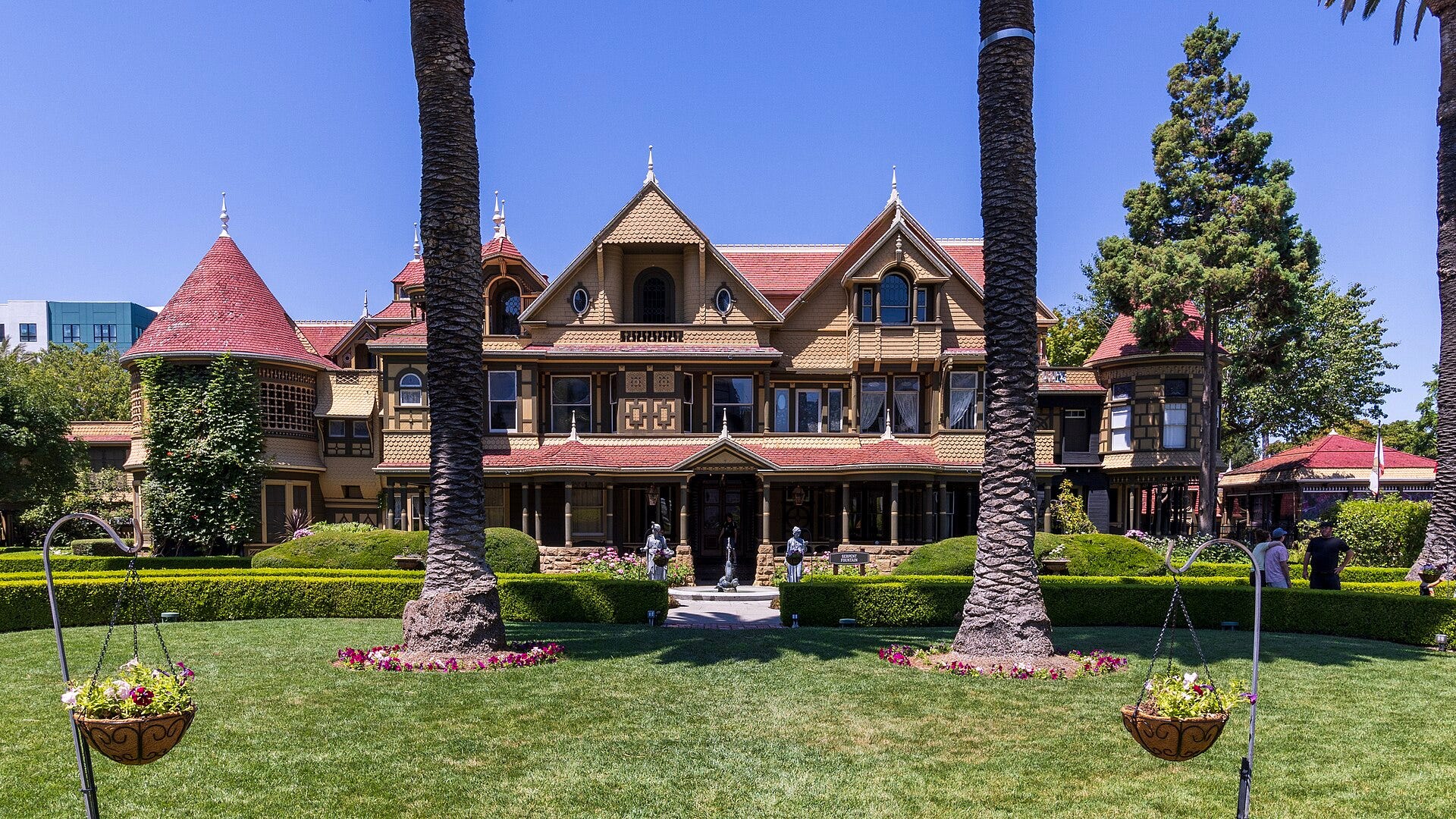
Sarah Winchester died on September 5, 1922. She left the mansion’s contents to her niece, while the property itself was sold.
In 1923, John and Mayme Brown leased the estate. Their original vision focused on the surrounding grounds as a recreational attraction, but visitors were far more interested in the strange house and the secretive woman who had built it.
The mansion opened for public tours on June 30, 1923. Approximately 10,000 people reportedly arrived on opening day.
The Browns had discovered the property’s true value.
Not as a home. As a story.
Harry Houdini visited in 1924. Later accounts sometimes credit him with popularizing the name “Winchester Mystery House,” although the property’s own timeline says it was officially promoted under that identity during the 1930s.
Tourism preserved the building. It also rewarded the strangest possible version of Sarah’s life.
A wealthy architectural enthusiast is interesting. A tormented rifle heiress building a labyrinth for thousands of vengeful ghosts sells tickets.
The supernatural mansion continued expanding without adding another physical room.
WHO STILL WALKS THE HALLS?
Visitors and employees have reported cold spots, whispers, unexplained footsteps, moving doors, shadow figures, the smell of cooking food, and the sensation of being watched.
The house’s most famous reported ghost is sometimes called Clyde.
He appears as a mustached construction worker dressed in old-fashioned clothing. Witnesses claim to have seen him pushing a wheelbarrow or continuing work around the fireplace and basement.
Apparently, even death could not end the construction contract.
One longtime maintenance worker reported hearing footsteps above him inside the water tower. Every time he climbed another floor, the footsteps remained one level higher.
He eventually reached the roof. No one was there.
Shadowy figures have allegedly appeared around corners, in hallways, and behind windows. Some visitors believe they have encountered Sarah herself.
Skeptical explanations are readily available.
The mansion is enormous, old, drafty, and structurally unusual. Temperature differences create cold spots. Wood expands, contracts, settles, creaks, and knocks. Voices travel unpredictably through interconnected rooms. Visitors enter expecting an encounter, making ordinary sensations feel significant.
None of that proves a haunting. It does not prove every witness imagined one, either.
The house provides the perfect environment for uncertainty. There is always another room. Another corner. Another floorboard making a noise somewhere you cannot see.
THE POP-CULTURE HOUSE
The Winchester Mystery House feels as if it were designed for movies and video games before either medium knew what to do with it.
It has secret passages. Locked rooms. Environmental storytelling. An enormous family fortune with blood behind it. A dead child. A grieving widow. A map designed by someone who apparently hated players.
Put a typewriter and a few medicinal herbs in the hallway and the place becomes a Resident Evil level.
The house has appeared in paranormal programs, inspired fictional mansions, and became the subject of the 2018 film Winchester, starring Helen Mirren as Sarah.
Pop culture usually embraces the supernatural version. That makes sense.
“Woman discusses property management and architectural magazines” is a harder pitch than “widow builds rooms for the dead.” But the real Sarah may be the more compelling character.
A woman excluded from formal architectural education built one of the most recognizable houses in America.
She managed her own fortune. She employed workers through difficult economic periods. She endured extraordinary loss. Then, because she preferred privacy and refused to explain herself, generations transformed her independence into madness.
The haunted widow became easier to sell than the woman who actually lived there.
WHY WE KEEP TELLING THIS STORY
The Winchester Mystery House combines several fears Americans understand instinctively.
- The fear that wealth carries a price.
- The fear that violence eventually returns home.
- The fear that grief can become obsession.
- The fear that a building can absorb what happened inside it.
The legend transforms the Winchester fortune into a moral equation. Guns created money. Money created the house. The dead followed both.
Whether Sarah personally believed that equation is almost secondary to why later generations wanted her to believe it.
We expect guilt to leave evidence. A 160-room mansion feels like evidence. The house also represents grief without an ending.
Sarah could build another room. Redesign another hallway. Replace another window. Employ another carpenter. But no amount of construction could restore her daughter or husband.
The project could continue forever because grief does not arrive with a blueprint showing where it should stop.
Maybe that is why the legend needs the spirits.
Ghosts give invisible pain a visible purpose. Without them, Sarah was simply building because she needed something to keep building.
That may be less frightening. It may also be sadder.
THE CTRL+BINGE CONNECTION
The Winchester Mystery House works because it contains two stories occupying the same space.
One is historical.
- A wealthy, private widow spent decades experimenting with architecture. Her home grew through additions, revisions, physical accommodations, changing tastes, and earthquake damage.
The other is folklore.
- A cursed heiress built a labyrinth to escape the victims of the weapons that funded it.
Neither story completely evicts the other. Every strange staircase invites the legend back inside. Every boarded doorway looks intentional when someone tells you ghosts were being confused. Every creak sounds different once you know a dead workman may still be pushing his wheelbarrow through the basement.
The house is a real-world example of environmental storytelling. It does not hand visitors a complete answer. It gives them rooms, objects, damage, rumors, and contradictions—then allows them to construct the narrative themselves.
Sarah built the mansion. Everyone who came afterward helped build the mystery.
FINAL PUSH
The Winchester Mystery House is real. Its labyrinth is real. The Staircase to Nowhere is real.
The earthquake damage, endless remodeling, strange windows, tiny steps, and bewildering corridors are all waiting in San Jose.
The ghosts remain unproven. But the legend may be the most successful addition anyone ever built onto the house.
Sarah Winchester stopped construction in 1922. More than a century later, we are still adding rooms to her story.
THE QUESTION THAT LINGERS
What truly haunts the Winchester Mystery House:
the spirits people claim still walk its halls…or the story we refuse to stop building around the woman who lived there?