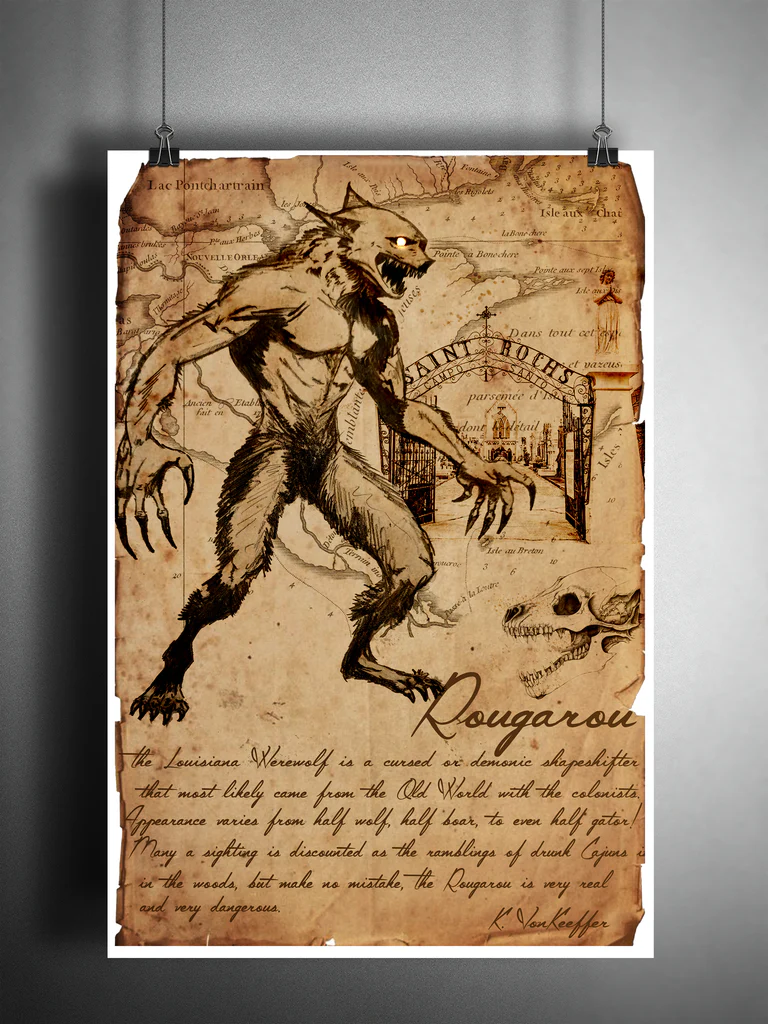
Swamp Werewolves? What the Heck is a Rougarou?!
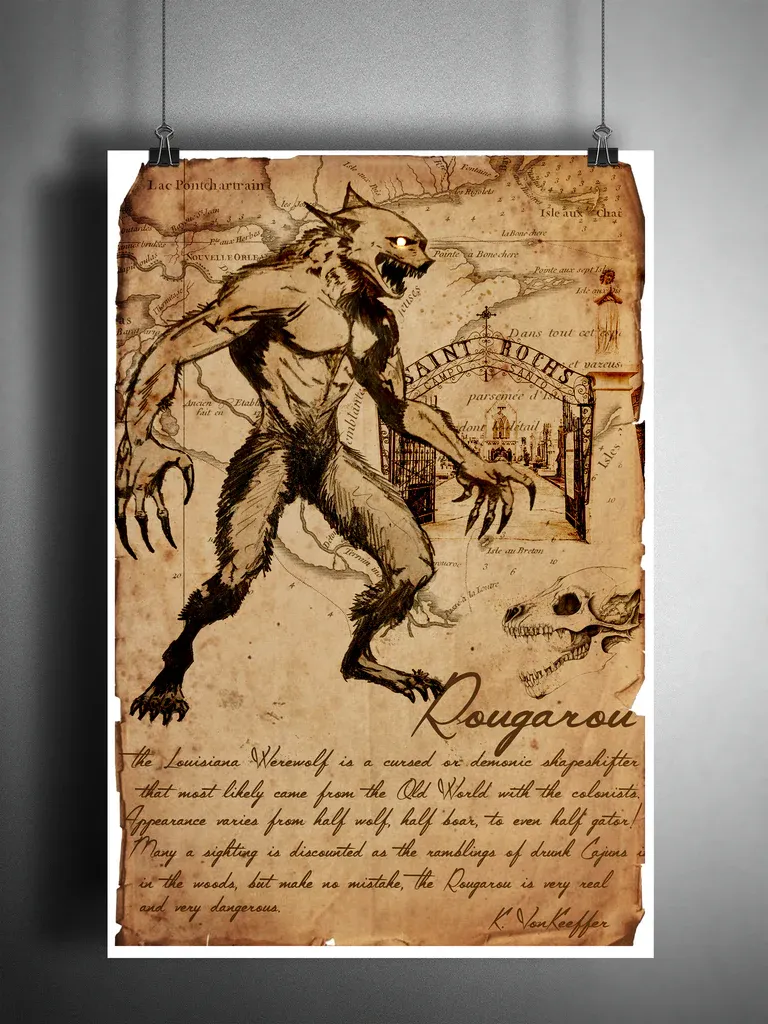
If you’ve never heard of the Rougarou, imagine this:
It’s late.
You’re in the Louisiana bayou.
The air is thick.
The water barely moves.
And somewhere in the trees, something howls.
Not quite wolf.
Not quite man.
That’s the Rougarou.
But what exactly is it?
The Story as It’s Told
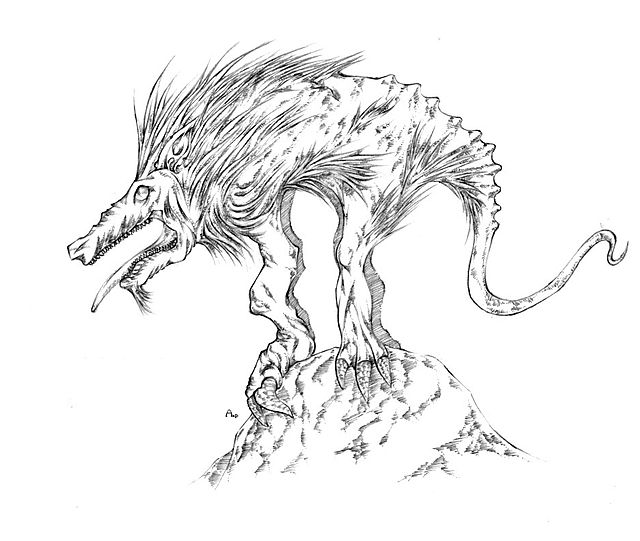
In Cajun and Creole folklore, the Rougarou (sometimes spelled loup-garou) is a shape-shifting creature — usually described as a man who turns into a wolf-like beast.
Sometimes:
- It has the body of a man and the head of a wolf.
- Sometimes it’s more like a full werewolf.
- Sometimes it’s something stranger — glowing eyes, long limbs, swamp-shadow thin.
The core idea stays the same:
It hunts at night.
And it punishes.
Depending on the version, the Rougarou stalks people who:
- Break religious rules (like ignoring Lent)
- Misbehave or disobey
- Wander too far into the swamp
It’s not just a monster.
It’s a warning.
Where Did the Rougarou Come From?
The name comes from the French word loup-garou, meaning “werewolf.”
When French settlers came to Louisiana in the 1700s — especially Acadians who became Cajuns — they brought their folklore with them.
And European werewolf legends were already old by then.
But something changed in Louisiana.
The story adapted.
European forests became Southern swamps.
Medieval superstition became Cajun cautionary tale.
The Rougarou became local.
The Cajun Twist
In some Louisiana versions:
If someone becomes a Rougarou, the curse lasts 101 days.
They can pass the curse to someone else by drawing blood.
And here’s the interesting part:
Some stories say the Rougarou specifically targets Catholics who fail to observe Lent for seven years in a row.
That’s not random.
This wasn’t just folklore — it was social control.
“Behave, go to church, follow tradition… or the swamp gets you.”
It’s a monster with a moral code.
Is It Just a Werewolf?
Not exactly.
European werewolves were often tied to:
- Witchcraft
- Demonic possession
- Medieval hysteria
The Rougarou feels more grounded.
Less castle dungeon.
More backwater trail.
It’s quieter. Closer. More personal.
And instead of silver bullets and full moons being the only trigger, the Rougarou often feels like a curse tied to behavior.
It’s less about transformation.
More about consequence.
Could There Be a Real Explanation?
Like many legends, there are grounded possibilities.
Wolves and Wild Dogs
While wolves weren’t common in Louisiana swamps, wild animals, feral dogs, and coyotes absolutely were — and are.
Strange sounds in the swamp travel far at night.
And once fear enters the equation, imagination fills in the rest.
Cultural Memory
The Rougarou may simply be the French werewolf legend transplanted into new terrain.
Stories migrate like people do.
They adapt to new landscapes.
The Rougarou is proof of that.
Social Tool
Folklore often serves a purpose.
In isolated bayou communities, a monster story:
- Keeps children from wandering at night
- Reinforces religious observance
- Strengthens shared identity
It’s not about whether the creature is real.
It’s about what the story does.
The Rougarou Today
Unlike some old myths, the Rougarou hasn’t faded.
It’s still celebrated in Louisiana festivals.
It shows up in local storytelling.
It even pops into pop culture and modern fiction.
The name alone carries atmosphere.
You don’t need a full description.
“Rougarou” sounds like something watching you from the trees.
Why It Works
The Rougarou isn’t grand like a dragon.
It’s not heroic like Robin Hood.
It’s intimate.
It lives in the fog.
It waits at the tree line.
It punishes quietly.
And that might be more unsettling than a castle-dwelling monster.
Because dragons live far away.
The Rougarou lives close.
Question for readers:
If you heard something moving in the swamp at night…
Would you assume:
- Just wildlife?
- A story meant to scare you?
- Or something older — something that followed settlers across the ocean and never left? 🌕