Seinen: What Separates Men from Boys.
Not every anime is about friendship speeches and power-ups.
Some stories linger.
Some hurt.
Some stare back at you a little too long.
Welcome to seinen.
If shonen is the after-school battle cry, seinen is what you watch when the room gets quiet.
Seinen (青年) literally means “young man.” It’s manga primarily marketed toward adult men — usually 18 and up. The assumption most people make is simple: more violence, more blood, darker themes.
And sure, that’s part of it.
When people think seinen, they think of titles like:
Brutal fights. Moral grayness. Existential dread.
It’s anime that doesn’t blink.
That’s the version most people know.
But that’s not the whole story.
Seinen isn’t defined by gore.
It’s defined by complexity.
While shonen often asks, “Can I get stronger?”
Seinen asks, “Should I?”
Take Berserk. Yes, it’s violent. But its core is trauma, ambition, betrayal, and the cost of chasing a dream at any expense.
Or Monster. There are no flashy transformations. Just a doctor haunted by one decision, chasing the human embodiment of evil across Europe.
Even Vinland Saga evolves from revenge fantasy into a meditation on pacifism and what it means to break a cycle of violence.
Seinen magazines like Young Animal and Weekly Young Jump allow creators more room:
- Slower pacing
- Moral ambiguity
- Sexuality handled with realism instead of spectacle
- Characters who fail and don’t bounce back cleanly
And here’s something people miss:
Seinen also includes quiet masterpieces like March Comes in Like a Lion — a story about depression, loneliness, and healing through small human connections.
It’s not about shock value.
It’s about weight.
Seinen endures because it grows with you.
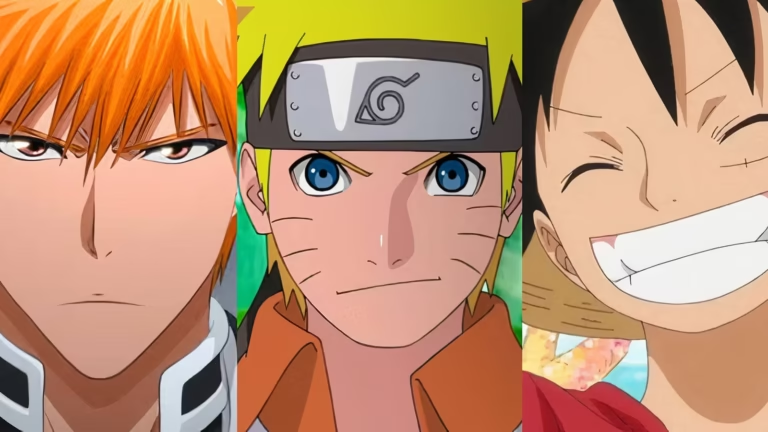
The same kid who watched Naruto at 13 might find themselves drawn to Vinland Saga at 25.
Because adulthood changes the questions.
You stop asking:
“Can I win?”
And start asking:
“What does winning cost?”
Seinen reflects a stage of life where answers are complicated, victories are partial, and sometimes survival is the only triumph.
It doesn’t offer clean morals.
It offers mirrors.
Look at modern prestige TV.
- Anti-heroes.
- Slow-burn narratives.
- Psychological thrillers.
- Moral gray protagonists.
That energy? Seinen’s been doing it for decades.
Video games like The Last of Us.
Dark fantasy shows dominating streaming.
Even meme culture embracing “existential dread” humor.
We’ve moved into an era where audiences crave nuance.
Seinen was built for that.
So here’s the real question:
When did you first realize anime could be this?
What was your first seinen that made you sit back and go,
“Oh. This isn’t for kids anymore.”