I Choose You! The First in a Series of Pokémon Video Game Reviews
Before open worlds.
Before hundreds of creatures.
Before Pokémon became the largest media franchise on Earth.
There were just two Game Boy cartridges and a simple idea:
Catch them all.
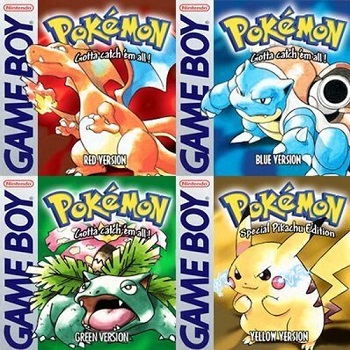
This week kicks off our Pokémon-themed Fridays with the originals — Pokémon Red and Blue (known as Pokémon Red and Green in Japan) and their enhanced cousin Pokémon Yellow.
And somehow, these tiny black-and-white (and a little color, in Yellow’s case) adventures changed gaming forever.
If you ask most people what the original Pokémon games are, they’ll say something like this:
“Those old Game Boy games where kids wandered around collecting monsters.”
You start with a starter Pokémon, beat eight gyms, and eventually defeat the Elite Four. Along the way you trade with friends, battle rivals, and try to collect all 151 Pokémon.
The reputation is simple:
nostalgic, charming, maybe a little primitive compared to modern RPGs.
For people who didn’t grow up with them, they’re often seen as the cute beginning of a franchise that eventually exploded through anime, trading cards, and merchandise.
But that reputation misses something important.
These games weren’t just charming.
They were revolutionary.
Mechanics — The Loop That Took Over the World
At its core, the gameplay loop in Pokémon is brilliantly simple.
You explore towns, forests, caves, and routes while capturing wild creatures called Pokémon. Each Pokémon has its own type, moves, strengths, and weaknesses. Battles are turn-based, meaning players choose attacks, items, or switches while trying to outmaneuver their opponent.
The deeper you go, the more the systems start to layer together.
Type matchups matter.
Team composition matters.
Move selection matters.
The real magic, though, came from something the Game Boy had that many games ignored: the Link Cable.
Certain Pokémon only existed in specific versions of the game. If you wanted them all, you had to trade with someone else.
It turned Pokémon from a solo RPG into a social experience. Kids were swapping cartridges at lunch tables and linking Game Boys in the back of school buses.
The game didn’t just exist in your hands.
It existed between players.
Story & Characters — A Simple Journey That Stuck
The narrative itself is straightforward but effective.
You play as a young trainer leaving home to explore the Kanto region, collecting Pokémon and challenging eight Gym Leaders to prove your strength.
Along the way you run into Team Rocket, a criminal organization using Pokémon for profit and power.
Your constant shadow is your rival — the kid who always seems one step ahead and never lets you forget it.
He’s arrogant. Competitive. Always popping up at the worst possible moment.
But that rivalry becomes the emotional backbone of the journey. Every victory feels personal because someone else is always trying to beat you to the top.
By the time you reach the Pokémon League, the story isn’t about saving the world.
It’s about becoming the best trainer in it.
World, Visuals & Atmosphere — Big Adventures on a Tiny Screen
On paper, the visuals were simple: pixelated creatures and monochrome environments running on the original Game Boy.
But the design did something clever.
Each area had a distinct identity.
Viridian Forest felt mysterious and dense.
Lavender Town felt eerie and unsettling.
Cerulean City felt bright and hopeful.
Despite the technical limitations, the world felt larger than the hardware that held it.
Part of that magic came from the sense of discovery. You never quite knew what Pokémon might appear in the tall grass or what hidden item might be tucked away behind a corner.
It made the world feel alive.
Sound & Music — The Songs That Live Rent-Free in Our Brains
The soundtrack by Junichi Masuda deserves serious recognition.
Using the Game Boy’s limited sound channels, Masuda created themes that players still recognize instantly decades later.
The energetic battle music.
The peaceful town themes.
The haunting melody of Lavender Town.
These tracks didn’t just accompany the game.
They became part of the emotional memory of playing it.
To this day, hearing those chiptune melodies is enough to send players straight back to childhood bedrooms and Game Boy screens glowing under blankets.
The original Pokémon games proved something incredibly powerful about games as a medium.
They showed that a game could be simple in structure but massive in cultural impact.
It wasn’t about cutting-edge graphics or complicated storytelling.
It was about:
Discovery
Competition
Connection
These games arrived at a time when handheld gaming was often seen as a smaller experience compared to consoles.
Pokémon flipped that idea completely.
Suddenly, the most exciting gaming moments were happening in schoolyards, on bus rides, and between friends trading creatures through a cable.
The game itself was only part of the experience.
The community around it became the real adventure.
You can still see the DNA of these first Pokémon games everywhere today.
Modern RPGs chase the same addictive progression loop of collecting, leveling, and team building.
Online multiplayer games still rely on the same social magic that Pokémon created with the Link Cable — players connecting to share an experience.
Even modern Pokémon titles like Pokémon Scarlet and Violet are still built on the exact same foundation that started here.
These games didn’t just launch a franchise.
They created a blueprint.
One that anime, trading cards, competitive battling, and decades of sequels would build upon.
QUESTION
The original Pokémon games started with 151 creatures and one big challenge:
Catch them all.
As of early 2026, there are 1,025 unique pocket monsters, and I’m assuming that number will grow even more.
So, here’s the question:
If you could go back to that very first adventure in Kanto…
which starter Pokémon are you choosing? 🔥🌿💧