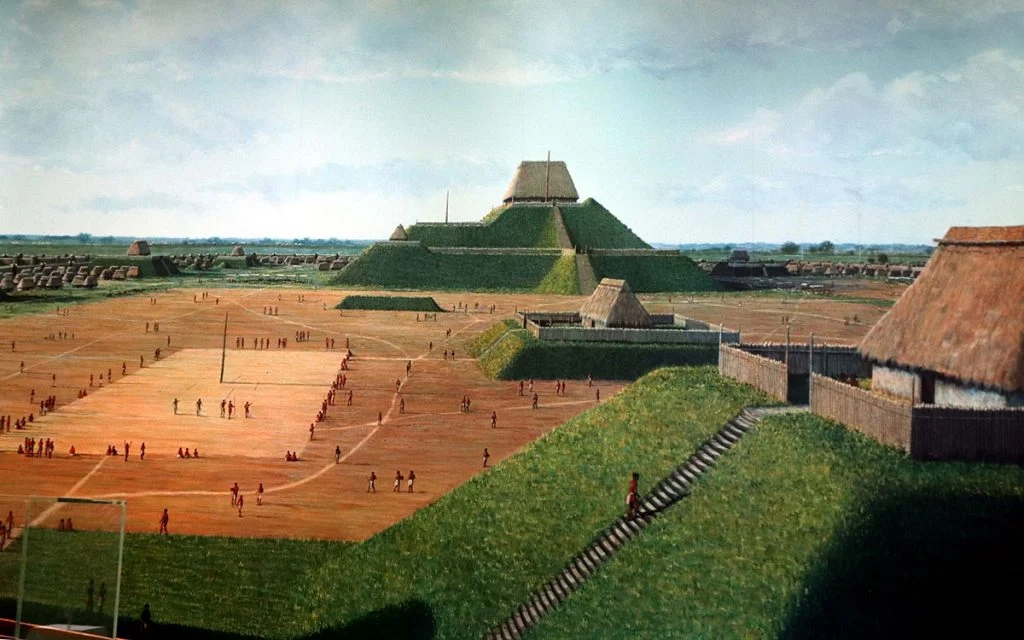
Cahokia: Diggin’ the Mound Life!
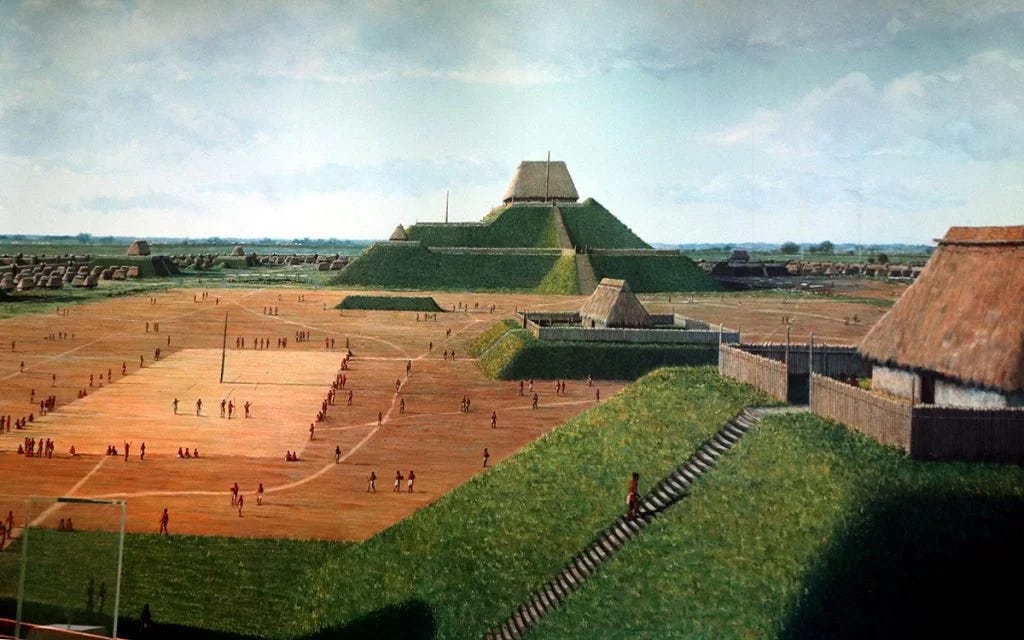
You think ancient megacities mean Rome.
Maybe Egypt.
Possibly the Maya.
You probably don’t think… Illinois.
But around the year 1100, North America had a city larger than London — built without stone pyramids, metal tools, or wheeled carts.
Instead?
They moved mountains.
One basket of dirt at a time.
Who Were They?
Cahokia was the largest urban center of what historians call the Mississippian culture — a network of Indigenous societies spread across the Mississippi River Valley.
This wasn’t a scattered village.
At its peak (around 1050–1200 CE), Cahokia likely had 10,000–20,000 residents. Some estimates go higher.
For comparison:
- London in 1100? Roughly similar size.
- Many European cities? Smaller.
So while Europe was still figuring out plumbing and arguing about feudal land rights, North America had a planned urban center with infrastructure.
History class kind of skipped that, huh?
Where Was It?
Right across the Mississippi River from present-day St. Louis.
If you’ve ever driven through that area and thought, “Wow, this is flat,” congratulations — you were looking at what used to be the center of one of the most important cities in North America.
The location wasn’t random. It sat near:
- Major river trade routes
- Fertile floodplains
- Transportation networks
Cahokia was plugged into a massive trade web stretching from the Great Lakes to the Gulf Coast.
They traded copper, shells, stone tools, and more.
This wasn’t isolated.
This was connected.
What Makes Cahokia Different?
The mounds.
Cahokia had over 100 earthen mounds, carefully shaped and arranged in a deliberate city layout.
The biggest one — Monks Mound — is still there.
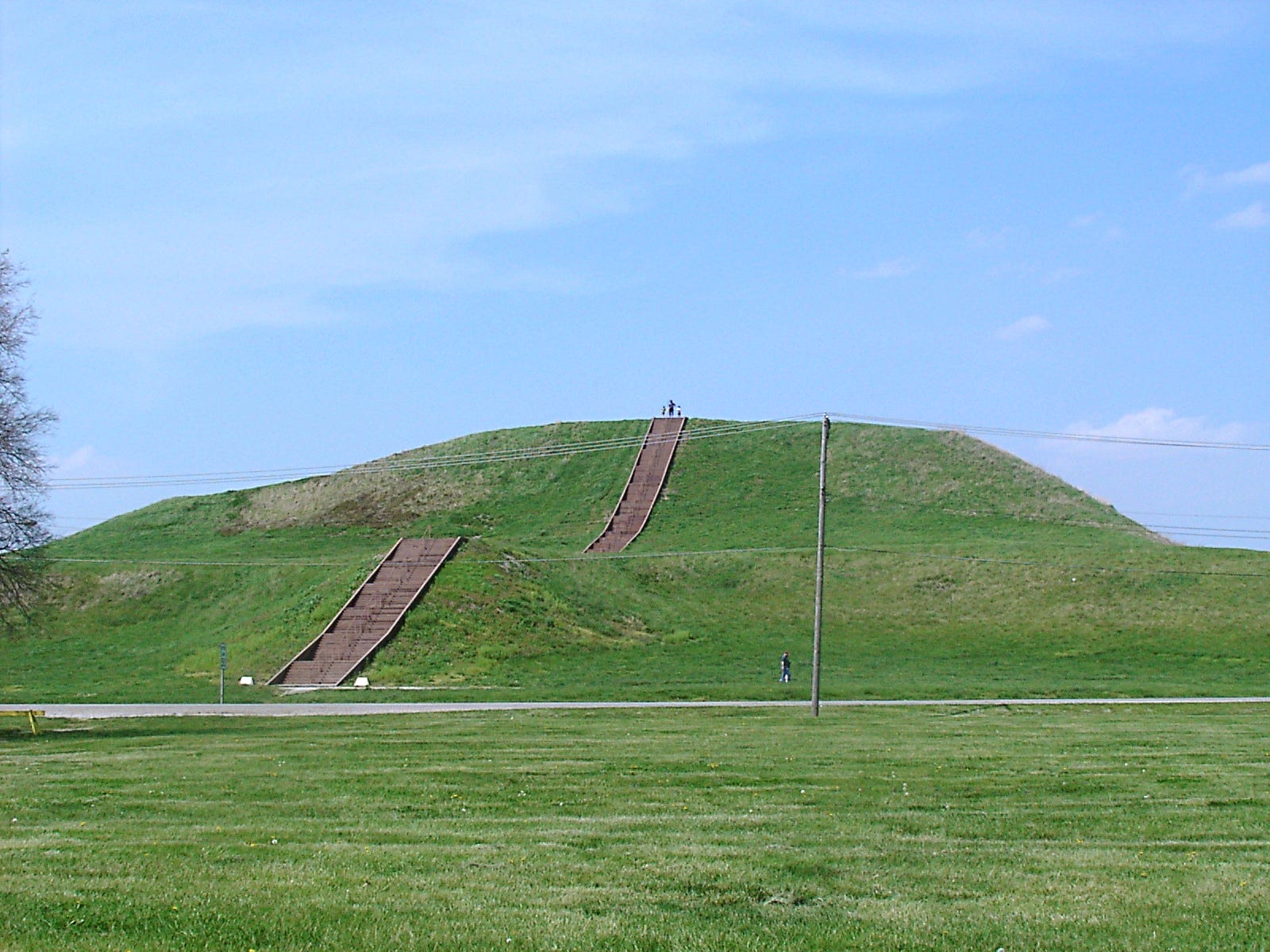
(Pictured: Monks Mound today. The concrete stairs follow the approximate course of an ancient wooden staircase)
It stands about 100 feet tall and covers more ground than the base of the Great Pyramid of Giza.
And here’s the wild part:
It was built basket by basket.
No draft animals.
No wheeled carts.
No heavy machinery.
Just people, dirt, and organization.
Imagine convincing thousands of people to move literal tons of earth without Instagram, electricity, or pizza breaks.
That takes leadership.
So… Why Build Mounds?
They weren’t random dirt hills.
They served clear purposes.
1. Political Power
The largest mounds supported elite buildings — likely the homes or ceremonial structures of leaders.
If you live on the highest platform in town, everyone sees you.
Height equals authority.
2. Religion
Many mounds were tied to ceremonial spaces. Governance and spirituality weren’t separate categories — they were the same system.
3. Burial
Some mounds contain elaborate burials of high-status individuals, along with grave goods and ritual offerings.
Hierarchy was visible — even in death.
4. Astronomy
Cahokia also had a structure nicknamed “Woodhenge” — a circle of wooden posts aligned with the sun during solstices and equinoxes.
They were tracking the sky.
So, the mounds weren’t just construction projects.
They were statements:
“We are organized.”
“We have power.”
“We understand the cosmos.”
“And yes, we can move this much dirt.”
What Happened to Cahokia?
By around 1300 CE, the city was largely abandoned.
There wasn’t one dramatic “fall.”
The leading theories include:
- Environmental strain (deforestation and flooding)
- Political tension
- Resource pressure
- Climate shifts
Big cities are fragile.
Cahokia may have grown so fast that it stressed its own systems.
Sound familiar?
The Part That’s Often Ignored
When European settlers encountered massive mounds centuries later, many refused to believe Indigenous peoples had built them.
For a long time, myths spread claiming some “lost civilization” must have done it.
Because apparently, accepting that Native societies built cities was harder than inventing fantasy civilizations.
Modern archaeology has made it clear:
Cahokia was built by Indigenous Mississippian people.
Full stop.
Why This Matters
Cahokia proves something important:
Advanced, urban civilization existed in North America long before Europeans arrived.
It just didn’t use stone pyramids.
It used earth.
And somehow, that made people underestimate it.
The Real Takeaway
Cahokia wasn’t primitive.
It wasn’t accidental.
It wasn’t a mystery race.
It was a city. With leadership, trade, religion, science, and architecture.
In Illinois.
Throwback Thursday reminder:
Sometimes the most impressive ancient city isn’t across an ocean.
It’s under your cornfield.
Question for readers:
Why do you think Cahokia isn’t talked about the same way as Egypt or Rome?
Because honestly… it probably should be